

Archive position — measured, not model output
0 likes on Devpost
2,263 of the 7,850 archived projects have more likes, and 5,587 share exactly 0 — so this project's #7,504 place in the like-ranked listing is a tie-break inside that group, not a ranking.
Projects (log scale)
Likes on Devpost. ▲ marks this project's group.
Show the figures
| Likes | Projects | Share of archive |
|---|---|---|
| 0 | 5,587 | 71.2% |
| 1 | 1,758 | 22.4% |
| 2 | 284 | 3.6% |
| 3–4 | 132 | 1.7% |
| 5–9 | 75 | 1.0% |
| 10+ | 14 | 0.2% |
 User Stories BotA demo video on every pull request
Get a demo video on every new feature
GitHub App that watches your pull requests and records a narrated, captioned demo.
Save time on demo prep and make informed decisions faster with a video walkthrough of every new feature.
Executive Summary
What the company appears to be: Vedum AI is a self-reported tool for teachers that uses GPT-5.6 to generate curriculum-aligned exam papers from simple inputs. It claims to support structured question generation with Bloom’s taxonomy, difficulty levels, and answer keys, outputting print-ready PDFs.
What changed: The author states they built this tool in response to the mechanical burden of exam paper creation, aiming to automate it using AI. There is no evidence of prior version or product iteration — only a single project submission.
Single most important open question: Is there any evidence of real-world usage or adoption by teachers? The description contains no data on customers, revenue, or traction beyond the author’s own account.
Note: This analysis is based entirely on the self-reported, unverified project description provided. No external verification, historical data, or third-party sources are available.
What The Product Actually Is
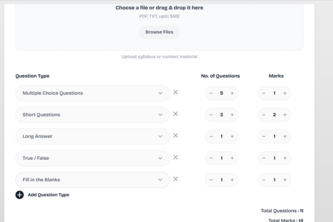
The description states that Vedum AI is a tool for teachers to generate exam papers using GPT-5.6. It allows users to input subject, grade, board (CBSE/ICSE/IB), question types, marks per question, due date, and optional syllabus uploads.
It then generates structured JSON output validated by Zod schema, which is rendered into a formatted PDF with:
- School headers
- Student info sections
- Labeled sections (A, B, C)
- Per-question difficulty badges
- Answer keys in teacher mode
The system uses:
- BullMQ for job queuing
- GPT-5.6 via OpenAI API
- Puppeteer for PDF generation
- WebSocket progress streaming
- Docker containers on Google Cloud Run
Inference: The product appears to be a web-based SaaS tool with asynchronous backend processing, designed for educators in India (based on CBSE/ICSE/IB boards). It is not a marketplace or platform but an AI-powered content generator.
Positioning & Claim Evolution
The author positions Vedum AI as solving a specific pain point: the time-consuming process of creating exam papers. They claim it leverages GPT-5.6 to automate structured question generation under pedagogical constraints such as Bloom’s taxonomy and difficulty distribution.
They also state that:
- The tool supports both student and teacher modes
- Output is print-ready, not browser-based
- Version history is preserved
- Regeneration is possible at any point
Claim vs Fact: These are claims made by the author. No evidence of actual use or customer feedback exists to confirm whether these features meet real needs or function as described.
Target Customer & ICP
The description states that Vedum AI targets teachers, particularly those in India (CBSE/ICSE/IB boards). The tool is built for educators who want to save time on exam paper creation while maintaining alignment with curriculum standards and Bloom’s taxonomy.
Inference: Based on the context of Indian education boards, the primary ICP seems to be K-12 teachers working in public or private schools. However, no evidence exists about actual customer segments or personas beyond the author's assumption.
Business Model & Pricing Evidence
There is no mention of pricing, monetization strategy, or business model in the description. The project appears to be a hackathon submission with no indication of commercial intent or revenue streams.
Not evidenced: No evidence of any business model, pricing plans, or monetization mechanisms.
Technical & Delivery Signals
The system is built using:
- Frontend: Next.js + React + TypeScript + Zustand
- Backend: Node.js + Express.js + Socket.io + BullMQ + Upstash Redis
- AI: GPT-5.6 via OpenAI API
- PDF Generation: Puppeteer
- Deployment: Google Cloud Run (with Docker containers)
- Validation: Zod schema validation
Key technical decisions include:
- Asynchronous job processing to avoid timeouts
- Tool_use mode for structured output from LLM
- Separate containerization of Puppeteer
- WebSocket reconnection handling
- Real-time progress updates during generation
Inference: The architecture shows thoughtful engineering around scalability, reliability, and UX. However, this is a single-person project with no evidence of production deployment or scaling beyond the hackathon context.
Traction & Maturity Signals
The description does not contain any data on:
- Number of users
- Revenue
- Customer acquisition
- Product usage metrics
- Market traction
It states that the author built it in a hackathon and has no prior versions or product iterations. The only signal is the author’s pride in the end-to-end pipeline running under 90 seconds.
Not evidenced: No evidence of traction, adoption, or maturity beyond the initial build.
Competitive Context
There are no references to competitors or existing solutions in the description. The author does not compare Vedum AI with other tools for generating exam papers or educational content.
Not evidenced: No competitive landscape or positioning relative to existing tools.
Open Questions & Risks
- Single-person team: Only one developer (Raunak Prasad) is mentioned, raising concerns about scalability and long-term maintenance.
- Unverified claims: All functionality described is self-reported without independent validation.
- No commercial traction: No evidence of customers, revenue, or product-market fit.
- Dependency on GPT-5.6: The tool relies heavily on a proprietary API that may not be stable or scalable for widespread use.
- Limited scope: The tool is narrowly focused on exam paper generation and lacks broader educational platform features.
Inference: The lack of commercial traction, team size, and external validation raises significant open questions about viability and scalability.
Questions the description leaves open
- What real-world feedback have you received from teachers using this tool?
- Have you tested the tool with actual educators or schools?
- How do you plan to monetize this product if you intend to commercialize it?
- What is your roadmap for expanding beyond exam paper generation?
- Are there any plans to integrate with existing LMS platforms or educational institutions?
- Can you provide evidence of performance under load or user testing?
- How will you handle data privacy and compliance (e.g., GDPR, FERPA)?
- Do you have a plan for supporting multiple languages or regional curricula?
Overall Assessment
There is no evidence to support any commercial due-diligence case for investment or partnership at this stage.
The project is a single-person hackathon submission with no demonstrated traction, revenue, or customer base. While the technical implementation shows competence and thoughtfulness, there is no indication that it has moved beyond prototype status or proven market demand.
Assessment: Not ready for investment or partnership consideration without further evidence of product-market fit, adoption, or commercial viability.
User Stories BotA demo video on every pull request
Get a demo video on every new feature
GitHub App that watches your pull requests and records a narrated, captioned demo.
Save time on demo prep and make informed decisions faster with a video walkthrough of every new feature.
Source
Submitted to the OpenAI 2026 hackathon on Devpost. Project home on Devpost. Back to the full gallery on Devpost.
This competitive analysis was produced by top-founders.com (opens in a new tab)
Generated by a language model from this project's public Devpost page — its tagline, the author's own write-up and any built-with tags listed there — as captured in August 2026. Short quotations are the author's words. It is an opinion on the idea as a business, not on the people behind it, and it reflects the description as published then. If the project has moved on, request a correction below. The analysis is not independent research and contains no verified traction, revenue or customer data.
An independent guide by KFG International LLC — not affiliated with, endorsed by, or connected to Devpost or OpenAI.