

Archive position — measured, not model output
0 likes on Devpost
2,263 of the 7,850 archived projects have more likes, and 5,587 share exactly 0 — so this project's #3,580 place in the like-ranked listing is a tie-break inside that group, not a ranking.
Projects (log scale)
Likes on Devpost. ▲ marks this project's group.
Show the figures
| Likes | Projects | Share of archive |
|---|---|---|
| 0 | 5,587 | 71.2% |
| 1 | 1,758 | 22.4% |
| 2 | 284 | 3.6% |
| 3–4 | 132 | 1.7% |
| 5–9 | 75 | 1.0% |
| 10+ | 14 | 0.2% |
 User Stories BotA demo video on every pull request
Get a demo video on every new feature
GitHub App that watches your pull requests and records a narrated, captioned demo.
Save time on demo prep and make informed decisions faster with a video walkthrough of every new feature.
Executive Summary
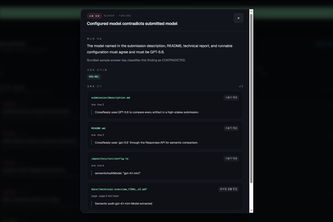
CrossReady is a self-reported CI-style tool for auditing final submission packages, designed to verify documents, code, manifests, and exact file bytes before submission. The author states it uses GPT-5.6 for requirement extraction and cross-artifact analysis, with deterministic checks overriding model output. It is built as a web interface using Next.js, React, and various OpenAI APIs, with a focus on preventing false confidence in audit results through evidence verification boundaries.
The project description claims CrossReady audits rules documents against ZIP submission bundles, extracts atomic requirements via GPT-5.6, and compares them with bounded textual evidence. It includes deterministic manifest and hash checks that override model findings, and prevents silent rewriting or submission of user content.
Key commercial due-diligence questions:
- What is the actual product's commercial viability?
- Is there a clear target market with sufficient demand?
- How does this differ from existing tools in the space?
The single most important open question: What evidence exists that any potential customers actually use or will use this tool, and what is the commercial traction beyond the hackathon demo?
What The Product Actually Is
The description states CrossReady is a CI-style tool for final submission packages. It audits requirements documents against submission bundles (PDF, Markdown, text) and ZIP files.
It performs:
- Safe ZIP inventory without execution
- SHA-256 hashing of archive and individual files
- Manifest.json claim verification against actual bytes
- Atomic requirement extraction using GPT-5.6
- Requirement comparison with bounded textual evidence from package
- Classification of requirements as PROVEN, CONTRADICTED, MISSING, or NEEDS_HUMAN
- Evidence inspection interface showing file, locator, excerpt, provenance, and next action
The system uses multiple trust layers:
- Deterministic file layer (ZIP scanner)
- GPT-5.6 reasoning layer
- Server verification layer
- Review interface
Not evidenced: actual product functionality beyond the demo, customer usage, revenue, or adoption data.
Positioning & Claim Evolution
The description states CrossReady is positioned as CI for final submission packages that examines entire handoffs including rules, submission copy, ZIP contents, source configuration, manifests, and exact file hashes. It claims to answer "Do all of the submitted artifacts tell the same, provable story?"
It evolved from a hackathon project aiming to solve problems where checklist-style workflows fail because evidence is scattered across multiple files and documents.
The author states it uses GPT-5.6 for requirement extraction and cross-artifact analysis but emphasizes that deterministic code decides whether model evidence is acceptable.
Not evidenced: market positioning beyond self-description, competitive differentiation, or customer feedback on positioning.
Target Customer & ICP
The description states CrossReady helps solo builders and small teams preparing work that must be correct at the moment it leaves their hands. It applies to RFP bids, grant applications, certification and audit packages, client deliverables, and research or competition submissions.
It targets users who need to ensure submission correctness and are willing to pay for verification.
Not evidenced: specific customer segments, size of target market, customer acquisition strategy, or actual user personas beyond the stated use cases.
Business Model & Pricing Evidence
The description states that CrossReady never silently rewrites files and never submits anything on behalf of users. It shows a reviewer path that is free and does not consume OpenAI credit.
It mentions:
- A public demo with a fingerprint-locked bundled answer key
- Paid GPT-5.6 path measured separately in a controlled local run
- Explicit user-visible cost budget for authenticated live audits
Not evidenced: pricing structure, revenue model, monetization strategy, or customer willingness to pay beyond the demo.
Technical & Delivery Signals
The description states CrossReady was built with:
- Next.js, React, TypeScript, Tailwind CSS
- OpenAI API (Responses API, Structured Outputs)
- Vercel hosting
- ZIP.js for safe archive handling
- Zod for schema validation
- Vitest for testing
- Codex for implementation and verification
It includes:
- Safe ZIP scanning with size limits, path traversal protection, duplicate path detection
- Deterministic manifest checks that override model output
- Server-side evidence verification boundary
- Accessible review interface with keyboard focus trapping and Escape-to-close behavior
- Cost and failure protection including timeouts, rate limits, concurrency limits
Not evidenced: actual technical performance data, scalability, or production deployment details beyond the demo.
Traction & Maturity Signals
The description states:
- 67 passing automated tests plus clean lint, TypeScript, production-build, browser-flow, and deployed-runtime checks
- A real paid run with GPT-5.6 that produced 14 extracted requirements, 14 findings, 21 excerpts, and 8,478 tokens
- A later controlled live-model run with 11 files, 16 findings, 9,038 tokens, and 71.9 seconds
- The demo was recorded with 64 passing automated tests (now 67)
- No account or API key required for public reviewer path
Not evidenced: customer base, revenue, user adoption, or market traction beyond the hackathon demo.
Competitive Context
The description does not mention specific competitors. It states that many checklist-style submission workflows stop at whether a file exists, but does not describe how CrossReady differs from existing tools in this space.
Not evidenced: competitive landscape, direct or indirect competitors, or market positioning relative to existing solutions.
Open Questions & Risks
- No commercial traction: The project is described as a hackathon submission with no evidence of revenue, customers, or adoption beyond the demo.
- Unproven market demand: No evidence that target customers actually need or will use this tool.
- Limited technical implementation: The description shows only a demo version without production deployment details.
- Dependency on paid APIs: Heavy reliance on OpenAI's GPT-5.6 with no indication of cost management or alternative solutions.
- Unverified claims: All claims are self-reported and unverified, including the effectiveness of the tool.
Questions the description leaves open
- What specific market pain points does CrossReady solve that existing tools don't?
- Have you identified any actual customers who would pay for this solution?
- What is your plan to scale beyond the current demo and hackathon version?
- How do you intend to manage costs associated with GPT-5.6 usage at scale?
- What are your plans for monetization and pricing strategy?
- How will you ensure the tool remains accurate as requirements documents become more complex?
- What is the timeline for moving from demo to production-ready product?
Overall Assessment
Not evidenced: No commercial due-diligence basis to assess investment or partnership potential.
The description presents a self-reported hackathon project with no evidence of traction, revenue, customers, or market validation. The tool appears to be a proof-of-concept rather than a commercial product. Without evidence of actual customer demand, adoption, or monetization strategy, there is insufficient basis for an investment or partnership decision at this stage.
The author states that the demo was recorded with 64 passing automated tests (now 67) and shows a controlled live-model run, but these are not indicators of commercial viability. The project lacks evidence of market demand, customer validation, or sustainable business model beyond the hackathon context.
This is a self-reported product description with no independent verification of its claims or commercial potential.
User Stories BotA demo video on every pull request
Get a demo video on every new feature
GitHub App that watches your pull requests and records a narrated, captioned demo.
Save time on demo prep and make informed decisions faster with a video walkthrough of every new feature.
Source
Submitted to the OpenAI 2026 hackathon on Devpost. Project home on Devpost. Back to the full gallery on Devpost.
This competitive analysis was produced by top-founders.com (opens in a new tab)
Generated by a language model from this project's public Devpost page — its tagline, the author's own write-up and any built-with tags listed there — as captured in August 2026. Short quotations are the author's words. It is an opinion on the idea as a business, not on the people behind it, and it reflects the description as published then. If the project has moved on, request a correction below. The analysis is not independent research and contains no verified traction, revenue or customer data.
An independent guide by KFG International LLC — not affiliated with, endorsed by, or connected to Devpost or OpenAI.