

Archive position — measured, not model output
0 likes on Devpost
2,263 of the 7,850 archived projects have more likes, and 5,587 share exactly 0 — so this project's #3,581 place in the like-ranked listing is a tie-break inside that group, not a ranking.
Projects (log scale)
Likes on Devpost. ▲ marks this project's group.
Show the figures
| Likes | Projects | Share of archive |
|---|---|---|
| 0 | 5,587 | 71.2% |
| 1 | 1,758 | 22.4% |
| 2 | 284 | 3.6% |
| 3–4 | 132 | 1.7% |
| 5–9 | 75 | 1.0% |
| 10+ | 14 | 0.2% |
 User Stories BotA demo video on every pull request
Get a demo video on every new feature
GitHub App that watches your pull requests and records a narrated, captioned demo.
Save time on demo prep and make informed decisions faster with a video walkthrough of every new feature.
Executive Summary
What the company appears to be
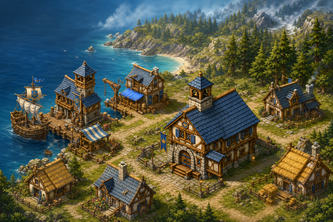
Crown Harbor is a browser-based isometric city builder game built by one developer (Radek Jankowski) as part of the OpenAI 2026 hackathon. The game focuses on production chains, resource management, logistics simulation, and exploration within a coastal settlement context.
What changed
This project was submitted to a hackathon, indicating it is an early-stage prototype or proof-of-concept rather than a commercial product. It has no evidence of revenue, customers, or market traction beyond its own self-description.
The single most important open question
Is there any evidence that this game will evolve into a commercially viable product with sustainable user engagement and monetization?
What The Product Actually Is
The description states that Crown Harbor is a "browser-based isometric city builder focused on production chains, roads and physical resource delivery." It is described as a settlement-building game where players gather resources, construct buildings, manage workers, organize transport routes, expand production chains, and uncover the surrounding map.
It includes features such as forests, stone deposits, mountains, rivers, ports, warehouses, local storage, settlement goals, weather events, and scouting expeditions launched from the Settlement Center. The game uses isometric rendering, procedural map generation, and deterministic simulation elements.
The author notes it was built using Astro, JavaScript, HTML Canvas, and CSS, with modules for terrain, buildings, economy, logistics, exploration, rendering, UI, and save management.
Evidence Self-reported by the author; no independent verification.
Positioning & Claim Evolution
The description states that Crown Harbor is inspired by classic isometric city-building games with beautiful artwork and a strong focus on settlement development. It emphasizes planning, resource management, production chains, exploration, and thoughtful expansion. Combat is not the main priority — the focus is on designing a thriving settlement and gradually turning it into a prosperous coastal town.
The author also mentions that they are proud of creating a complete playable settlement-building loop with multiple scenarios and a Creative mode, including seventeen building types, warehouse upgrades, finite natural resources, roads, bridges, physical deliveries, production chains, local storage, weather events, and scouting expeditions.
Evidence Self-reported claims about inspiration, focus, features, and accomplishments; no evidence of market positioning or competitive differentiation beyond self-description.
Target Customer & ICP
The description does not explicitly identify a target customer or ideal customer profile (ICP). It describes the game as being for players interested in city-building, resource management, logistics simulation, and exploration. However, there is no indication of specific demographics, user personas, or market segments.
Evidence Not evidenced; no mention of who plays this game or how it would be monetized.
Business Model & Pricing Evidence
There is no evidence provided regarding a business model or pricing strategy. The description does not mention any form of monetization, subscriptions, in-app purchases, ads, or other revenue streams.
Evidence Not evidenced; no indication of how the game might generate income.
Technical & Delivery Signals
The author states that the game was built as a lightweight browser experience using Astro, JavaScript, HTML Canvas, and CSS. It includes deterministic map generation, local saves, save migration, automated tests, generated building textures, and a custom isometric renderer.
It also features modules for terrain, buildings, economy, logistics, exploration, rendering, UI, and save management. The game supports multiple scenarios, a Creative mode, and seventeen building types.
Evidence Self-reported technical details; no evidence of scalability, performance metrics, or delivery infrastructure beyond the author's own account.
Traction & Maturity Signals
There is no evidence of traction or maturity in terms of user engagement, downloads, retention, or revenue. The project was submitted to a hackathon and has no data on active users, monetization, or growth trajectory.
Evidence Not evidenced; no signs of adoption, usage, or commercial success beyond the author's own description.
Competitive Context
The description does not provide any information about competitors or the competitive landscape. It does not reference similar games, platforms, or market players.
Evidence Not evidenced; no mention of competition or market positioning.
Open Questions & Risks
- Single-person development team: The project is built by one person (Radek Jankowski), which raises questions about scalability and long-term maintenance.
- No commercial traction or monetization strategy: There is no evidence of users, revenue, or a clear path to profitability.
- Hackathon submission: This suggests the project is in an early stage and may not yet be ready for market.
- Lack of external validation: No third-party reviews, press coverage, or user feedback are mentioned.
Inference The lack of evidence for traction, monetization, or team capacity raises concerns about whether this will become a viable product.
Questions the description leaves open
- What is the intended monetization strategy for Crown Harbor?
- How does the game plan to scale beyond its current single-developer scope?
- Are there any plans to add multiplayer or social features?
- Has the founder considered how to attract and retain players in a crowded market?
- What are the key performance indicators (KPIs) that will define success for this project?
Overall Assessment
There is insufficient evidence to support an investment or partnership decision. The project is described as a hackathon submission with no verified traction, revenue, or customer base. It lacks clear commercial signals and has not demonstrated any path to monetization.
Confidence Level Low — based entirely on self-reported information without external corroboration.
Assessment Not evidenced. No basis for investment or partnership consideration at this time.
User Stories BotA demo video on every pull request
Get a demo video on every new feature
GitHub App that watches your pull requests and records a narrated, captioned demo.
Save time on demo prep and make informed decisions faster with a video walkthrough of every new feature.
Source
Submitted to the OpenAI 2026 hackathon on Devpost. Project home on Devpost. Back to the full gallery on Devpost.
This competitive analysis was produced by top-founders.com (opens in a new tab)
Generated by a language model from this project's public Devpost page — its tagline, the author's own write-up and any built-with tags listed there — as captured in August 2026. Short quotations are the author's words. It is an opinion on the idea as a business, not on the people behind it, and it reflects the description as published then. If the project has moved on, request a correction below. The analysis is not independent research and contains no verified traction, revenue or customer data.
An independent guide by KFG International LLC — not affiliated with, endorsed by, or connected to Devpost or OpenAI.