

Archive position — measured, not model output
0 likes on Devpost
2,263 of the 7,850 archived projects have more likes, and 5,587 share exactly 0 — so this project's #3,583 place in the like-ranked listing is a tie-break inside that group, not a ranking.
Projects (log scale)
Likes on Devpost. ▲ marks this project's group.
Show the figures
| Likes | Projects | Share of archive |
|---|---|---|
| 0 | 5,587 | 71.2% |
| 1 | 1,758 | 22.4% |
| 2 | 284 | 3.6% |
| 3–4 | 132 | 1.7% |
| 5–9 | 75 | 1.0% |
| 10+ | 14 | 0.2% |
 User Stories BotA demo video on every pull request
Get a demo video on every new feature
GitHub App that watches your pull requests and records a narrated, captioned demo.
Save time on demo prep and make informed decisions faster with a video walkthrough of every new feature.
Executive Summary
What the company appears to be: Crucible is a self-reported adversarial learning laboratory for advanced technical concepts. The product uses frontier AI models (GPT-5.6) and code generation tools (Codex) to construct executable experiments that test learner understanding by identifying misconceptions, building falsifiable hypotheses, and executing controlled tests.
What changed: The project description shows a shift from a general "weakness-focused learning" idea to a specific implementation using AI-driven experimental design. It evolved into a structured eight-stage process for diagnosing conceptual understanding through executable evidence rather than traditional quiz formats.
Single most important open question: Does Crucible actually produce measurable improvements in learning outcomes, or is it primarily an experimental demonstration of AI capabilities? The description lacks any evidence of user testing, effectiveness metrics, or adoption data.
The analysis is based entirely on the self-reported project description. No independent verification exists for any claims about traction, revenue, customers, or actual performance. The description states that this is a hackathon submission with no team size indicated and no archived history.
What The Product Actually Is
The description states that Crucible is an "adversarial learning laboratory for advanced technical concepts." It implements an eight-stage process:
- THE FORGE - choose source material or paste technical content
- CONCEPT ATLAS - reconstruct claims, prerequisites, assumptions
- DIAGNOSTIC - commit free-form prediction before observing result
- HYPOTHESES - maintain competing mental models
- LIVE LAB - create bounded Python artifact with invariants and structured contract
- EVIDENCE - execute laboratory in disposable Docker environment
- MODEL UPDATE - revise hypothesis ledger only where evidence earns update
- TRANSFER - test revised distinction in unfamiliar context
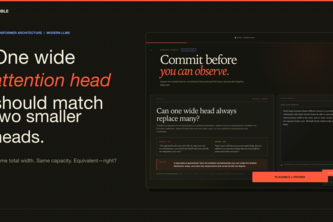
The flagship journey examines a subtle Transformer claim about attention head equivalence, constructing counterexamples that expose exactly where learner rules fail.
Evidence: The description explicitly lists these stages and their purpose. It states the product uses GPT-5.6 for semantic work and Codex for materializing falsifiers.
Positioning & Claim Evolution
The description shows a clear positioning evolution from general weakness-focused learning to specific AI-powered experimental design.
Original idea: Weakness-focused learning - identify misconceptions, practice fragile parts, let learners choose sources.
Evolved positioning: An adversarial learning laboratory that applies "controlled pressure" to explanations until shallow familiarity separates from transferable understanding. The product is described as a "crucible" that applies pressure revealing what a material is actually made of.
Key claims:
- Crucible treats responses as evidence about hidden causal models, not just answer matching
- It uses a "frontier loop": reconstruct → commit → hypothesize → discriminate → build → execute → update → transfer
- The decisive output is executable evidence, not second model opinion
- It distinguishes between source-bounded material, GPT inference, generated artifacts, execution observations, and checked results
Evidence: The description explicitly states these claims about the approach and positioning.
Target Customer & ICP
The description indicates that Crucible targets "advanced technical learners" who are working with concepts like Transformer attention mechanisms. It mentions a "flagship journey examines a subtle Transformer claim" and that the flagship misconception is "sophisticated enough to sound plausible to a technically informed learner."
Evidence: The description states that the audience is "technically informed learners" and that the flagship domain is "Transformer attention head equivalence." It also notes that the human participant "originated the weakness-focused learning problem, rejected shallow chatbot and quiz variants, selected the audience and flagship domain."
Business Model & Pricing Evidence
Not evidenced
The description does not contain any information about pricing, revenue models, monetization strategies, or business model details. No claims are made about how the product would be sold or who would pay for it.
Technical & Delivery Signals
The description provides detailed technical implementation signals:
Architecture: Uses GPT-5.6 for semantic work and Codex for materializing falsifiers. The system has two complementary paths:
- Hosted showcase with "VERIFIED REPLAY" that requires no visitor credentials
- Full local experience using host-side runner bound to 127.0.0.1
Security measures:
- Generated laboratory code materialized at fixed path
- Executed in disposable Docker container with no Codex credentials, no Docker socket, bounded resources, and no network by default
- Exact structured evidence returns to distinct GPT-5.6 update stage
Technology stack: Built with Next.js, React, Python, and uses Codex and OpenAI
Testing approach: Automated tests cover runner API, flagship experiment, rendered interface, types, lint, and production build
Evidence: The description explicitly details these technical aspects including security measures, architecture, and implementation approaches.
Traction & Maturity Signals
Not evidenced
The description contains no evidence of traction, revenue, customers, or adoption. It states that this is a hackathon submission with "no team size indicated" and that "no revenue, customer or traction data is available beyond what they state." The project has no archived history for analysis.
Competitive Context
Not evidenced
The description does not contain any information about competitors, market positioning relative to existing products, or competitive landscape. No claims are made about how Crucible compares to other educational tools or learning platforms.
Open Questions & Risks
Inference: Based on the self-reported nature of the description and lack of evidence for key elements:
- Unproven effectiveness: The description states that "Crucible will not claim universal domain support until each domain has a credible evidence mechanism" - suggesting the approach may not yet be validated.
- Prototype status: The description explicitly states this is a "Build Week sandbox" that is still a prototype with "residual risks rather than claiming perfect isolation."
- No validation data: There's no evidence of user testing, effectiveness metrics, or adoption data to support claims about learning outcomes.
- Self-reporting bias: All claims are self-reported and unverified, with no independent corroboration.
- Technical implementation risk: The description notes that "generated labs run separately from Codex credentials and host authority" which suggests potential security or reliability concerns in the execution model.
Questions the description leaves open
- What specific learning outcomes have you measured in any user testing? How do you define success for this approach?
- How do you plan to validate that the diagnostic method actually improves understanding versus just generating interesting experiments?
- What are the actual technical limitations of the current prototype that would prevent scaling to broader use cases?
- How do you plan to handle the security and isolation concerns when running generated code in Docker containers?
- What evidence do you have that advanced learners actually prefer this adversarial approach over traditional instruction methods?
- How will you calibrate hypothesis scores and ensure consistent diagnostic quality across different domains?
- What is your roadmap for moving from prototype to production-ready system?
- How do you plan to address the challenge of making frontier AI outputs legible without exposing private reasoning?
Overall Assessment
Not evidenced
The description provides no information about valuation, funding rounds, or investment status. It does not indicate whether this represents a commercial opportunity or if there are any existing partnerships or investment discussions. The project is described as a hackathon submission with no archived history for analysis.
The description states that "no revenue, customer or traction data is available beyond what they state" and that the project has no archived history. This is a self-reported hackathon submission with no evidence of commercial viability or traction.
User Stories BotA demo video on every pull request
Get a demo video on every new feature
GitHub App that watches your pull requests and records a narrated, captioned demo.
Save time on demo prep and make informed decisions faster with a video walkthrough of every new feature.
Source
Submitted to the OpenAI 2026 hackathon on Devpost. Project home on Devpost. Back to the full gallery on Devpost.
This competitive analysis was produced by top-founders.com (opens in a new tab)
Generated by a language model from this project's public Devpost page — its tagline, the author's own write-up and any built-with tags listed there — as captured in August 2026. Short quotations are the author's words. It is an opinion on the idea as a business, not on the people behind it, and it reflects the description as published then. If the project has moved on, request a correction below. The analysis is not independent research and contains no verified traction, revenue or customer data.
An independent guide by KFG International LLC — not affiliated with, endorsed by, or connected to Devpost or OpenAI.