

Archive position — measured, not model output
0 likes on Devpost
2,263 of the 7,850 archived projects have more likes, and 5,587 share exactly 0 — so this project's #3,585 place in the like-ranked listing is a tie-break inside that group, not a ranking.
Projects (log scale)
Likes on Devpost. ▲ marks this project's group.
Show the figures
| Likes | Projects | Share of archive |
|---|---|---|
| 0 | 5,587 | 71.2% |
| 1 | 1,758 | 22.4% |
| 2 | 284 | 3.6% |
| 3–4 | 132 | 1.7% |
| 5–9 | 75 | 1.0% |
| 10+ | 14 | 0.2% |
 User Stories BotA demo video on every pull request
Get a demo video on every new feature
GitHub App that watches your pull requests and records a narrated, captioned demo.
Save time on demo prep and make informed decisions faster with a video walkthrough of every new feature.
Executive Summary
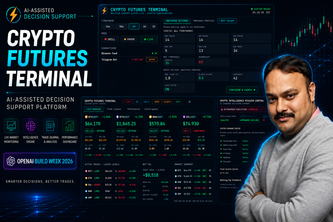
The company appears to be a solo project, Crypto Intelligence Terminal – Evidence Review Assistant, submitted by Arindam Das for the OpenAI 2026 hackathon. The author states that it is an AI-assisted platform focused on post-trade evidence review in crypto trading. It is described as a read-only system that analyzes completed trades to explain outcomes, highlight execution issues and help users learn from them without placing new trades.
The project is self-reported and unverified. No revenue, customers, or traction data are provided beyond the author's own account. The system is built with Python, FastAPI, and OpenAI technologies, and is designed with a modular architecture separating trading from analysis.
The single most important open question is: What is the actual commercial viability of this product, given that it is described as read-only, non-trading, and focused on post-trade analysis?
What The Product Actually Is
- The description states that Crypto Intelligence Terminal is an AI-assisted platform for post-trade analysis.
- It collects and organizes structured trade evidence.
- It reviews completed trades and highlights supporting and opposing signals.
- It identifies execution-quality issues.
- It presents explainable summaries to help users understand past decisions.
- The system is designed to be completely separate from live trading, not placing, modifying, or managing trades.
- It is described as an Evidence Review Assistant focused on reviewing completed trades during OpenAI Build Week.
Positioning & Claim Evolution
- The author states that most trading platforms "tell users what happened after a trade, but very few explain why it happened."
- The goal is to help traders "learn from completed trades by reviewing the evidence behind every decision."
- The system aims to make post-trade analysis more transparent, explainable, and educational.
- It is positioned as a read-only tool that focuses on reviewing past decisions, not influencing future ones.
- The author emphasizes explainability over black-box AI, stating the system should be reproducible and supported by available evidence.
Target Customer & ICP
- Not evidenced.
The description does not state who the target customer is, what their role or industry is, or how they would use this tool. No specific persona or buyer profile is described.
Business Model & Pricing Evidence
- Not evidenced.
There is no mention of pricing, monetization strategy, or business model in the self-reported description.
Technical & Delivery Signals
- The system is built using Python, FastAPI, and OpenAI technologies.
- It uses structured evidence schemas, deterministic validation, and explainable review rules.
- The architecture is described as modular, separating trading functionality from analysis and future AI capabilities.
- It includes synthetic test scenarios and comprehensive testing before AI integration.
- The system is designed to be safe, isolated, with clear boundaries between analytical features and live trading logic.
- It uses Pydantic, SQLite, pytest, and JSON for data handling and validation.
Traction & Maturity Signals
- Not evidenced.
There is no evidence of revenue, customers, usage metrics, or product maturity beyond the author's own account. The project is described as a hackathon submission with no indication of prior traction or adoption.
Competitive Context
- Not evidenced.
No mention of competitors, market size, or competitive positioning in the self-reported description.
Open Questions & Risks
- Read-only design: The system is explicitly designed to not place trades. This raises questions about its commercial viability and utility — if it doesn’t influence trading decisions, what value does it add?
- Solo development: With only one team member (Arindam Das), there are risks around scalability, feature delivery, and long-term maintenance.
- AI integration timeline: The AI features are described as being introduced in a "staged approach", with validation before AI integration. This suggests that the full product may not yet be functional or tested.
- Lack of commercial evidence: No revenue, customers, or traction data is provided — only self-reported claims about functionality and design.
Questions the description leaves open
- What specific use cases do you expect users to have for this read-only system?
- How does the system differentiate from existing post-trade analysis tools in crypto?
- Are there any plans to monetize or extend beyond the hackathon version?
- What are the key assumptions about user behavior and adoption that underpin your design decisions?
- How do you plan to scale beyond a solo developer?
Overall Assessment
- Not evidenced.
There is no evidence of revenue, customers, traction, or financials to support an investment or partnership decision. The project is described as a hackathon submission with no indication of commercial viability or market readiness. The read-only nature and lack of monetization strategy raise significant questions about its potential for growth or value creation.
User Stories BotA demo video on every pull request
Get a demo video on every new feature
GitHub App that watches your pull requests and records a narrated, captioned demo.
Save time on demo prep and make informed decisions faster with a video walkthrough of every new feature.
Source
Submitted to the OpenAI 2026 hackathon on Devpost. Project home on Devpost. Back to the full gallery on Devpost.
This competitive analysis was produced by top-founders.com (opens in a new tab)
Generated by a language model from this project's public Devpost page — its tagline, the author's own write-up and any built-with tags listed there — as captured in August 2026. Short quotations are the author's words. It is an opinion on the idea as a business, not on the people behind it, and it reflects the description as published then. If the project has moved on, request a correction below. The analysis is not independent research and contains no verified traction, revenue or customer data.
An independent guide by KFG International LLC — not affiliated with, endorsed by, or connected to Devpost or OpenAI.