

Archive position — measured, not model output
0 likes on Devpost
2,263 of the 7,850 archived projects have more likes, and 5,587 share exactly 0 — so this project's #5,548 place in the like-ranked listing is a tie-break inside that group, not a ranking.
Projects (log scale)
Likes on Devpost. ▲ marks this project's group.
Show the figures
| Likes | Projects | Share of archive |
|---|---|---|
| 0 | 5,587 | 71.2% |
| 1 | 1,758 | 22.4% |
| 2 | 284 | 3.6% |
| 3–4 | 132 | 1.7% |
| 5–9 | 75 | 1.0% |
| 10+ | 14 | 0.2% |
 User Stories BotA demo video on every pull request
Get a demo video on every new feature
GitHub App that watches your pull requests and records a narrated, captioned demo.
Save time on demo prep and make informed decisions faster with a video walkthrough of every new feature.
Executive Summary
What the company appears to be
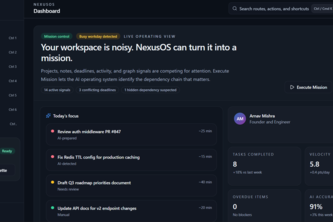
NexusOS is described as an AI operating system for knowledge work, built by a single founder (Arnav Mishra) as a hackathon project. It claims to turn scattered workspace context into structured, explainable missions using GPT-5.6, specialized agents, and evidence-backed recommendations.
What changed
The author states that the original idea was to build an AI assistant that could summarize or chat with documents but evolved toward a system focused on explaining decisions through evidence-based reasoning. This shift reflects a move from black-box AI to explainable AI in productivity tools.
Single most important open question — the commercial due-diligence read
Is there any evidence of traction, revenue, customer adoption, or product-market fit beyond the author’s own account? The description contains no data on users, customers, usage metrics, or monetization.
What The Product Actually Is
The description states that NexusOS is an AI operating system for knowledge work. It claims to observe the current workspace, analyze projects, tasks, documents, analytics, and relationships inside a knowledge graph, then turn this context into an actionable mission.
It uses GPT-5.6 and specialized agents (e.g., project analysis, task prioritization, risk detection) to generate structured outputs rather than single chat responses. Recommendations are backed by evidence through features like Mission Briefs, Investigation Replay, Evidence Graph, and After Action Report.
The system is built as a pnpm monorepo using Next.js, React, TypeScript, Prisma, PostgreSQL, and integrates with OpenAI APIs for reasoning.
Evidence
- The author describes the product’s core functionality.
- Technology stack is listed: codex, css, gpt-5.6, next.js, openai, pnpm, postgresql, prisma, react, tailwind, turborepo, typescript.
- Features like Investigation Replay and Evidence Graph are described.
Inference
- The system appears to be a prototype or proof-of-concept built in a hackathon setting.
- It is not yet integrated with real productivity tools (as stated in "What's next").
Positioning & Claim Evolution
The author states that NexusOS was inspired by the frustration of having too much information but no clear direction on what to do next. The original idea was to build an AI assistant that could summarize or chat with documents, but evolved into a system focused on explainable recommendations.
Key claims:
- It does not act like another chatbot.
- It answers “what should I do next, and why?”
- Every recommendation is backed by evidence.
- It uses multi-agent reasoning pipelines to generate structured work sessions.
Evidence
- The author describes the evolution from a smart task manager to one that emphasizes trustworthiness via explainability.
- Features like Mission Briefs, Investigation Replay, Evidence Graph, and After Action Report are described as part of this positioning.
Inference
- This is a shift toward a more mature AI product that prioritizes transparency over simplicity.
- The positioning implies a move away from generic AI tools toward a specialized decision-support system for knowledge workers.
Target Customer & ICP
The description states that NexusOS targets users engaged in knowledge work, who are spread across projects, documents, meeting notes, and tasks and struggle to prioritize what matters next.
It is implied that the primary user is an individual working in a knowledge-intensive role, possibly a developer or professional requiring structured context management.
Evidence
- The author describes the problem faced by users: “after a few days of work spread across projects, documents, meeting notes, and tasks, I still had to figure out what actually mattered.”
- The product is positioned for “knowledge work.”
Inference
- The target customer likely includes professionals who use tools like Notion, GitHub, Slack, Linear, etc.
- There is no explicit mention of enterprise customers or B2B targeting.
Business Model & Pricing Evidence
There is no evidence in the description regarding pricing models, monetization strategies, or business model assumptions. The project is described as a hackathon submission and not yet integrated with real productivity tools.
Evidence
- No mention of subscriptions, freemium tiers, usage-based pricing, or any commercial structure.
- The author says the current version focuses on demonstrating the core experience, implying no revenue generation yet.
Inference
- If this becomes a product, it may follow SaaS or freemium models common in productivity AI tools.
- No indication of whether the tool will be sold directly to individuals or through integrations with existing platforms.
Technical & Delivery Signals
The system is built using modern web technologies:
- Frontend: Next.js, React, TypeScript, Tailwind CSS
- Backend: Prisma, PostgreSQL
- AI Layer: GPT-5.6 via OpenAI API, structured outputs for validation
- Development Tools: Codex, Turborepo, pnpm
The author notes that Codex was used not only as a coding assistant but also to scaffold features, refactor components, improve testing, organize the repository, strengthen documentation, and prepare the project for release.
Evidence
- Technology stack is clearly listed.
- The AI layer uses structured outputs from GPT-5.6.
- Codex played a role in hardening the codebase and preparing it for public release.
Inference
- The architecture suggests scalability potential but lacks evidence of production-grade infrastructure or deployment practices.
- The use of Turborepo indicates an attempt at modularizing development, which is typical for larger projects.
Traction & Maturity Signals
There is no evidence of traction, revenue, customer adoption, or usage metrics. The project is described as a hackathon submission and not yet integrated with real productivity tools.
Evidence
- The author says it's a prototype built during a hackathon.
- No mention of user base, active users, or product adoption.
- The next steps include integrating with GitHub, Google Workspace, Slack, Notion, Linear — indicating the tool is not yet live in those environments.
Inference
- The project has not reached market readiness or proven product-market fit.
- It is early-stage and likely not generating any revenue or user engagement at this time.
Competitive Context
The description does not provide information about competitors. However, based on the stated functionality — AI-powered workspace understanding, explainable recommendations, multi-agent reasoning — NexusOS appears to compete with:
- AI productivity assistants (e.g., Notion AI, ChatGPT Plugins)
- Task and project management tools (e.g., Linear, Asana)
- Knowledge graph-based systems (e.g., Obsidian, Roam Research)
Evidence
- No competitor names or market positioning are mentioned.
- The author does not reference existing products in the space.
Inference
- The product may be positioned as a niche solution focused on explainability and structured decision-making.
- It could differentiate itself from generic AI chatbots by emphasizing evidence-based outputs.
Open Questions & Risks
Several key risks and open questions emerge from the self-reported description:
- Single-founder project: Only one person built the entire system, raising concerns about scalability and long-term maintenance.
- No traction or revenue: No evidence of users, customers, or monetization.
- Unverified technology claims: GPT-5.6 is not publicly available; this may be a placeholder or speculative naming.
- Prototype status: Described as a hackathon project with no integration into real tools.
- Lack of commercial viability: No pricing model, business plan, or monetization strategy described.
Evidence
- Team size: 1 member.
- Not integrated with real productivity tools.
- No mention of revenue, customers, or usage data.
Inference
- The project is likely in an exploratory phase and not yet ready for commercial deployment.
- Risk of technical debt or scalability issues due to lack of team resources.
Questions the description leaves open
- What specific problems are you solving that existing tools don’t?
- How do you plan to validate the accuracy and usefulness of your AI recommendations in real-world settings?
- Are there any early adopters or pilot users who have tested the system?
- Can you walk us through how you would monetize this product if it were to become a commercial offering?
- What are the technical challenges in scaling this beyond a single-person prototype?
- How do you intend to integrate with real productivity tools like GitHub, Slack, Notion, etc.?
- Is there any internal testing or evaluation data showing how well your agents perform compared to baseline performance?
Overall Assessment
The description indicates that NexusOS is a hackathon project built by one person and not yet integrated with real productivity tools. There is no evidence of traction, revenue, customer adoption, or commercial viability.
Assessment Not evidenced as a viable investment or partnership opportunity at this stage. The project shows promise in concept but lacks the foundational signals needed for due-diligence evaluation.
Confidence Level Low — based entirely on self-reported information with no external validation or data points to support claims of product-market fit, scalability, or commercial readiness.
User Stories BotA demo video on every pull request
Get a demo video on every new feature
GitHub App that watches your pull requests and records a narrated, captioned demo.
Save time on demo prep and make informed decisions faster with a video walkthrough of every new feature.
Source
Submitted to the OpenAI 2026 hackathon on Devpost. Project home on Devpost. Back to the full gallery on Devpost.
This competitive analysis was produced by top-founders.com (opens in a new tab)
Generated by a language model from this project's public Devpost page — its tagline, the author's own write-up and any built-with tags listed there — as captured in August 2026. Short quotations are the author's words. It is an opinion on the idea as a business, not on the people behind it, and it reflects the description as published then. If the project has moved on, request a correction below. The analysis is not independent research and contains no verified traction, revenue or customer data.
An independent guide by KFG International LLC — not affiliated with, endorsed by, or connected to Devpost or OpenAI.