

Archive position — measured, not model output
1 like on Devpost
505 of the 7,850 archived projects have more likes, and 1,758 share exactly 1 — so this project's #1,624 place in the like-ranked listing is a tie-break inside that group, not a ranking.
Projects (log scale)
Likes on Devpost. ▲ marks this project's group.
Show the figures
| Likes | Projects | Share of archive |
|---|---|---|
| 0 | 5,587 | 71.2% |
| 1 | 1,758 | 22.4% |
| 2 | 284 | 3.6% |
| 3–4 | 132 | 1.7% |
| 5–9 | 75 | 1.0% |
| 10+ | 14 | 0.2% |
 User Stories BotA demo video on every pull request
Get a demo video on every new feature
GitHub App that watches your pull requests and records a narrated, captioned demo.
Save time on demo prep and make informed decisions faster with a video walkthrough of every new feature.
Executive Summary
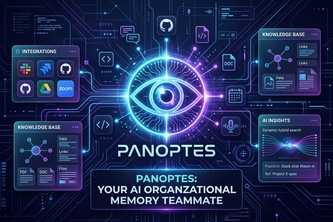
Panoptes, as described by its author, is an AI-powered organizational memory system designed to unify information across enterprise collaboration tools. The project claims to offer a privacy-first, local embedding engine that synthesizes data from 11+ platforms (e.g., Slack, Jira, Notion) into a single searchable intelligence graph. It integrates with communication, document, and issue-tracking tools using a hybrid search system combining full-text and vector similarity.
The author states this is a single-person project built for the OpenAI 2026 hackathon, using Python, Flask, and Hugging Face transformers. No revenue, customers, or traction are evidenced. The product is positioned as a privacy-preserving AI teammate, but there is no evidence of commercial adoption or market validation.
The single most important open question
Is Panoptes a viable product concept that can scale beyond a hackathon prototype, or does it remain an unproven idea with limited commercial potential?
What The Product Actually Is
The description states that Panoptes is an AI organizational memory teammate. It integrates with 11+ enterprise tools (Slack, Jira, Notion, Zoom, etc.) and claims to:
- Synthesize information across communication and collaboration platforms.
- Use a hybrid search system combining full-text keyword search and dense vector similarity.
- Run local embeddings using sentence transformers.
- Support real-time sync via webhooks and batch indexing.
- Store credentials securely with Fernet encryption.
It is built as a single-node, privacy-focused system using Python, Flask, SQLite, and Hugging Face models. The frontend is described as an interactive dashboard.
Inference: Based on the architecture described, Panoptes appears to be a local-first RAG (Retrieval-Augmented Generation) engine designed for enterprise use cases where data privacy is paramount.
Positioning & Claim Evolution
The author positions Panoptes as:
- A “connected organizational memory” that solves context switching and fragmented information.
- An AI teammate that answers complex questions with full contextual awareness.
- A privacy-first solution, emphasizing local embeddings to avoid third-party data exposure.
It is named after the mythological figure Panoptes, symbolizing all-seeing observation. The tagline “Connected Organizational Memory” reinforces this positioning.
Inference: This is a product concept rooted in enterprise productivity and AI privacy concerns, but there is no evidence of prior market testing or customer feedback to validate its relevance.
Target Customer & ICP
The description states that Panoptes targets organizations facing information fragmentation across tools like Slack, Jira, Notion, Zoom, etc. It aims to reduce context switching and improve team productivity by unifying data into a single search interface.
It is described as a privacy-first solution, appealing to enterprises concerned about data leakage or third-party AI services.
Inference: The ICP appears to be enterprise teams or departments that rely heavily on multiple collaboration tools and are sensitive to data privacy. However, no specific customer segments or personas are defined.
Business Model & Pricing Evidence
No evidence of a business model or pricing structure is provided in the description. The author does not state whether Panoptes will be offered as:
- A SaaS product,
- An on-premise solution,
- A freemium tool,
- Or a paid enterprise license.
There are no mentions of monetization, subscription tiers, or usage-based pricing.
Inference: The business model is not evidenced, and there is no indication of how the project intends to generate revenue.
Technical & Delivery Signals
The author describes Panoptes as:
- Built with Python (Flask) for backend.
- Uses SQLite with FTS5 + vector search for hybrid retrieval.
- Employs sentence transformers for local embeddings.
- Implements Fernet encryption for credential storage.
- Supports real-time webhook ingestion and background sync.
- Has a modular connector suite for enterprise tools.
It is described as a single-node system, not scalable to multi-tenant environments or large-scale deployments.
Inference: The technical stack suggests a proof-of-concept or prototype-level architecture, likely not production-ready. It lacks scalability, multi-tenancy, and cloud-native features.
Traction & Maturity Signals
The project is described as:
- A single-person effort (1 member).
- Built for the OpenAI 2026 hackathon.
- Submitted to Devpost.
- No evidence of revenue, users, or adoption.
There are no metrics on usage, performance, or customer feedback.
Inference: There is no traction or maturity evidence. It remains a conceptual or experimental project, not a product in active use.
Competitive Context
The description does not mention competitors directly. However, based on the stated functionality (unified search across tools, local embeddings, AI reasoning), Panoptes appears to compete with:
- Enterprise RAG platforms (e.g., LlamaIndex, LangChain, Qdrant).
- AI-powered knowledge management tools (e.g., Notion AI, Slack AI, Microsoft Viva).
- Privacy-focused collaboration tools that emphasize local processing.
It is positioned as a privacy-first alternative to mainstream solutions, which may appeal to organizations with strict data governance policies.
Inference: The competitive landscape is not clearly defined, and no evidence of market positioning or differentiation from existing tools is provided.
Open Questions & Risks
- Single-person project: No team, no resources, no scalability.
- Hackathon prototype: Not a product in development or production.
- No commercial traction: No customers, revenue, or usage data.
- Limited technical maturity: Single-node architecture, not cloud-native or enterprise-grade.
- Privacy-first approach may limit adoption: While appealing to some, it could be seen as overly restrictive for broader use cases.
- No pricing or monetization model: Unclear how the product will be commercialized.
Inference: The project is high-risk and unproven, with no evidence of viability beyond a hackathon submission.
Questions the description leaves open
- What is the intended path from this prototype to a production-ready product?
- How does Panoptes plan to scale beyond single-node architecture?
- Are there any enterprise customers or pilot programs currently in progress?
- What are the plans for monetization and pricing?
- How does Panoptes handle data normalization across heterogeneous platforms at scale?
- Has the team considered integrating with more enterprise tools beyond the 11 mentioned?
- What is the long-term vision for AI reasoning and proactive features?
Overall Assessment
Not evidenced.
There is no evidence of a commercial product, traction, or financials to support an investment or partnership decision. The project is described as a single-person hackathon submission, with no indication of market readiness, scalability, or business model viability.
Inference: At this stage, Panoptes is not a viable candidate for investment or partnership unless there are plans to evolve it beyond the prototype phase and demonstrate real-world traction.
User Stories BotA demo video on every pull request
Get a demo video on every new feature
GitHub App that watches your pull requests and records a narrated, captioned demo.
Save time on demo prep and make informed decisions faster with a video walkthrough of every new feature.
Source
Submitted to the OpenAI 2026 hackathon on Devpost. Project home on Devpost. Back to the full gallery on Devpost.
This competitive analysis was produced by top-founders.com (opens in a new tab)
Generated by a language model from this project's public Devpost page — its tagline, the author's own write-up and any built-with tags listed there — as captured in August 2026. Short quotations are the author's words. It is an opinion on the idea as a business, not on the people behind it, and it reflects the description as published then. If the project has moved on, request a correction below. The analysis is not independent research and contains no verified traction, revenue or customer data.
An independent guide by KFG International LLC — not affiliated with, endorsed by, or connected to Devpost or OpenAI.