

Archive position — measured, not model output
1 like on Devpost
505 of the 7,850 archived projects have more likes, and 1,758 share exactly 1 — so this project's #1,626 place in the like-ranked listing is a tie-break inside that group, not a ranking.
Projects (log scale)
Likes on Devpost. ▲ marks this project's group.
Show the figures
| Likes | Projects | Share of archive |
|---|---|---|
| 0 | 5,587 | 71.2% |
| 1 | 1,758 | 22.4% |
| 2 | 284 | 3.6% |
| 3–4 | 132 | 1.7% |
| 5–9 | 75 | 1.0% |
| 10+ | 14 | 0.2% |
 User Stories BotA demo video on every pull request
Get a demo video on every new feature
GitHub App that watches your pull requests and records a narrated, captioned demo.
Save time on demo prep and make informed decisions faster with a video walkthrough of every new feature.
Executive Summary
Company: Paprism
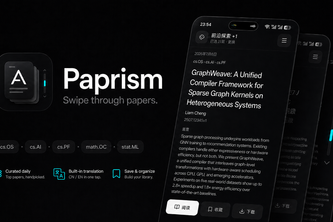
Self-reported purpose: A mobile-first research discovery and reading application built around a vertical, swipeable paper feed, designed to make browsing arXiv papers as natural as modern content feeds while preserving the original document and offering AI-assisted features like translation and question-answering.
What changed: The project is described as having evolved from a visual prototype into a working, locally installable application with a complete discovery-to-reading workflow. It supports local storage, offline reading, and uses an OpenAI-compatible API for translation and Q&A without requiring user accounts or backend services.
Single most important open question: Is there any evidence of user adoption, engagement, or traction beyond the author's own development efforts?
What The Product Actually Is
The description states that Paprism is a mobile-first research discovery and reading application, built with React Native, Expo, TypeScript, and Bun. It features:
- A vertical, swipeable paper feed for browsing newly published arXiv papers.
- Filtering by research category.
- Native reading view without switching to external browser tabs.
- Structured block translation that preserves the original document.
- Question-answering on selected passages.
- Local storage of saved papers, history, and offline downloads.
- Use of OpenAI-compatible API credentials stored locally.
- No account creation or data sent to a backend.
It is designed to help users discover research easily while keeping access to the full paper. The application communicates directly with arXiv and does not use an application server between the user and the source.
Confidence: High — this is a self-reported technical description of how the product works, but no evidence of actual usage or performance exists.
Positioning & Claim Evolution
The author claims that Paprism started from the question: “What would a research discovery experience look like if it were as natural to browse as a modern content feed, without reducing papers to disposable content?”
This positions Paprism as an alternative to traditional academic databases (which assume prior knowledge) and passive content feeds (optimized for consumption rather than learning). The name “Paprism” reflects the idea of refracting paper into multiple layers of understanding: metadata, summaries, translation, questions, saved references, and the original text.
The project also emphasizes that it does not replace source material with AI summaries but instead supports movement between different levels of engagement — from quick relevance checks to deep investigation.
Confidence: Medium — this is a self-stated positioning narrative; no external validation or market feedback is provided.
Target Customer & ICP
The description implies the target audience includes researchers, students, and professionals who want to browse academic papers efficiently, especially those interested in arXiv publications. The app is built for mobile use, suggesting a focus on users who prefer consuming content during spare time or while commuting.
It also targets individuals who value privacy and do not want to share personal data with platforms that require accounts or send library information to backends.
Confidence: Medium — the description does not name specific personas or segments, nor does it describe any customer interviews or feedback loops.
Business Model & Pricing Evidence
There is no evidence in the description of a business model or pricing strategy. The app is described as supporting local-first storage and allowing users to use their own OpenAI-compatible API credentials without requiring an account or sending data to a backend. No monetization mechanism, subscription plans, or paid features are mentioned.
Confidence: Very low — no indication of how the company intends to generate revenue.
Technical & Delivery Signals
The application is built using:
- React Native, Expo, TypeScript, and Bun
- Direct communication with arXiv
- No backend server between user and source
- Local storage for all data (papers, history, preferences, translations)
- Structured block-level translation pipeline with validation and caching
- Durable state queue to ensure persistence before reporting completion
- Offline document handling and PDF download lifecycle management
The team also mentions:
- Open-source nature of the project
- Automated testing, CI checks, multi-architecture builds, GitHub releases
- Design for mobile reading with dark editorial UI
- Handling complex interactions like swipe gestures within scrollable text
Confidence: High — detailed technical architecture is described, though no evidence of production deployment or scalability.
Traction & Maturity Signals
The description states that the project has moved beyond a visual prototype into a working, locally installable application with a complete discovery-to-reading workflow. It includes:
- Full offline reading support
- Block-level translation
- Local-first design
- Open-source release
However, there is no evidence of user adoption, active usage metrics, or customer feedback.
Confidence: Low — the project appears mature in development but lacks any traction indicators.
Competitive Context
The description does not mention competitors. However, based on its functionality (swipeable research feed, translation, offline reading), it could be positioned against:
- Traditional academic databases like Semantic Scholar, Google Scholar
- Content feeds optimized for passive consumption (e.g., TikTok, YouTube)
- Other AI-powered tools for research such as ChatGPT, Claude, or ResearchRabbit
No competitive analysis or differentiation strategy is provided.
Confidence: Low — no mention of existing solutions or competitive positioning.
Open Questions & Risks
- No revenue or monetization model – The app appears to be open-source and free, with no indication of how it will scale or generate income.
- Single-person team – The project is built by one person (Alan Wake), which raises concerns about long-term maintenance and scalability.
- Local-first approach may limit growth – Storing everything locally means limited ability to build community features, analytics, or cross-device sync.
- AI integration risks – The reliance on structured AI responses introduces risk of misalignment between prompts and outputs without robust validation.
- No user feedback or adoption data – Despite being a product for researchers, there is no evidence of real-world usage or impact.
Confidence: Medium — these are inferred risks from the self-reported description; they are not explicitly stated but can be reasonably deduced.
Questions the description leaves open
- What is your plan for monetization or scaling beyond a single developer?
- How do you intend to attract and retain users in a niche market like academic research?
- Have you considered how the local-first approach might affect long-term data migration or recovery?
- What are the limitations of using OpenAI-compatible APIs, especially around rate limits or cost?
- Are there any plans for expanding beyond arXiv or integrating with other sources?
- How do you plan to handle edge cases in translation (e.g., mathematical notation)?
- Has the app been tested by actual researchers or students?
- What are your thoughts on building a community or platform around the tool?
Overall Assessment
Not evidenced — There is no evidence of revenue, customers, or traction beyond the author’s own development efforts.
The project shows strong technical execution and a clear vision for improving access to research through mobile-first design and AI integration. However, without any signs of user adoption, engagement, or business model clarity, it remains an experimental prototype with potential but unproven commercial viability.
Assessment: Not ready for investment or partnership at this stage, unless further evidence emerges regarding traction, market fit, or monetization strategy.
User Stories BotA demo video on every pull request
Get a demo video on every new feature
GitHub App that watches your pull requests and records a narrated, captioned demo.
Save time on demo prep and make informed decisions faster with a video walkthrough of every new feature.
Source
Submitted to the OpenAI 2026 hackathon on Devpost. Project home on Devpost. Back to the full gallery on Devpost.
This competitive analysis was produced by top-founders.com (opens in a new tab)
Generated by a language model from this project's public Devpost page — its tagline, the author's own write-up and any built-with tags listed there — as captured in August 2026. Short quotations are the author's words. It is an opinion on the idea as a business, not on the people behind it, and it reflects the description as published then. If the project has moved on, request a correction below. The analysis is not independent research and contains no verified traction, revenue or customer data.
An independent guide by KFG International LLC — not affiliated with, endorsed by, or connected to Devpost or OpenAI.