

Archive position — measured, not model output
0 likes on Devpost
2,263 of the 7,850 archived projects have more likes, and 5,587 share exactly 0 — so this project's #5,552 place in the like-ranked listing is a tie-break inside that group, not a ranking.
Projects (log scale)
Likes on Devpost. ▲ marks this project's group.
Show the figures
| Likes | Projects | Share of archive |
|---|---|---|
| 0 | 5,587 | 71.2% |
| 1 | 1,758 | 22.4% |
| 2 | 284 | 3.6% |
| 3–4 | 132 | 1.7% |
| 5–9 | 75 | 1.0% |
| 10+ | 14 | 0.2% |
 User Stories BotA demo video on every pull request
Get a demo video on every new feature
GitHub App that watches your pull requests and records a narrated, captioned demo.
Save time on demo prep and make informed decisions faster with a video walkthrough of every new feature.
Executive Summary
What the company appears to be
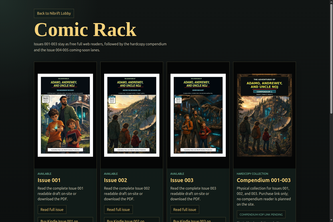
Nib Rift Studios, as described by the author, is a human-directed, AI-assisted comic production and publishing pipeline. It spans from story creation through to release and audience engagement, using tools like GPT-5.6 (via Codex), GPT Image, Blender, Astro, Svelte, and others. The system supports continuity management, consistent art production, panel QA, interactive reader development, website building, game integration, and approval-gated social campaigns.
What changed
During the OpenAI 2026 Build Week hackathon, Nib Rift Studios extended its existing workflow using Codex with GPT-5.6 to improve performance, accessibility, release processes, QA coverage, and audience operations. This included adding a new arcade cartridge (Tremor Breaker), expanding website functionality, and strengthening social media workflows.
Single most important open question
Is there evidence of any revenue-generating activity or customer traction beyond the author’s personal use and family audience? The description states no such data exists.
What The Product Actually Is
The description states that Nib Rift Studios is a human-directed, AI-assisted comic production and publishing pipeline. It connects the journey from story idea to finished issue and then to readers.
It includes:
- Story and continuity management (bible, character/location references, issue locks, prop state, scene-state checks)
- Comic studio tools for script structuring, panel planning, and artwork generation
- Lettering separate from image generation
- Release formatting into multiple formats (PDFs, CBZ, EPUB, KDP-ready packages)
- An interactive website built with Astro, Svelte, HTML5 Canvas
- A game cartridge built using TypeScript/Svelte
- Social media campaign preparation with AI-assisted content but human approval
The author notes that the system uses GPT Image, Codex (with GPT-5.6), Blender, Playwright, Cloudflare Pages, and other technologies to support these functions.
Positioning & Claim Evolution
The description states that this project began as a personal experiment for the author’s nephews and evolved into a larger endeavor involving:
- A continuing comic series (issue 006)
- Kindle releases via Amazon KDP
- Free interactive website
- Games and social presence
It is positioned as an AI-assisted creative workflow that enables one person to scale their own comic creation beyond what they could do alone.
The author emphasizes that the goal was never to fully automate comics but to give a creator leverage to build a small, personal studio. The positioning has evolved from a family project into something with broader potential for audience engagement and content expansion.
Target Customer & ICP
Not evidenced.
The description does not provide information about:
- Who the customers are beyond the author’s nephews
- Whether there is an external market or user base
- Any defined buyer personas or target segments
There is no indication of whether this project targets publishers, creators, or general consumers.
Business Model & Pricing Evidence
Not evidenced.
The description does not contain any information about:
- Revenue streams
- Pricing models
- Monetization strategies
- Customer acquisition costs
- Sales channels
It only mentions that the comic series is available through Amazon KDP and on a free interactive website, but no commercial data or pricing details are provided.
Technical & Delivery Signals
The description states that the system uses:
- Astro, Svelte, TypeScript, HTML5 Canvas for the website
- Python, YAML, JSON, manifests, deterministic renderers for comic production
- Playwright for QA
- Blender and scripted bpy passes for spatial composition
- Cloudflare Pages for hosting
- GPT Image workflows for candidate artwork
- Meta Graph API with human approval protocol for social publishing
Codex (with GPT-5.6) was used for:
- Reasoning
- Coding
- Orchestration
- Debugging
- Documentation
- QA
It also mentions that the author used Openclaw and agent Rune as orchestrators.
Traction & Maturity Signals
The description states:
- The project started as a personal experiment.
- It has grown into a continuing comic series (issue 006).
- It includes Kindle releases through Amazon KDP.
- There is a free interactive website.
- A game cartridge was added during Build Week.
- Social media presence exists.
However, there is no evidence of:
- Revenue
- Customer adoption or usage metrics
- Market traction beyond the author’s personal audience
- Any measurable growth in readership or engagement
Competitive Context
Not evidenced.
The description does not mention:
- Direct competitors
- Market size or segmentation
- Competitive advantages or differentiators
- Industry benchmarks or positioning relative to others
No comparison with existing tools or platforms for comic creation, publishing, or audience engagement is made.
Open Questions & Risks
Inferences based on the self-reported description:
- Lack of commercial traction: The project appears to be a personal endeavor without any evidence of revenue or customer base.
- Dependency on single creator: The entire operation seems to rely on one individual (Jonathan Hess), which raises concerns about scalability and sustainability.
- Unproven monetization model: While the author mentions KDP releases, there is no indication of how this translates into sustainable income.
- Unclear audience reach or engagement metrics: No data on readership, downloads, or social media performance.
- Potential over-reliance on AI tools: The system depends heavily on AI for production and orchestration, which may be fragile if those tools change or become unavailable.
Questions the description leaves open
- What is the current level of audience engagement beyond your family?
- Are there any plans to monetize beyond KDP and free web access?
- How do you plan to scale this system beyond one person?
- Have you considered how changes in AI tool availability might affect your workflow?
- Do you have any data on reader retention or feedback from the interactive website?
- What are the key performance indicators (KPIs) you track for growth and engagement?
Overall Assessment
Not evidenced.
There is no evidence of:
- Financial performance
- Customer traction
- Market validation
- Scalability potential
- Commercial viability beyond personal use
The project appears to be a personal creative experiment that has grown into a semi-commercial endeavor, but without any demonstrated commercial success or market demand. It lacks the data required to assess its investment or partnership potential.
User Stories BotA demo video on every pull request
Get a demo video on every new feature
GitHub App that watches your pull requests and records a narrated, captioned demo.
Save time on demo prep and make informed decisions faster with a video walkthrough of every new feature.
Source
Submitted to the OpenAI 2026 hackathon on Devpost. Project home on Devpost. Back to the full gallery on Devpost.
This competitive analysis was produced by top-founders.com (opens in a new tab)
Generated by a language model from this project's public Devpost page — its tagline, the author's own write-up and any built-with tags listed there — as captured in August 2026. Short quotations are the author's words. It is an opinion on the idea as a business, not on the people behind it, and it reflects the description as published then. If the project has moved on, request a correction below. The analysis is not independent research and contains no verified traction, revenue or customer data.
An independent guide by KFG International LLC — not affiliated with, endorsed by, or connected to Devpost or OpenAI.