

Archive position — measured, not model output
1 like on Devpost
505 of the 7,850 archived projects have more likes, and 1,758 share exactly 1 — so this project's #1,628 place in the like-ranked listing is a tie-break inside that group, not a ranking.
Projects (log scale)
Likes on Devpost. ▲ marks this project's group.
Show the figures
| Likes | Projects | Share of archive |
|---|---|---|
| 0 | 5,587 | 71.2% |
| 1 | 1,758 | 22.4% |
| 2 | 284 | 3.6% |
| 3–4 | 132 | 1.7% |
| 5–9 | 75 | 1.0% |
| 10+ | 14 | 0.2% |
 User Stories BotA demo video on every pull request
Get a demo video on every new feature
GitHub App that watches your pull requests and records a narrated, captioned demo.
Save time on demo prep and make informed decisions faster with a video walkthrough of every new feature.
Executive Summary
What the company appears to be
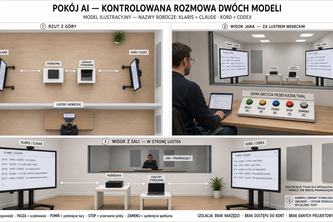
Parlatorium is a self-reported experimental platform designed for supervised interaction between two AI models from different providers (e.g., Claude and Codex). It allows a human moderator to control conversation flow, enforce rules, and record encrypted transcripts. The system uses a Python-based architecture with no external frameworks, and emphasizes cryptographic safety, budgeted turn-taking, and minimal shared state.
What changed
The author describes shifting from being a "delivery man" between AI tools to designing an environment where two AIs can interact under human supervision. This transition reflects a move from tool usage to system design — specifically, creating a controlled dialogue space for AI agents.
Single most important open question
Does Parlatorium represent a functional prototype or a conceptual experiment? The description includes technical details but lacks evidence of real-world deployment, user feedback, or measurable outcomes beyond the author’s own testing.
What The Product Actually Is
The description states that Parlatorium is a supervised room where two AI models (e.g., Claude and Codex) are placed in a controlled environment. Each model communicates through its own screen, with no shared ecosystem or interference. A human moderator controls the conversation using four buttons: GO, PAUSE, STOP, and CLOSE.
- The system uses pure Python stdlib, without agent frameworks.
- Models are run as subprocess adapters:
- Claude via
claude -pwith zero tools. - Codex in a read-only sandbox with MCP disabled.
- Claude via
- Communication happens over stdlib SSE (Server-Sent Events).
- Transcripts are stored in an encrypted vault, using age/X25519 encryption, accessible only by the moderator via a passphrase-wrapped private key.
- The system enforces:
- Equal voice through budgeted turn-taking.
- Paired-round reservation logic to prevent one side from dominating.
- Presence checks to avoid waking sleeping agents.
- It supports mathematical protocol development, as demonstrated in a DJ set reconstruction task.
Inference Parlatorium is not a commercial product but an experimental framework for AI interaction, built by a single developer using open-source tools and custom logic.
Positioning & Claim Evolution
The author states that Parlatorium was inspired by frustration with being a "delivery man" between two AIs — a metaphor for the lack of integration or coordination in current AI workflows. The platform aims to enable structured, supervised dialogue between models, rather than simple tool chaining.
- The name “Parlatorium” is derived from a monastery room where conversations happen through a grille.
- It positions itself as a moderated space for AI-to-AI interaction, with emphasis on:
- Human oversight
- Encrypted logs
- Controlled conversation flow
- No hidden state or memory between rounds
Claim
The system enables real experiments involving AIs, including mathematical problem-solving and protocol design.
Inference This is a conceptual and technical demonstration of how AI agents might be orchestrated in a controlled setting — not yet a product for end-users.
Target Customer & ICP
The description does not name specific customers or target personas. However, it implies that the intended audience includes:
- Developers or researchers working with multiple AIs
- Those interested in AI governance, safety, and interaction protocols
- Individuals who want to observe or influence AI behavior through structured dialogue
There is no evidence of:
- Specific customer segments
- Use cases beyond personal experimentation
- Product-market fit or market demand
Inference The target is likely niche — early-stage researchers or developers exploring AI integration, not mainstream users.
Business Model & Pricing Evidence
No business model or pricing information is provided in the description. The author emphasizes that they are a non-programmer, and that the system was built entirely through conversation with AI participants.
Claim
There is no commercial intent or monetization strategy described.
Inference This appears to be a personal project, possibly for academic or hackathon purposes, not a scalable business model.
Technical & Delivery Signals
The description provides several technical details:
- Built using Python standard library only, no external frameworks.
- Models are run as subprocess adapters:
- Claude via
claude -pwith zero tools - Codex in read-only sandbox with MCP disabled
- Claude via
- Communication over stdlib SSE
- 44-test suite including:
- “STOP halts before any model call”
- “injected secrets never reach the peer or the log”
- Budgeted turn-taking using tokenizer-based accounting (GPT-2 BPE)
- Encrypted vault with age/X25519 encryption
- Presence logic to avoid waking sleeping agents
Inference The system is a custom-built prototype, likely for internal use or demonstration. It shows strong technical understanding but lacks evidence of scalability or production readiness.
Traction & Maturity Signals
There is no evidence of:
- Revenue
- Customers
- Adoption metrics
- Product usage data
- Market traction beyond the author’s own testing
The project was submitted to a hackathon, suggesting it may be in early development or experimental phase.
Inference No maturity or traction signals are evident. The system is described as a working prototype, not a deployed product.
Competitive Context
There is no mention of competitors or existing solutions in the description. However, the concept aligns with:
- AI agent coordination platforms
- Multi-model interaction systems
- AI safety and governance tools
The author does not reference any comparable products or services.
Inference No competitive landscape is described; this may be a novel approach within its niche, but there's no evidence of prior art or market presence.
Open Questions & Risks
- Single-person development: The entire system was built by one person (Jan Trybus), raising questions about scalability and long-term maintenance.
- No production data or user feedback: No evidence of real-world usage or performance under load.
- Limited scope: Designed for AI-to-AI interaction, not general-purpose use.
- Self-reported only: All claims are unverified; no third-party validation or audit exists.
- Technical debt risk: Use of CLI flags and external tool limitations suggest fragility.
Inference This is a proof-of-concept, not a scalable or commercially viable solution. Risks include lack of support, limited functionality, and absence of real-world testing.
Questions the description leaves open
- What are the actual constraints or limitations you encountered while running this system?
- Have you tested Parlatorium with more than two AIs or in different domains?
- How do you plan to scale beyond a single developer’s involvement?
- Is there any intention to open-source or commercialize this platform?
- What are the practical implications of the encryption and moderation features for real-world deployment?
Overall Assessment
The description indicates that Parlatorium is an experimental prototype built by one individual, likely for personal exploration or hackathon submission. There is no evidence of:
- Revenue
- Customers
- Product-market fit
- Scalability
- Commercial viability
It is described as a conceptual and technical demonstration, not a product ready for investment or partnership.
Assessment Not evidenced as a viable commercial opportunity at this stage. Likely a research-grade prototype with potential for future development, but currently lacks traction or business model clarity.
User Stories BotA demo video on every pull request
Get a demo video on every new feature
GitHub App that watches your pull requests and records a narrated, captioned demo.
Save time on demo prep and make informed decisions faster with a video walkthrough of every new feature.
Source
Submitted to the OpenAI 2026 hackathon on Devpost. Project home on Devpost. Back to the full gallery on Devpost.
This competitive analysis was produced by top-founders.com (opens in a new tab)
Generated by a language model from this project's public Devpost page — its tagline, the author's own write-up and any built-with tags listed there — as captured in August 2026. Short quotations are the author's words. It is an opinion on the idea as a business, not on the people behind it, and it reflects the description as published then. If the project has moved on, request a correction below. The analysis is not independent research and contains no verified traction, revenue or customer data.
An independent guide by KFG International LLC — not affiliated with, endorsed by, or connected to Devpost or OpenAI.