

Archive position — measured, not model output
1 like on Devpost
505 of the 7,850 archived projects have more likes, and 1,758 share exactly 1 — so this project's #1,629 place in the like-ranked listing is a tie-break inside that group, not a ranking.
Projects (log scale)
Likes on Devpost. ▲ marks this project's group.
Show the figures
| Likes | Projects | Share of archive |
|---|---|---|
| 0 | 5,587 | 71.2% |
| 1 | 1,758 | 22.4% |
| 2 | 284 | 3.6% |
| 3–4 | 132 | 1.7% |
| 5–9 | 75 | 1.0% |
| 10+ | 14 | 0.2% |
 User Stories BotA demo video on every pull request
Get a demo video on every new feature
GitHub App that watches your pull requests and records a narrated, captioned demo.
Save time on demo prep and make informed decisions faster with a video walkthrough of every new feature.
Executive Summary
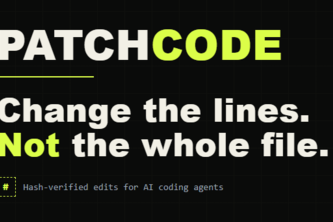
What the company appears to be: PatchCode is a self-reported open-source command-line interface (CLI) tool designed to enable AI coding agents to make surgical, hash-verified file edits — changing only lines that have actually changed and rejecting stale edits. It claims to reduce token usage by ~99% per edit through targeted patching rather than full-file rewriting.
What changed: The author states this is a hackathon submission (submitted to the OpenAI 2026 hackathon), built using GPT-5.6 in a live debugging session within Codex, and based on an existing MIT-licensed concept from "Oh My Pi". It was not previously known or referenced outside of this submission.
Single most important open question: Is there any evidence that PatchCode has been adopted, tested, or used beyond the author’s own development environment? The description does not indicate any real-world usage, customer feedback, or product deployment — only a prototype built in a hackathon context.
Note: This analysis is based entirely on the self-reported, unverified project description provided by the caller. No external verification or historical data are available.
What The Product Actually Is
The description states that PatchCode is a lightweight, open-source CLI tool for AI agents to perform surgical file edits using hash-verified patches.
It includes three core functions:
- Read:
hashline readreturns only requested lines, tagged with content hashes (fingerprinting). - Patch:
hashline patchapplies targeted edits — but only if the hash still matches; otherwise, it is rejected. - Result: Reduces token usage by ~99% by patching only changed lines instead of rewriting entire files.
The tool uses:
- Line-numbered anchors
- Content-hash tags for verification
- Built with JavaScript, Node.js, and MIT-licensed components
Inference: The product is described as a CLI utility that enforces safety in multi-agent editing environments by preventing silent overwrites. It is not a hosted service or SaaS offering.
Positioning & Claim Evolution
The author positions PatchCode as a solution to inefficiencies and risks in current AI coding agent workflows:
- Current agents rewrite entire files just to change one line.
- This leads to high token consumption and dangerous silent overwrites when multiple agents edit the same file.
- PatchCode introduces a surgical, hash-verified patching protocol that avoids these issues.
It claims to offer:
- A 99% reduction in tokens per edit
- Safety guarantees against stale edits
- No need for complex systems or bigger models
Claim: The tool is positioned as an improvement over existing AI agent file interaction patterns, not a replacement for them. It focuses on protocol-level fixes rather than model-level enhancements.
Target Customer & ICP
The description does not specify target customers or personas. However, it implies:
- AI coding agents (e.g., those powered by Codex or similar tools)
- Developers working in environments where multiple AI agents may interact with the same files
- Teams looking to reduce token costs and improve reliability of automated code changes
Inference: The primary users are likely developers or engineering teams who use AI agents for code editing, particularly in collaborative or multi-agent settings.
Business Model & Pricing Evidence
There is no evidence of a business model or pricing structure in the description. The tool is described as:
- Open-source
- Built with MIT license
- Published on Devpost as part of a hackathon submission
Not evidenced: No mention of monetization, subscriptions, paid features, or any commercial offering.
Technical & Delivery Signals
The author states:
- The CLI was built and debugged live in OpenAI Codex using GPT-5.6
- It uses line-numbered anchors + content-hash tags (adapted from "Oh My Pi")
- It handles relative-path errors via Codex’s debugging capability
- Challenges included ensuring hash-matching logic is bulletproof and reproducing race conditions
Inference: The tool is technically feasible and tested in a controlled environment. However, there is no evidence of production deployment or scalability testing.
Traction & Maturity Signals
The description indicates:
- This is a hackathon project (OpenAI 2026)
- Submitted to Devpost
- Built by one person (leonardo froeder)
- No mention of users, adoption, or product traction beyond the author’s own use case
Not evidenced: No evidence of customers, revenue, usage metrics, or product maturity beyond a prototype.
Competitive Context
The description does not reference competitors or similar tools. It focuses on:
- AI coding agents like Codex
- The inefficiency of full-file rewriting in such systems
- A novel approach to patching via hashing
Inference: The tool addresses a gap in current AI agent workflows, but there is no indication of existing solutions or competitive landscape.
Open Questions & Risks
Key concerns based on the description:
- No real-world usage or testing — only a hackathon prototype.
- Single-person team — raises questions about scalability and long-term maintenance.
- Open-source, no commercial model — unclear path to monetization or product development.
- Limited scope — described as a CLI with no mention of broader integration capabilities or framework support.
- Unverified claims — token savings (~99%) and safety guarantees are self-reported without independent validation.
Inference: The project is in early-stage prototype form, lacking evidence of product-market fit or commercial viability.
Questions the description leaves open
- Has PatchCode been tested beyond the hackathon environment? Are there any real-world use cases or pilot deployments?
- What are the technical limitations or edge cases that have not yet been addressed in the current implementation?
- How does PatchCode integrate with existing AI agent frameworks (e.g., LangChain, AutoGen)?
- Is there a plan to expand language/framework coverage beyond what is currently supported?
- Are there any plans for monetization or commercial product development?
Overall Assessment
Not evidenced: There is no evidence of revenue, traction, or customer adoption that would support an investment or partnership decision.
Assessment: This is a self-reported hackathon prototype with a clear technical concept and potential value proposition. However, it lacks any indication of real-world usage, product maturity, or commercial viability. It may be a promising idea for future development but does not yet meet the criteria for investment or strategic partnership at this time.
Confidence level: Low — based on minimal evidence provided in a self-reported description.
User Stories BotA demo video on every pull request
Get a demo video on every new feature
GitHub App that watches your pull requests and records a narrated, captioned demo.
Save time on demo prep and make informed decisions faster with a video walkthrough of every new feature.
Source
Submitted to the OpenAI 2026 hackathon on Devpost. Project home on Devpost. Back to the full gallery on Devpost.
This competitive analysis was produced by top-founders.com (opens in a new tab)
Generated by a language model from this project's public Devpost page — its tagline, the author's own write-up and any built-with tags listed there — as captured in August 2026. Short quotations are the author's words. It is an opinion on the idea as a business, not on the people behind it, and it reflects the description as published then. If the project has moved on, request a correction below. The analysis is not independent research and contains no verified traction, revenue or customer data.
An independent guide by KFG International LLC — not affiliated with, endorsed by, or connected to Devpost or OpenAI.