

Archive position — measured, not model output
1 like on Devpost
505 of the 7,850 archived projects have more likes, and 1,758 share exactly 1 — so this project's #1,630 place in the like-ranked listing is a tie-break inside that group, not a ranking.
Projects (log scale)
Likes on Devpost. ▲ marks this project's group.
Show the figures
| Likes | Projects | Share of archive |
|---|---|---|
| 0 | 5,587 | 71.2% |
| 1 | 1,758 | 22.4% |
| 2 | 284 | 3.6% |
| 3–4 | 132 | 1.7% |
| 5–9 | 75 | 1.0% |
| 10+ | 14 | 0.2% |
 User Stories BotA demo video on every pull request
Get a demo video on every new feature
GitHub App that watches your pull requests and records a narrated, captioned demo.
Save time on demo prep and make informed decisions faster with a video walkthrough of every new feature.
Executive Summary
What the company appears to be
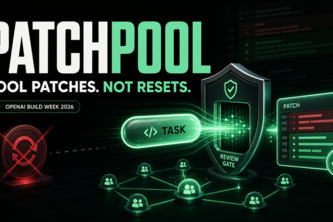
PatchPool is a self-reported developer tool that enables open-source maintainers to describe bounded tasks and receive structured, auditable patch outcomes without transferring access credentials or entitlements. It operates as a coordination layer for open-source contributions, using AI to generate patches while maintaining strict safety boundaries.
What changed
The project evolved from an idea of sharing Codex resets (API credits) to a safer model of pooling patches rather than access. The author repositioned the tool to focus on structured task encapsulation and human-in-the-loop review, with deterministic checks and cryptographic sealing of task capsules.
Single most important open question
Is there any evidence that this tool has been used or tested by actual open-source maintainers beyond the author’s own development?
What The Product Actually Is
The description states that PatchPool is a developer coordination tool for open-source tasks. It allows users to submit a GitHub URL and a task description, then generates a structured "Task Capsule" containing objective, non-goals, acceptance criteria, test plan, risk, budget, and provenance.
It uses:
- AI (GPT-5.6 via OpenAI SDK)
- Deterministic safety checks
- HMAC-sealed Task Capsules
- Browser-local demo Task Grants
- Fixture mode for non-executed patch generation
The system does not clone or modify repositories, nor does it execute submitted code. It produces a fixture diff and requires human approval before issuing any receipt.
Not evidenced No actual repository execution, no live model output in current MVP, no real-world usage data, no customer base, no revenue streams, no pricing model.
Positioning & Claim Evolution
The author claims PatchPool was originally inspired by the idea of sharing unused Codex resets but pivoted to a safer architecture focused on bounded outcomes instead of access transfer.
Key positioning shifts:
- From "reset-sharing" → "patch-pooling"
- From entitlement transfer → structured task coordination
- From AI autonomy → human authority over final decision
The tool is positioned as a responsible AI developer tool, emphasizing:
- No credential or reset transfer
- Deterministic safety controls
- Human-in-the-loop review
- Cryptographic sealing of task capsules
Inference This evolution suggests an awareness of risks in AI-assisted development tools, particularly around access and control.
Not evidenced No market positioning data, no competitor comparison, no user feedback or adoption metrics.
Target Customer & ICP
The description states that PatchPool is intended for open-source maintainers who want to describe bounded tasks and receive structured patch outcomes without sharing credentials.
It targets:
- Open-source project owners
- Contributors looking to help with specific issues
- Developers seeking safe AI-assisted patch generation
It does not appear to target enterprise users or commercial software teams directly.
Not evidenced No customer personas, no segmentation strategy, no evidence of actual user interviews or feedback.
Business Model & Pricing Evidence
The description makes no mention of a business model or pricing structure. It is entirely self-reported and unverified.
Not evidenced No revenue model, no monetization strategy, no pricing tiers, no customer acquisition plans.
Technical & Delivery Signals
PatchPool is built using:
- Next.js, React, TypeScript
- Zod schemas for input/output validation
- OpenAI GPT-5.6 API with structured outputs
- HMAC-SHA256 for sealing Task Capsules
- Deterministic safety checks before model processing
- Fixture mode as default workflow (no live execution)
- Browser-local demo reservations
- Vitest, ESLint, TypeScript typecheck, npm audit
Security features include:
- Secret redaction
- No repository cloning or modification
- No API key exposure in client bundle
- Tamper detection via HMAC seals
- Human approval gates
Not evidenced No production deployment details, no scalability assumptions, no infrastructure architecture, no performance benchmarks.
Traction & Maturity Signals
The project is described as an MVP submitted to the OpenAI 2026 hackathon. It includes:
- End-to-end fixture workflow
- 12 files and 110 tests passed (Vitest)
- TypeScript typecheck passed
- ESLint passed
- Next.js build passed
- npm audit: 0 vulnerabilities
However, it does not execute repositories or produce verified receipts in its current form.
Not evidenced No user base, no customer traction, no revenue, no usage data, no product-market fit indicators.
Competitive Context
The description does not reference any existing tools or platforms in the space. It is unclear whether PatchPool competes with:
- AI-assisted code generation tools
- Open-source contribution platforms
- GitHub Copilot or similar AI coding assistants
- Developer collaboration tools
Not evidenced No competitive analysis, no market size estimates, no differentiation from existing solutions.
Open Questions & Risks
- No real-world usage: The MVP only supports fixture mode and does not execute repositories.
- Limited functionality: Verified receipts are not yet possible due to lack of live execution.
- Unproven adoption: No evidence of actual users or community interest beyond the author.
- Dependency on AI API: Relies on OpenAI’s GPT-5.6, which is currently rate-limited in demo mode.
- No monetization path: No indication of how this will be commercialized.
- Single-person team: The project was built by one person (Miki Chihara), raising concerns about scalability and long-term maintenance.
Inference The tool may not yet be ready for production use or market adoption without significant development.
Questions the description leaves open
- What specific open-source maintainers have expressed interest in using PatchPool?
- How does the team plan to scale beyond the current MVP and fixture-only mode?
- Are there any plans to integrate with GitHub App or other CI/CD systems?
- What is the roadmap for enabling live execution and verified receipts?
- Has the tool been tested by others outside of the author’s own development environment?
- How does PatchPool intend to differentiate itself from existing AI-assisted code tools?
Overall Assessment
Not evidenced No financials, no valuation, no funding history, no investor interest.
This is a self-reported MVP submitted as part of a hackathon. It shows strong technical design and security focus but lacks any evidence of traction, revenue, or customer adoption.
Confidence level Low — based entirely on the author’s own description, which is unverified and self-promotional.
Assessment PatchPool is an early-stage concept with promising safety mechanisms and a clear vision for responsible AI tooling. However, without external validation, usage data, or product-market fit evidence, it cannot be considered a viable investment or partnership opportunity at this time.
User Stories BotA demo video on every pull request
Get a demo video on every new feature
GitHub App that watches your pull requests and records a narrated, captioned demo.
Save time on demo prep and make informed decisions faster with a video walkthrough of every new feature.
Source
Submitted to the OpenAI 2026 hackathon on Devpost. Project home on Devpost. Back to the full gallery on Devpost.
This competitive analysis was produced by top-founders.com (opens in a new tab)
Generated by a language model from this project's public Devpost page — its tagline, the author's own write-up and any built-with tags listed there — as captured in August 2026. Short quotations are the author's words. It is an opinion on the idea as a business, not on the people behind it, and it reflects the description as published then. If the project has moved on, request a correction below. The analysis is not independent research and contains no verified traction, revenue or customer data.
An independent guide by KFG International LLC — not affiliated with, endorsed by, or connected to Devpost or OpenAI.