

Archive position — measured, not model output
1 like on Devpost
505 of the 7,850 archived projects have more likes, and 1,758 share exactly 1 — so this project's #1,632 place in the like-ranked listing is a tie-break inside that group, not a ranking.
Projects (log scale)
Likes on Devpost. ▲ marks this project's group.
Show the figures
| Likes | Projects | Share of archive |
|---|---|---|
| 0 | 5,587 | 71.2% |
| 1 | 1,758 | 22.4% |
| 2 | 284 | 3.6% |
| 3–4 | 132 | 1.7% |
| 5–9 | 75 | 1.0% |
| 10+ | 14 | 0.2% |
 User Stories BotA demo video on every pull request
Get a demo video on every new feature
GitHub App that watches your pull requests and records a narrated, captioned demo.
Save time on demo prep and make informed decisions faster with a video walkthrough of every new feature.
Executive Summary
What the company appears to be
Pathmark is a local-first memory management tool for coding agents. The author states it runs as a local MCP server, enabling agents to save and recover decisions across sessions while preserving context, evidence, and provenance. It is built in TypeScript on Node.js and designed to keep data durable and inspectable on the developer's machine.
What changed
During Build Week, Pathmark underwent significant development including fixes for multi-process SQLite races, lifecycle controls (purge, compaction), redaction, recall consistency, relevance filtering, and structured provenance tracking. The project evolved from a basic JSONL store with SQLite index to a more robust system with scoped operations, encryption options, diagnostics, and safer concurrent access.
The single most important open question
Is there evidence of real-world usage or adoption beyond the author’s own development and demo? The description states no revenue, customers, or traction data exist beyond what is self-reported.
What The Product Actually Is
- The description states that Pathmark runs as a local MCP server.
- It supports saving and recovering decisions across sessions with visible evidence (memory IDs, timestamps, sources, tags, previews, match metadata).
- It includes features like namespace-scoped reads/writes, default secret redaction, revision history, expiration, retention, diagnostics, backup, compaction, preview-first hard purge, optional encrypted portable exports, and safer concurrent SQLite indexing.
- The system uses append-only JSONL for canonical records and SQLite FTS as a disposable search index.
- It is written in TypeScript on Node.js 22.5+.
- It exposes a provider-neutral stdio MCP server.
Inference Pathmark appears to be a developer tool aimed at improving agent memory consistency and auditability by keeping data local, inspectable, and traceable.
Positioning & Claim Evolution
- The author claims Pathmark addresses the problem of “coding agents are increasingly capable, but every fresh task still starts cold.”
- It positions itself as a solution that makes context durable and visible across agents while maintaining source-of-truth on the developer’s machine.
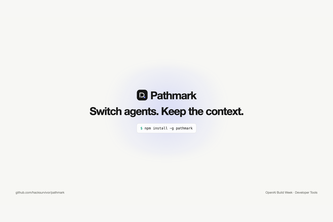
- The tagline is: “Switch coding agents. Keep the context.”
Inference The positioning has evolved from addressing basic agent memory issues to offering a full lifecycle management system for local agent memory with safety, auditability, and portability features.
Target Customer & ICP
- The description does not name specific customer segments or personas.
- It implies usage by developers working with coding agents.
- The tool is described as local-first, running on developer machines without requiring an account or hosted service.
- It targets users who want to maintain control over their agent memory and ensure consistency across sessions.
Inference The primary ICP appears to be developers using coding agents in local environments, particularly those seeking durable, auditable, and portable agent memories.
Business Model & Pricing Evidence
- No pricing information is provided.
- The description states the tool works locally without an account or hosted service.
- It is MIT licensed and available via npm.
- There is no mention of monetization strategies or business models beyond open-source distribution.
Inference No evidence of a commercial model or pricing structure exists in the provided description.
Technical & Delivery Signals
- Built with TypeScript on Node.js 22.5+.
- Uses MCP (Model Context Protocol) as its interface standard.
- Canonical records stored in append-only JSONL; SQLite FTS used for search index.
- Implements lifecycle controls including purge, compaction, diagnostics, backup, and expiration.
- Includes support for scoped import/export, optional AES-256-GCM portable exports.
- Features include multi-concept relevance thresholds, stop words, near-duplicate suppression, project/namespace preference, and explicit cross-project fallback.
- Adds structured prompt, memory, tool-result, and final-answer provenance while keeping tool-output text private by default.
- Release pipeline includes CodeQL checks, dependency review, npm auditing, OpenSSF analysis, immutable GitHub Action pins, and package provenance.
Inference Pathmark shows technical maturity in handling concurrency, data integrity, and lifecycle management. It is designed with safety and auditability as core principles.
Traction & Maturity Signals
- The project has a pre-challenge baseline (v0.1.5) and qualifying releases (v0.1.6, v0.1.7, v0.1.8).
- A demo was created showing two-process recovery with visible provenance.
- The author reports that the package passed build, runtime, lint, CodeQL, dependency review, audit, package, and provenance checks.
- A retrieval acceptance corpus covers real production failure modes.
- An installed-package canary verifies upgrade migration and live Codex capture across process boundaries.
Inference There is evidence of iterative development and testing, but no data on actual user adoption or usage metrics beyond the author’s own demos and internal validation.
Competitive Context
- No mention of direct competitors in the description.
- The tool focuses on local-first agent memory management within the context of coding agents.
- It leverages MCP (Model Context Protocol), which is a relatively new standard for agent interoperability.
Inference Pathmark operates in a niche space related to developer tools and agent memory systems. Its competitive landscape is not clearly defined, but it may relate to broader trends in local-first AI tooling or agent memory platforms.
Open Questions & Risks
- The project is self-reported and unverified; no third-party validation exists.
- No evidence of revenue, customers, or traction beyond the author’s own use.
- The tool is described as a single-person effort (team size: 1).
- It is not clear whether it has been integrated into any larger systems or workflows.
- The focus on local-first design may limit scalability or adoption in enterprise settings.
Inference The lack of external validation, traction, and team size raises questions about long-term viability and market readiness.
Questions the description leaves open
- What is the actual use case or workflow where this tool would be applied?
- Has it been tested in real-world environments beyond the author’s own demos?
- Are there plans to expand beyond local-first, or does it remain focused on developer machines?
- How does Pathmark handle integration with existing agent frameworks or tools?
- What are the long-term goals for the project — is it intended to evolve into a commercial product?
Overall Assessment
- The description indicates a strong technical foundation and clear problem-solving approach.
- However, there is no evidence of traction, revenue, or customer feedback.
- The author is a solo developer working on a niche tool within the rapidly evolving agent ecosystem.
- The project is open-source and MIT licensed, suggesting potential for community-driven development or integration.
Inference While Pathmark shows promise as a technical solution to a real problem in agent memory management, its current state lacks commercial viability indicators. It may be suitable for early-stage investment if the author plans to scale beyond solo development and demonstrate adoption or traction.
User Stories BotA demo video on every pull request
Get a demo video on every new feature
GitHub App that watches your pull requests and records a narrated, captioned demo.
Save time on demo prep and make informed decisions faster with a video walkthrough of every new feature.
Source
Submitted to the OpenAI 2026 hackathon on Devpost. Project home on Devpost. Back to the full gallery on Devpost.
This competitive analysis was produced by top-founders.com (opens in a new tab)
Generated by a language model from this project's public Devpost page — its tagline, the author's own write-up and any built-with tags listed there — as captured in August 2026. Short quotations are the author's words. It is an opinion on the idea as a business, not on the people behind it, and it reflects the description as published then. If the project has moved on, request a correction below. The analysis is not independent research and contains no verified traction, revenue or customer data.
An independent guide by KFG International LLC — not affiliated with, endorsed by, or connected to Devpost or OpenAI.