

Archive position — measured, not model output
1 like on Devpost
505 of the 7,850 archived projects have more likes, and 1,758 share exactly 1 — so this project's #1,634 place in the like-ranked listing is a tie-break inside that group, not a ranking.
Projects (log scale)
Likes on Devpost. ▲ marks this project's group.
Show the figures
| Likes | Projects | Share of archive |
|---|---|---|
| 0 | 5,587 | 71.2% |
| 1 | 1,758 | 22.4% |
| 2 | 284 | 3.6% |
| 3–4 | 132 | 1.7% |
| 5–9 | 75 | 1.0% |
| 10+ | 14 | 0.2% |
 User Stories BotA demo video on every pull request
Get a demo video on every new feature
GitHub App that watches your pull requests and records a narrated, captioned demo.
Save time on demo prep and make informed decisions faster with a video walkthrough of every new feature.
Executive Summary
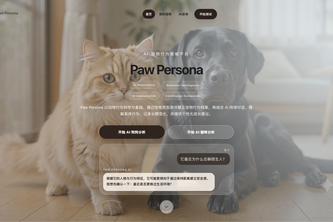
Paw Persona is an AI-powered pet personality and behavior companion, as described by its author. The project was built during the OpenAI 2026 hackathon and integrates behavioral science with conversational AI to help dog and cat owners understand their pets' personalities and behaviors.
The platform allows users to complete personality assessments for pets, receive personalized reports, and engage in context-aware AI consultations grounded in each pet’s profile. It uses a combination of React, Supabase, Vercel, and OpenAI APIs, with support for multilingual interfaces (English, Chinese, Korean).
Key claims include:
- Combines behavioral science, structured personality assessment, and conversational AI.
- Offers personalized insights through an AI assistant that understands each pet’s assessment results.
- Aims to improve understanding of companion animals through scientifically inspired tools.
However, there is no evidence of revenue, customers, traction, or commercial adoption. The project is presented as a prototype or proof-of-concept with no indication of market validation or monetization strategy.
The single most important open question: Is there any evidence that users are engaging with the platform beyond its initial development phase?
What The Product Actually Is
The description states that Paw Persona is an AI-powered pet personality platform. It enables:
- Personality assessments for dogs and cats.
- Comprehensive personality reports.
- Behavioral tendencies, emotional traits, and social characteristics exploration.
- Conversational AI consultation grounded in each pet’s assessment results.
It also includes:
- Multilingual support (English, Chinese, Korean).
- Persistent pet profiles.
- Assessment history tracking.
- Context-aware prompt architecture using OpenAI APIs.
The platform is built with:
- Frontend: React, Vite, React Router
- Backend: Supabase, PostgreSQL
- Hosting: Vercel
- AI integration: OpenAI API (including GPT-5.6 and Codex)
- Development tools: Prompt engineering, TypeScript
Inferred from the description:
- The system is designed to maintain long-term context across conversations.
- It avoids generic advice by tailoring responses based on structured behavioral data.
Not evidenced:
- Whether any of these features have been tested with real users or deployed beyond a prototype.
- If the AI consultation is live or simulated.
- Any technical performance metrics or user feedback loops.
Positioning & Claim Evolution
The author positions Paw Persona as an evolution of personality assessment platforms like 16Personalities, but tailored for pets. The core claim is that it bridges the gap between entertainment-based quizzes and meaningful behavioral insights.
Key claims:
- Combines behavioral science with AI to offer scientifically inspired tools.
- Provides personalized AI consultation grounded in pet profiles.
- Reimagines personality assessment for companion animals rather than humans.
The project evolved from a hackathon submission into a vision of an AI companion that helps owners better understand, communicate with, and care for their pets.
Inferred:
- The author sees this as a step toward long-term behavioral coaching and health tracking.
- There is intent to expand beyond dogs and cats to other species.
Not evidenced:
- Any evidence of market positioning or competitive differentiation in the broader pet tech space.
- Whether the platform has moved past the prototype stage.
- How it differentiates from existing AI chatbots or pet behavior apps (if any exist).
Target Customer & ICP
The author states that Paw Persona targets dog and cat owners who want to better understand their pets' personalities and behaviors.
Inferred:
- The target audience likely includes pet owners seeking emotional connection, behavioral guidance, or scientific insight.
- Users may be interested in personalized advice over generic content.
Not evidenced:
- Specific demographics or psychographics of the intended users.
- Any customer segmentation strategy.
- Whether the platform has begun targeting specific user groups or niches.
- No evidence of actual customers or user personas beyond general assumptions.
Business Model & Pricing Evidence
The description does not contain any information about pricing, monetization, or business model.
Inferred:
- The author implies a future direction toward monetized services (e.g., premium assessments, coaching features).
- There is no indication whether the platform will be free-to-use, subscription-based, or pay-per-use.
Not evidenced:
- Any revenue streams.
- Pricing tiers or plans.
- Monetization strategy beyond the initial concept.
- Whether there are any paid features or partnerships in development.
Technical & Delivery Signals
The project is built using modern web technologies:
- Frontend: React, Vite, React Router
- Backend: Supabase, PostgreSQL
- Hosting: Vercel
- AI APIs: OpenAI (GPT-5.6, Codex)
- Development stack includes TypeScript, CSS, HTML, JavaScript
Key technical elements mentioned:
- Multilingual support.
- Persistent pet profiles.
- Assessment history tracking.
- Context-aware prompt architecture.
Inferred:
- The system attempts to preserve context across multiple interactions with the AI assistant.
- Prompt engineering is used to tailor AI responses based on structured data.
Not evidenced:
- Performance benchmarks or scalability assumptions.
- Data privacy or security measures.
- Any production deployment metrics or uptime details.
- Whether the platform supports real-time updates or integrates with external pet tracking devices.
Traction & Maturity Signals
There is no evidence of traction, adoption, or user engagement beyond the hackathon submission.
Inferred:
- The project was completed during a hackathon and deployed as a prototype.
- Future plans include scientific validation, long-term coaching, and community features.
Not evidenced:
- Any user base, active usage statistics, or retention rates.
- Customer feedback or reviews.
- Product roadmap execution or milestones achieved.
- No evidence of monetization or revenue generation.
Competitive Context
The description does not mention any competitors or existing solutions in the pet behavior or personality space.
Inferred:
- The author may be positioning Paw Persona as a novel approach combining AI and behavioral science for pets.
- It could potentially compete with general pet care apps, AI chatbots, or personality quizzes.
Not evidenced:
- Any competitive landscape analysis.
- Existing players in the market.
- Competitive advantages or unique value propositions beyond the author’s claims.
- No evidence of differentiation from similar tools (if any exist).
Open Questions & Risks
Several risks and open questions are present based on the self-reported description:
- Lack of Traction: The project is described only as a hackathon submission with no evidence of real-world usage or adoption.
- Unvalidated Assumptions: The author assumes that pet owners desire scientifically inspired personality assessments, but there is no market validation for this demand.
- AI Context Management Risk: While the system claims to maintain long-term context, it's unclear how well this works in practice without real user testing or feedback.
- Scalability Concerns: The use of OpenAI APIs and a small team (1 member) raises questions about scalability and cost-efficiency at scale.
- Scientific Validity Claims: The description mentions "behavioral science" but does not provide evidence of scientific rigor or peer-reviewed validation.
Not evidenced:
- Any risk mitigation strategies.
- No evidence of product-market fit or user testing.
- No indication of how the team plans to address scalability or monetization challenges.
Questions the description leaves open
- What specific behavioral science models or frameworks are being used in the personality assessments?
- How is the AI consultation experience designed to maintain context across multiple conversations?
- Have you conducted any user testing or gathered feedback from pet owners?
- What is your plan for validating the scientific accuracy of the personality models?
- Are there any existing partnerships or integrations with veterinarians, pet care providers, or animal behaviorists?
- How do you intend to monetize this platform if at all?
- What are the key technical challenges that remain unresolved in moving from prototype to production?
- Is there a plan to expand beyond dogs and cats to other companion animals?
Overall Assessment
At this stage, Paw Persona is a self-reported hackathon project with no demonstrated traction or commercial viability.
The author describes an ambitious vision for an AI-powered pet personality platform that combines behavioral science and conversational AI. However, there is no evidence of revenue, customers, or product-market fit, nor any indication that the platform has moved beyond its initial prototype phase.
The project appears to be a conceptual exploration rather than a scalable business opportunity. While the idea has potential, it lacks the foundational signals needed for investment or partnership consideration at this time.
Confidence Level: Low
This assessment is based entirely on self-reported information and does not reflect any external validation or performance data.
User Stories BotA demo video on every pull request
Get a demo video on every new feature
GitHub App that watches your pull requests and records a narrated, captioned demo.
Save time on demo prep and make informed decisions faster with a video walkthrough of every new feature.
Source
Submitted to the OpenAI 2026 hackathon on Devpost. Project home on Devpost. Back to the full gallery on Devpost.
This competitive analysis was produced by top-founders.com (opens in a new tab)
Generated by a language model from this project's public Devpost page — its tagline, the author's own write-up and any built-with tags listed there — as captured in August 2026. Short quotations are the author's words. It is an opinion on the idea as a business, not on the people behind it, and it reflects the description as published then. If the project has moved on, request a correction below. The analysis is not independent research and contains no verified traction, revenue or customer data.
An independent guide by KFG International LLC — not affiliated with, endorsed by, or connected to Devpost or OpenAI.