

Archive position — measured, not model output
0 likes on Devpost
2,263 of the 7,850 archived projects have more likes, and 5,587 share exactly 0 — so this project's #5,556 place in the like-ranked listing is a tie-break inside that group, not a ranking.
Projects (log scale)
Likes on Devpost. ▲ marks this project's group.
Show the figures
| Likes | Projects | Share of archive |
|---|---|---|
| 0 | 5,587 | 71.2% |
| 1 | 1,758 | 22.4% |
| 2 | 284 | 3.6% |
| 3–4 | 132 | 1.7% |
| 5–9 | 75 | 1.0% |
| 10+ | 14 | 0.2% |
 User Stories BotA demo video on every pull request
Get a demo video on every new feature
GitHub App that watches your pull requests and records a narrated, captioned demo.
Save time on demo prep and make informed decisions faster with a video walkthrough of every new feature.
Executive Summary
What the company appears to be
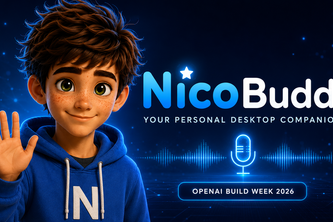
NicoBuddy is a self-reported personal desktop companion built as a solo project by Daniela-Nanizinha Homem. It is described as an animated avatar that listens on demand, responds in European Portuguese, and remembers personal details locally. The author states it was developed for the OpenAI 2026 hackathon.
What changed
The project evolved from a simple script into a working desktop application with voice interaction, local memory, and an animated interface. It moved from continuous listening to click-to-talk interaction due to privacy and performance concerns.
Single most important open question
Is there any evidence of user adoption or market traction beyond the author’s solo development?
What The Product Actually Is
The description states that NicoBuddy is a Windows desktop application built in Python. It includes:
- An animated avatar (using PySide6)
- Click-to-talk voice interaction
- Speech recognition in Portuguese (via Faster-Whisper)
- Voice responses in European Portuguese (using neural TTS)
- Local memory storage (in JSON files)
- Modular architecture for listening, speech, memory, commands, and animation
It is described as a personal desktop companion that listens only when the user clicks on the avatar.
Evidence
- Built with Python and PySide6
- Uses Silero VAD for voice activity detection
- Uses Faster-Whisper for transcription
- Uses neural TTS for voice responses
- Stores personal data locally in JSON files
Inference It is a desktop application, not a web or mobile product.
Positioning & Claim Evolution
The author states that the goal was to create a "friendly desktop companion" that feels present on the desktop and is simple enough for anyone to use. It was not intended to be another complicated assistant.
The positioning evolved from:
- A basic question-and-answer script
- To a working animated desktop companion with voice interaction, memory, and privacy controls
Claims
- The product is “friendly”, “accessible”, and “simple”
- It listens only on demand for privacy
- It responds naturally in European Portuguese
- It remembers personal information locally
Inference The positioning emphasizes simplicity, privacy, and local processing — not scalability or enterprise use.
Target Customer & ICP
The description does not explicitly state the target customer or ideal customer profile (ICP). The author describes it as a personal desktop companion, suggesting a consumer or individual user rather than an enterprise or B2B audience.
Claims
- Designed for anyone to use
- A “small companion” that feels present on the desktop
Inference The ICP likely includes individuals seeking a personal, privacy-conscious assistant — possibly tech-savvy beginners or users looking for a simple, local solution.
Business Model & Pricing Evidence
There is no evidence of any business model or pricing structure. The project is described as a solo hackathon submission with no mention of monetization, subscriptions, or sales.
Claims
- No explicit business model mentioned
- Not described as a commercial product
Inference It appears to be a prototype or personal project, not a revenue-generating product.
Technical & Delivery Signals
The author describes the technical stack and architecture:
- Built in Python
- Uses PySide6 for GUI and animation
- Speech recognition via Faster-Whisper
- Voice activity detection via Silero VAD
- TTS using neural voice models
- Local memory stored in JSON files
- Modular code structure
Claims
- Modular design for testing, repair, and expansion
- Uses Codex and GPT-5.6 as development partners
- Developed solo with version control (Git)
Inference The technical approach suggests a personal or experimental project, not a scalable product.
Traction & Maturity Signals
There is no evidence of traction, customers, or adoption beyond the author’s own development. The project is described as a solo hackathon submission with no mention of users, downloads, or usage metrics.
Claims
- Developed by one person
- Prototype that grew from a script to a working application
- No revenue, customer data, or usage statistics
Inference No evidence of product-market fit or user engagement.
Competitive Context
The description does not mention any competitors. However, it is implied that the product is positioned as a personal assistant, possibly in contrast to larger platforms like Siri, Alexa, or Google Assistant — but with a focus on local processing and privacy.
Inference It may compete with or complement existing personal assistants by offering a privacy-first, local, animated desktop experience.
Open Questions & Risks
- No commercial traction or user data — the project is described as a solo hackathon effort.
- Solo development — no team, no external validation, no product-market fit evidence.
- Limited scope and features — not scalable or enterprise-ready.
- No monetization strategy — no indication of how it would generate revenue.
- Privacy-focused but unproven in real-world use — the click-to-talk model is described as a solution to privacy concerns, but no real-world testing is reported.
Questions the description leaves open
- What is the intended user base beyond personal use?
- Are there any plans for monetization or commercialization?
- How does the local memory system handle data persistence and updates?
- Has the product been tested with real users, or is it purely experimental?
- What are the scalability limitations of the current architecture?
Overall Assessment
Not evidenced.
There is no evidence of revenue, customers, traction, or commercial viability beyond a solo developer’s hackathon project. The product is described as a prototype with no indication of market demand, business model, or team.
Confidence Low — the description is self-reported and unverified, and lacks any evidence of commercial readiness or user adoption.
User Stories BotA demo video on every pull request
Get a demo video on every new feature
GitHub App that watches your pull requests and records a narrated, captioned demo.
Save time on demo prep and make informed decisions faster with a video walkthrough of every new feature.
Source
Submitted to the OpenAI 2026 hackathon on Devpost. Project home on Devpost. Back to the full gallery on Devpost.
This competitive analysis was produced by top-founders.com (opens in a new tab)
Generated by a language model from this project's public Devpost page — its tagline, the author's own write-up and any built-with tags listed there — as captured in August 2026. Short quotations are the author's words. It is an opinion on the idea as a business, not on the people behind it, and it reflects the description as published then. If the project has moved on, request a correction below. The analysis is not independent research and contains no verified traction, revenue or customer data.
An independent guide by KFG International LLC — not affiliated with, endorsed by, or connected to Devpost or OpenAI.