

Archive position — measured, not model output
0 likes on Devpost
2,263 of the 7,850 archived projects have more likes, and 5,587 share exactly 0 — so this project's #5,557 place in the like-ranked listing is a tie-break inside that group, not a ranking.
Projects (log scale)
Likes on Devpost. ▲ marks this project's group.
Show the figures
| Likes | Projects | Share of archive |
|---|---|---|
| 0 | 5,587 | 71.2% |
| 1 | 1,758 | 22.4% |
| 2 | 284 | 3.6% |
| 3–4 | 132 | 1.7% |
| 5–9 | 75 | 1.0% |
| 10+ | 14 | 0.2% |
 User Stories BotA demo video on every pull request
Get a demo video on every new feature
GitHub App that watches your pull requests and records a narrated, captioned demo.
Save time on demo prep and make informed decisions faster with a video walkthrough of every new feature.
Executive Summary
What the company appears to be
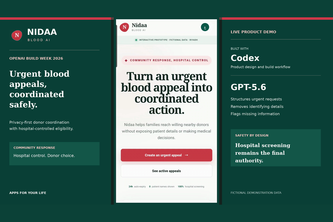
Nidaa Blood AI is a self-reported prototype built by one developer for a hackathon (OpenAI 2026) that aims to streamline hospital blood appeals using natural language processing and AI. It allows hospitals or requesters to submit urgent, structured, time-limited alerts in Arabic or English, which are then parsed into standardized fields while preserving privacy and removing patient identifiers.
What changed
The project is a proof-of-concept prototype submitted to a hackathon. No commercial product, revenue, customers, or operational traction are evidenced.
Single most important open question
Is there evidence of hospital partnerships, verified use cases, or any pathway toward production deployment?
What The Product Actually Is
The description states that Nidaa Blood AI is a mobile-first prototype built with React and GPT-5.6, designed to convert natural-language hospital blood requests into structured, privacy-safe, time-limited community appeals.
It supports Arabic and English inputs and includes features such as:
- Structuring of hospital request data (blood group, number of donors, deadline, area)
- Removal of patient-identifying information
- Review and editing before publishing
- Automatic expiry of alerts
- Opt-in donor notification system
The prototype uses Codex and GPT-5.6 during development to design workflows, privacy rules, and safety language.
It is described as a coordination bridge, not a replacement for hospital or medical services.
Claim: The product is a working prototype built with AI tools.
Evidence: Author states they used Codex and GPT-5.6 in building the interface and workflow.
Inference: The system may be capable of handling real-world data if extended beyond demo mode.
Not evidenced: No actual deployment, live data, or integration details provided.
Positioning & Claim Evolution
The author positions Nidaa Blood AI as a safer coordination mechanism between hospitals and community donors in urgent blood needs.
Key claims:
- It reduces delays in donor response by quickly distributing verified alerts.
- It operates under hospital control, with no medical decision-making done by the platform.
- It is designed for conflict-affected or underserved areas where access to blood is limited.
- It avoids exposing patient identity and ensures privacy-safe communication.
The project evolved from a personal idea of a general practitioner who wanted to explore safer coordination in healthcare settings.
Claim: The system improves coordination between hospitals and donors.
Evidence: Author describes the need for faster response times and safer information sharing.
Inference: It could reduce reliance on informal networks like social media or phone calls.
Not evidenced: No data or user feedback to support this claim.
Target Customer & ICP
The primary target customer is hospitals or medical institutions that issue urgent blood appeals, especially in resource-constrained or conflict-affected regions.
Secondary users include:
- Community members who opt-in to receive alerts
- Blood banks, potentially as partners or end-users
The author notes that the system is designed for low-bandwidth environments, suggesting a focus on areas with limited connectivity.
Claim: Hospitals are the main users.
Evidence: The description says requesters write in Arabic or English and the workflow is hospital-controlled.
Inference: The system targets underserved or conflict zones.
Not evidenced: No specific geographic or demographic data provided.
Business Model & Pricing Evidence
There is no evidence of a business model, pricing structure, monetization strategy, or revenue streams in the description.
The author mentions that future versions may include:
- Verified request intake
- Donor accounts
- Legal and security reviews
- SMS-based alerts
But no indication of how these features would be monetized or whether any commercialization plan exists.
Claim: No business model is described.
Evidence: The description does not mention pricing, subscriptions, fees, or revenue generation.
Technical & Delivery Signals
The prototype was built using:
- React
- Codex and GPT-5.6
- Vite, CSS, JavaScript
- Responsive design for mobile-first experience
It includes:
- Bilingual support (Arabic/English)
- Structured data parsing from natural language
- Privacy controls and automatic expiry
- User journey with editable fields and review steps
Claim: The system uses AI to parse and structure requests.
Evidence: Author states GPT-5.6 was used for workflow design and testing.
Inference: The prototype may scale with more robust backend systems.
Not evidenced: No mention of scalability, infrastructure, or production readiness.
Traction & Maturity Signals
There is no evidence of:
- Customers
- Revenue
- Product usage
- Partnerships
- Live deployments
- Iteration history beyond the hackathon prototype
The project is described as a public prototype built for a hackathon and uses fictional data.
Claim: No traction or maturity signals are evident.
Evidence: The description explicitly says it's a demo, not a live product.
Competitive Context
There is no evidence of competitors or market analysis in the description. The author does not reference existing platforms or tools for blood donation coordination.
Claim: No competitive landscape is described.
Evidence: No mention of similar products or services.
Open Questions & Risks
- No verified hospital partnerships or real-world use cases
- Single-person team raises concerns about scalability and execution
- Prototype-only status suggests no production-ready system
- Privacy and legal compliance are mentioned but not demonstrated in practice
- AI dependency (Codex, GPT-5.6) may not be sustainable or scalable without further development
Inference: The project lacks operational maturity.
Not evidenced: No evidence of risk mitigation strategies.
Questions the description leaves open
- Have you engaged with any hospitals or blood banks for testing or feedback?
- What is the plan to ensure legal compliance in different jurisdictions?
- How will the system handle edge cases like unclear or incomplete requests?
- Is there a roadmap for moving from prototype to production?
- What are the technical and operational risks of scaling this system?
- Are there any plans for monetization or long-term sustainability?
Overall Assessment
Not evidenced: No commercial traction, revenue, or partnership data exists.
This is a self-reported hackathon prototype, not a product in development or deployment.
Claim: Not ready for investment or partnership.
Evidence: The description indicates no live system, no customers, and no business model.
Inference: If extended with hospital partnerships and backend infrastructure, it could evolve into a viable solution.
Not evidenced: No evidence of such evolution or intent.
User Stories BotA demo video on every pull request
Get a demo video on every new feature
GitHub App that watches your pull requests and records a narrated, captioned demo.
Save time on demo prep and make informed decisions faster with a video walkthrough of every new feature.
Source
Submitted to the OpenAI 2026 hackathon on Devpost. Project home on Devpost. Back to the full gallery on Devpost.
This competitive analysis was produced by top-founders.com (opens in a new tab)
Generated by a language model from this project's public Devpost page — its tagline, the author's own write-up and any built-with tags listed there — as captured in August 2026. Short quotations are the author's words. It is an opinion on the idea as a business, not on the people behind it, and it reflects the description as published then. If the project has moved on, request a correction below. The analysis is not independent research and contains no verified traction, revenue or customer data.
An independent guide by KFG International LLC — not affiliated with, endorsed by, or connected to Devpost or OpenAI.