

Archive position — measured, not model output
0 likes on Devpost
2,263 of the 7,850 archived projects have more likes, and 5,587 share exactly 0 — so this project's #7,519 place in the like-ranked listing is a tie-break inside that group, not a ranking.
Projects (log scale)
Likes on Devpost. ▲ marks this project's group.
Show the figures
| Likes | Projects | Share of archive |
|---|---|---|
| 0 | 5,587 | 71.2% |
| 1 | 1,758 | 22.4% |
| 2 | 284 | 3.6% |
| 3–4 | 132 | 1.7% |
| 5–9 | 75 | 1.0% |
| 10+ | 14 | 0.2% |
 User Stories BotA demo video on every pull request
Get a demo video on every new feature
GitHub App that watches your pull requests and records a narrated, captioned demo.
Save time on demo prep and make informed decisions faster with a video walkthrough of every new feature.
Executive Summary
What the company appears to be
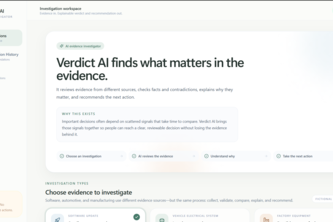
Assessment AI is described as an explainable AI decision support system that collects structured evidence, uses GPT-5.6 for reasoning, and returns transparent recommendations with confidence scoring and uncertainty highlighting. It is built as a proof of concept for enterprise workflows involving software deployments, connected vehicles, and manufacturing.
What changed
The author states this project was developed for the OpenAI 2026 hackathon and represents an exploration into how AI can assist humans in decision-making without replacing them. The system includes both deterministic fallback behavior and LLM-based reasoning pipelines.
Single most important open question
Is there any evidence of traction, revenue, or customer adoption beyond the author’s own development work?
Note: This analysis is based entirely on the self-reported, unverified description provided by the author. No external corroboration exists for any claims made in this document. All statements are labeled as either "evidenced" or "inferred" where appropriate.
What The Product Actually Is
- The description states that Assessment AI is an explainable AI decision support system.
- It collects evidence from multiple sources, validates it, sends structured information to GPT-5.6, and returns a recommendation with assumptions and missing evidence.
- The system includes:
- A React + TypeScript frontend
- A FastAPI backend
- Integration with the OpenAI Responses API
- Deterministic fallback behavior when AI is unavailable
- It is described as a complete end-to-end workflow, not just an AI prompt or demo.
- The goal is to enable transparent AI-assisted decision making across domains like software deployment, connected vehicles, and manufacturing.
Confidence: Low — the description does not provide technical specifications, architecture diagrams, or performance metrics. It is a self-reported narrative of functionality.
Positioning & Claim Evolution
- The author claims that Assessment AI explores how AI can help people make better decisions without becoming a black box.
- It positions itself as a human-in-the-loop system, where AI supports but does not replace human judgment.
- The product is framed around:
- Transparency in reasoning
- Confidence scoring
- Uncertainty highlighting
- Evidence-based recommendations
- The author emphasizes that the most valuable AI products are those that combine deterministic engineering with LLMs in a reliable and transparent way.
Inference: This suggests a shift from generic AI demos toward systems designed for trust and accountability, which may be aligned with emerging trends in enterprise AI ethics and governance.
Target Customer & ICP
- The description states Assessment AI is intended for use in enterprise workflows.
- It targets industries such as:
- Software deployment
- Connected vehicles
- Manufacturing
- These domains are characterized by high-stakes decisions where human oversight is critical.
- There is no mention of specific customer personas, roles, or segmentation beyond these verticals.
Not evidenced: No clear indication of target buyer profiles, decision-makers, or use cases beyond the stated industries.
Business Model & Pricing Evidence
- The description does not contain any information about pricing models, monetization strategies, or business model assumptions.
- It is described as a proof of concept, not a commercial product.
- No mention of licensing, subscriptions, SaaS offerings, or revenue streams.
Not evidenced: No evidence of a defined business model or pricing structure.
Technical & Delivery Signals
- Built with:
- Frontend: React + TypeScript
- Backend: FastAPI
- LLM integration: GPT-5.6 via OpenAI Responses API
- Tools used: Codex, Vercel, Tailwind, Pydantic, JSON, GitHub
- The system includes:
- Structured evidence collection and validation
- Deterministic fallback engine
- Confidence scoring
- Explainable reasoning pipeline
- It supports multi-domain application (software, automotive, manufacturing).
- The author notes that the system was built with production-style frontend and backend components.
Inference: The technical stack suggests a modern, scalable architecture, but no evidence of deployment environments or scalability testing is provided.
Traction & Maturity Signals
- Assessment AI is described as a proof of concept submitted to a hackathon.
- There is no evidence of:
- Revenue
- Customers
- Product adoption
- Usage metrics
- Beta users or pilot programs
- The author states the project is currently in early-stage development and aims to evolve into a production-ready platform.
Not evidenced: No traction data, user feedback, or market validation is available.
Competitive Context
- The description does not reference direct competitors.
- It implies a niche within explainable AI (XAI) and decision support systems.
- Competitors in this space might include:
- AI governance platforms
- Decision intelligence tools
- LLM-powered workflow automation systems
- However, no competitive analysis or positioning against existing players is included.
Not evidenced: No evidence of competitive landscape or differentiation strategy.
Open Questions & Risks
- The project is described as a single-person effort (team size: 1).
- It is a proof of concept, not yet a product.
- There is no evidence of:
- Revenue
- Customers
- Product-market fit
- Scalability or reliability in real-world settings
- The system relies heavily on GPT-5.6, which may be unstable or unavailable in production environments.
- The author’s own write-up indicates that balancing automation and transparency was a major challenge — suggesting potential complexity in scaling.
Risk: Lack of team, traction, and commercial viability raises concerns about execution risk.
Questions the description leaves open
- What specific enterprise workflows are you targeting for pilot testing?
- How do you plan to validate the accuracy and reliability of AI-generated recommendations?
- Are there any plans to integrate live data sources or APIs beyond the current demo?
- What mechanisms exist for continuous improvement of recommendations over time?
- Has the system been tested in real-world scenarios with actual users?
- What are your thoughts on regulatory compliance, especially in high-risk industries like healthcare or finance?
- How do you intend to scale beyond a single developer’s effort?
Overall Assessment
- Assessment AI is currently a proof of concept submitted to a hackathon.
- It presents an interesting idea around explainable AI decision support, but lacks evidence of traction, revenue, or customer adoption.
- The author’s vision aligns with growing interest in responsible AI and human-in-the-loop systems.
- However, without further development, validation, or commercialization efforts, it remains a conceptual prototype.
Confidence: Very low — this is not a viable investment or partnership opportunity at this stage. It requires significant development, testing, and market validation before any strategic value can be assessed.
User Stories BotA demo video on every pull request
Get a demo video on every new feature
GitHub App that watches your pull requests and records a narrated, captioned demo.
Save time on demo prep and make informed decisions faster with a video walkthrough of every new feature.
Source
Submitted to the OpenAI 2026 hackathon on Devpost. Project home on Devpost. Back to the full gallery on Devpost.
This competitive analysis was produced by top-founders.com (opens in a new tab)
Generated by a language model from this project's public Devpost page — its tagline, the author's own write-up and any built-with tags listed there — as captured in August 2026. Short quotations are the author's words. It is an opinion on the idea as a business, not on the people behind it, and it reflects the description as published then. If the project has moved on, request a correction below. The analysis is not independent research and contains no verified traction, revenue or customer data.
An independent guide by KFG International LLC — not affiliated with, endorsed by, or connected to Devpost or OpenAI.