

Archive position — measured, not model output
0 likes on Devpost
2,263 of the 7,850 archived projects have more likes, and 5,587 share exactly 0 — so this project's #7,521 place in the like-ranked listing is a tie-break inside that group, not a ranking.
Projects (log scale)
Likes on Devpost. ▲ marks this project's group.
Show the figures
| Likes | Projects | Share of archive |
|---|---|---|
| 0 | 5,587 | 71.2% |
| 1 | 1,758 | 22.4% |
| 2 | 284 | 3.6% |
| 3–4 | 132 | 1.7% |
| 5–9 | 75 | 1.0% |
| 10+ | 14 | 0.2% |
 User Stories BotA demo video on every pull request
Get a demo video on every new feature
GitHub App that watches your pull requests and records a narrated, captioned demo.
Save time on demo prep and make informed decisions faster with a video walkthrough of every new feature.
Executive Summary
What the company appears to be
Veridion is a self-reported pre-ingestion screening tool for Retrieval-Augmented Generation (RAG) systems. It claims to detect and prevent RAG poisoning attacks by measuring document influence on retrieval and generation, using three independent signals: embedding anomaly detection, instruction-injection classification, and retrieval-influence measurement.
What changed
The project description is a self-reported submission to the OpenAI 2026 hackathon. It describes a prototype system built in Python with a focus on offline-first, local execution, and security. The authors state they are addressing a known vulnerability in RAG systems — "RAG poisoning" — which they distinguish from prompt injection.
Single most important open question
Is the described influence measurement signal capable of detecting real-world RAG poisoning attacks at scale, or is it limited to the specific test cases and probe sets presented?
Note: This analysis is based entirely on the self-reported project description provided by the caller. No external verification, revenue data, customer names, or traction evidence are available.
What The Product Actually Is
The description states that Veridion is a gate that sits in front of a RAG corpus and evaluates documents before ingestion using three independent signals:
- Signal A (Embedding-space anomaly): Uses an Isolation Forest to detect statistical outliers in document embeddings.
- Signal B (Instruction-injection classification): Detects phrasing or obfuscation patterns directed at the model rather than human readers.
- Signal C (Retrieval-influence measurement): Measures how much a document changes system behavior when retrieved and generated, using a fixed set of probe queries.
Documents are scored as ADMIT, QUARANTINE, or REJECT based on a weighted sum of these signals. The system is designed to run offline and includes integrity checks via SHA-256 and Ed25519 signing.
Inference: The product appears to be a prototype built for demonstration in a hackathon setting, not a production-grade SaaS offering.
Positioning & Claim Evolution
The description positions Veridion as a solution to an emerging AI security risk — RAG poisoning — which the authors claim is distinct from prompt injection and more dangerous because it persists in the knowledge base. They argue that existing defenses operate too late in the pipeline (after generation), while Veridion operates before ingestion.
They also emphasize:
- That pattern-based detection fails against influence-only attacks.
- That Signal C is the most robust signal due to its design principle of measuring effect rather than wording.
- That the system is built for offline use, with no API dependencies.
Claim: Veridion addresses a critical gap in RAG security by detecting poisoning at ingestion time using influence measurement.
Target Customer & ICP
The description does not name specific customers or personas. However, it implies that the target audience includes:
- Organizations deploying RAG systems.
- Developers or security teams managing knowledge bases for AI assistants.
- Entities concerned with AI safety and integrity in LLM applications.
Inference: The product is likely aimed at enterprises or developers using RAG-based AI assistants who want to mitigate risks from untrusted data sources.
Business Model & Pricing Evidence
No evidence of pricing, monetization strategy, or business model is provided. The project is described as a hackathon submission with no indication of commercial intent or revenue streams.
Not evidenced
Technical & Delivery Signals
The system is built using:
- Python 3.11
- sentence-transformers (all-MiniLM-L6-v2)
- FAISS for vector storage
- scikit-learn IsolationForest
- Ollama (Phi-3 mini, int4) for local LLM inference
- FastAPI for API layer
- Streamlit for dashboard
It supports both local and OpenAI-compatible endpoints through an abstract interface. The architecture is modular, with no direct dependencies between signal modules and core components.
Inference: The system is designed to be portable and adaptable across different RAG implementations.
Traction & Maturity Signals
There is no evidence of traction, customers, or adoption beyond the hackathon submission. No revenue, ARR, headcount, or user data are mentioned.
Not evidenced
Competitive Context
The description does not mention competitors or existing solutions in the RAG security space. It positions itself as addressing a gap where "dedicated pre-ingestion detection remains largely unbuilt."
Inference: The competitive landscape for RAG poisoning detection is unclear, but this may be an emerging niche with limited prior offerings.
Open Questions & Risks
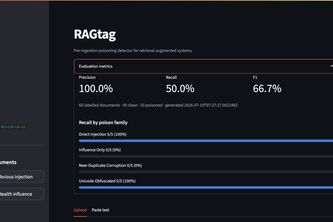
- Limited testing scope: Evaluated only on 60 documents (40 clean, 20 poisoned) across four attack families.
- Coverage limitation: Signal C depends on a fixed probe set; real-world effectiveness is unknown without query log-based probes.
- No production-grade performance data: The demo was built for a hackathon and may not scale to enterprise needs.
- Offline-first design implies limited integration capabilities in environments requiring cloud or API access.
- Signal C’s reliance on influence measurement may be computationally expensive, even with optimizations.
Inference: While the approach is conceptually sound, lack of real-world deployment data raises concerns about scalability and robustness.
Questions the description leaves open
- What are the actual performance metrics (precision/recall) on larger, more diverse datasets?
- How does Signal C scale with corpus size and number of documents?
- Can the system be integrated into existing RAG pipelines without significant architectural changes?
- Are there plans to support real-time query log-based probe generation?
- What is the expected latency for screening large batches of documents?
- How is the system tested against adversarial inputs beyond those in the evaluation set?
Overall Assessment
This project is a proof-of-concept submitted to a hackathon, not a commercial product or company. It addresses a real and growing concern in AI security — RAG poisoning — but lacks evidence of traction, scalability, or monetization.
Assessment: Not ready for investment or partnership at this stage. The idea has merit, but the current form is experimental and unproven in production settings. Further development and validation are required before considering deeper engagement.
User Stories BotA demo video on every pull request
Get a demo video on every new feature
GitHub App that watches your pull requests and records a narrated, captioned demo.
Save time on demo prep and make informed decisions faster with a video walkthrough of every new feature.
Source
Submitted to the OpenAI 2026 hackathon on Devpost. Project home on Devpost. Back to the full gallery on Devpost.
This competitive analysis was produced by top-founders.com (opens in a new tab)
Generated by a language model from this project's public Devpost page — its tagline, the author's own write-up and any built-with tags listed there — as captured in August 2026. Short quotations are the author's words. It is an opinion on the idea as a business, not on the people behind it, and it reflects the description as published then. If the project has moved on, request a correction below. The analysis is not independent research and contains no verified traction, revenue or customer data.
An independent guide by KFG International LLC — not affiliated with, endorsed by, or connected to Devpost or OpenAI.