

Archive position — measured, not model output
0 likes on Devpost
2,263 of the 7,850 archived projects have more likes, and 5,587 share exactly 0 — so this project's #5,553 place in the like-ranked listing is a tie-break inside that group, not a ranking.
Projects (log scale)
Likes on Devpost. ▲ marks this project's group.
Show the figures
| Likes | Projects | Share of archive |
|---|---|---|
| 0 | 5,587 | 71.2% |
| 1 | 1,758 | 22.4% |
| 2 | 284 | 3.6% |
| 3–4 | 132 | 1.7% |
| 5–9 | 75 | 1.0% |
| 10+ | 14 | 0.2% |
 User Stories BotA demo video on every pull request
Get a demo video on every new feature
GitHub App that watches your pull requests and records a narrated, captioned demo.
Save time on demo prep and make informed decisions faster with a video walkthrough of every new feature.
Executive Summary
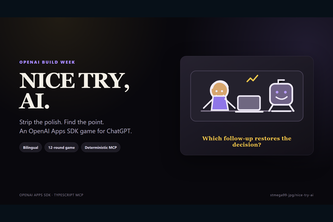
The company appears to be a solo project named NICE TRY, AI, submitted by one individual (S R) as part of the OpenAI 2026 hackathon. The product is described as an interactive game embedded within ChatGPT, designed to help users identify what an AI response actually established after removing rhetorical polish.
The core idea is to teach AI literacy through gameplay: players choose follow-ups that strip away polished language to reveal the substantive content of an AI answer.
What changed: The author describes a self-contained, deterministic game built using OpenAI’s Apps SDK and TypeScript. It includes bilingual question banks (Japanese/English), scoring, explanations, and mobile responsiveness — all running inside ChatGPT via an iframe widget.
Single most important open question: Is there any evidence of traction, revenue, or user adoption beyond the hackathon submission? The project is described as a prototype with no commercial or customer data provided.
Note: This analysis is based solely on the self-reported description supplied by the caller. No external verification, historical data, or third-party sources are available.
What The Product Actually Is
- The description states that NICE TRY, AI is a bilingual game embedded inside ChatGPT.
- It runs as an OpenAI Apps SDK iframe widget, using a TypeScript MCP server for backend logic.
- Players read an AI-generated response and select from four follow-up options to reveal what the original answer actually established.
- The system uses GPT-5.6 in a development-only pipeline for generating questions, with Responses API, Structured Outputs, Zod schema validation, and human review before publishing.
- The game includes features such as:
- Randomized play order
- Scoring and explanations
- Missed-question review
- Language switching (English/Japanese)
- Responsive mobile layout
- Accessible reduced-motion behavior
Inference: The product is a self-contained, deterministic game built for ChatGPT using OpenAI’s tools. It does not appear to be a standalone SaaS offering or a scalable platform.
Positioning & Claim Evolution
- The author positions NICE TRY, AI as a game-based tool for AI literacy, aimed at helping users distinguish between confidence and evidence in AI responses.
- It is described as a way to "teach practical AI-literacy skill without turning the experience into a lecture."
- The tagline reads: “A bilingual game inside ChatGPT where you choose the follow-up that strips away polished AI rhetoric and reveals what the answer actually established.”
- The project claims to address a gap in how people interact with AI — specifically, the tendency of AI responses to sound convincing while failing to fulfill user needs.
Claim vs Fact: These are self-reported claims about intent and positioning. There is no evidence of actual adoption or impact beyond the hackathon submission.
Target Customer & ICP
- The description does not name specific customer segments.
- It implies a target audience interested in AI literacy, critical thinking, or understanding AI behavior.
- The game is embedded within ChatGPT, suggesting it targets ChatGPT users who are already engaged with AI tools.
- The inclusion of both English and Japanese suggests an intent to reach bilingual audiences.
Not evidenced: No explicit customer personas, user research, or segmentation data provided. The ICP remains inferred from the product’s framing.
Business Model & Pricing Evidence
- There is no mention of pricing, monetization, or business model in the description.
- The project is described as a hackathon submission, not a commercial product.
- It uses OpenAI tools (e.g., Apps SDK, GPT-5.6) but does not indicate whether it intends to charge for access or integrate with paid services.
Not evidenced: No evidence of revenue streams, pricing models, or monetization strategy.
Technical & Delivery Signals
- Built using:
- OpenAI Apps SDK
- TypeScript MCP server
- Node.js
- HTML/CSS/JavaScript
- Zod schema validation
- Structured Outputs API
- Responses API
- GPT-5.6 (development-only pipeline)
- The runtime is deterministic, and no OpenAI API key is required during gameplay.
- Includes automated tests (38 total) and independent audit feedback.
- Features include:
- Bilingual question banks
- Session state management
- Inline SVG illustrations
- Mobile responsiveness
- Reduced-motion accessibility
Inference: The technical stack suggests a well-engineered prototype, but the delivery is limited to a single-person project and a hackathon submission.
Traction & Maturity Signals
- The project was submitted to the OpenAI 2026 hackathon.
- No evidence of:
- Revenue
- Customers
- User engagement or adoption
- Product-market fit
- Post-submission development or iteration
Not evidenced: No traction data, usage metrics, or signs of product maturity beyond the initial prototype.
Competitive Context
- The description does not mention competitors.
- It is positioned as a novel approach to AI literacy through gamification.
- There are no references to similar tools or platforms in the market for teaching critical thinking around AI responses.
Not evidenced: No competitive landscape, benchmarking, or market positioning data provided.
Open Questions & Risks
- The project is described as a single-person hackathon submission, with no evidence of team expansion or ongoing development.
- It is embedded in ChatGPT but does not appear to be a scalable SaaS product.
- No commercial viability or monetization strategy is evident.
- The use of GPT-5.6 in a development-only pipeline suggests the game may not be production-ready for broader deployment.
- Lack of user feedback, engagement data, or performance metrics raises questions about real-world utility.
Inference: The project lacks commercial traction and may not be ready for product-market fit or scaling.
Questions the description leaves open
- What is the intended long-term vision for this product beyond the hackathon?
- Are there any plans to expand beyond ChatGPT or integrate with other AI platforms?
- Has the game been tested with real users, and what were their reactions?
- Is there a plan to monetize or scale this concept?
- How would you define success for this product if it were to move beyond prototype?
Overall Assessment
- The project is described as a prototype submitted to a hackathon.
- No evidence of revenue, customers, or traction exists.
- It is not evident that the project has moved beyond the idea stage or has any commercial viability.
Assessment: Not suitable for investment or partnership at this time. This appears to be an experimental concept with no demonstrated market readiness or business model.
User Stories BotA demo video on every pull request
Get a demo video on every new feature
GitHub App that watches your pull requests and records a narrated, captioned demo.
Save time on demo prep and make informed decisions faster with a video walkthrough of every new feature.
Source
Submitted to the OpenAI 2026 hackathon on Devpost. Project home on Devpost. Back to the full gallery on Devpost.
This competitive analysis was produced by top-founders.com (opens in a new tab)
Generated by a language model from this project's public Devpost page — its tagline, the author's own write-up and any built-with tags listed there — as captured in August 2026. Short quotations are the author's words. It is an opinion on the idea as a business, not on the people behind it, and it reflects the description as published then. If the project has moved on, request a correction below. The analysis is not independent research and contains no verified traction, revenue or customer data.
An independent guide by KFG International LLC — not affiliated with, endorsed by, or connected to Devpost or OpenAI.