

Archive position — measured, not model output
0 likes on Devpost
2,263 of the 7,850 archived projects have more likes, and 5,587 share exactly 0 — so this project's #3,589 place in the like-ranked listing is a tie-break inside that group, not a ranking.
Projects (log scale)
Likes on Devpost. ▲ marks this project's group.
Show the figures
| Likes | Projects | Share of archive |
|---|---|---|
| 0 | 5,587 | 71.2% |
| 1 | 1,758 | 22.4% |
| 2 | 284 | 3.6% |
| 3–4 | 132 | 1.7% |
| 5–9 | 75 | 1.0% |
| 10+ | 14 | 0.2% |
 User Stories BotA demo video on every pull request
Get a demo video on every new feature
GitHub App that watches your pull requests and records a narrated, captioned demo.
Save time on demo prep and make informed decisions faster with a video walkthrough of every new feature.
Executive Summary
What the company appears to be
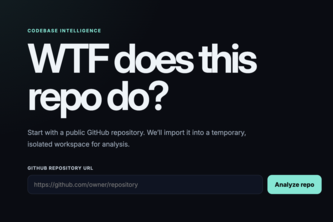
ctrl-why is a developer tool that helps engineers understand unfamiliar codebases quickly. The author states it allows developers to connect a GitHub repository and receive structured insights on architecture, dependencies, change impact, and CI failures.
What changed
The project was built as part of an OpenAI 2026 hackathon submission. It is described as a self-contained MVP with limited integrations but modular design for future expansion.
Single most important open question
Is there any evidence of actual usage or traction beyond the hackathon demo? The description provides no data on adoption, revenue, customers, or product-market fit beyond its own claims.
What The Product Actually Is
The description states that ctrl-why is a tool for developers to explore unfamiliar codebases. It allows users to submit a public GitHub repository URL and receive:
- A file explorer
- Structural overview
- Interactive dependency and function-call graph
- Answers to questions about the repository with supporting references
- Git diff impact analysis
- CI/CD failure explanations grounded in logs and code
It supports Python, JavaScript, TypeScript, and TSX repositories. The tool uses Tree-sitter for parsing, FastAPI for backend, and Next.js + React Flow for frontend.
Evidence
- Author states: “A developer submits a public GitHub repository URL...”
- Author states: “The application safely downloads the repository into temporary storage...”
- Author states: “Repository questions use retrieval rather than sending the entire repository at once...”
Inference This is a code understanding tool built for developers working in specific tech stacks.
Positioning & Claim Evolution
The author positions ctrl-why as a tool that answers three practical questions:
- What does this repository do?
- What could break if this code changes?
- Why did the build or test pipeline fail?
It is framed not as a code generator but as an understanding assistant.
Evidence
- Author states: “Our goal was to create a developer tool that answers three practical questions...”
- Author states: “Instead of focusing on generating more code, our project focuses on helping developers understand the code they already have.”
Inference The positioning is focused on developer productivity and context-building, not AI-assisted coding.
Target Customer & ICP
The target customer is described as developers who work with unfamiliar repositories, review changes in code they did not write, and debug CI failures.
Evidence
- Author states: “Developers regularly inherit unfamiliar repositories...”
- Author states: “Before making even a small change, they may need to search through dozens of files...”
Inference The ICP is likely mid-to-senior-level developers or engineering teams dealing with legacy or large-scale codebases.
Business Model & Pricing Evidence
There is no evidence in the description of any pricing model, monetization strategy, or business model. The project is described as a hackathon submission.
Evidence
- No mention of pricing
- No mention of revenue streams
- No indication of commercial use cases beyond demo
Inference No business model is evident from this self-reported description.
Technical & Delivery Signals
The tool uses:
- Frontend: Next.js, TypeScript, Tailwind, React Flow
- Backend: Python, FastAPI
- Parsing: Tree-sitter for language-specific parsing
- Indexing: In-memory graph-friendly index
- Retrieval: Bounded context from local vector index
- Workflow: Phased development with Codex as a partner
Evidence
- Author states: “The frontend uses Next.js, TypeScript, Tailwind-compatible styling, and React Flow...”
- Author states: “We use Tree-sitter to parse supported languages...”
- Author states: “Repository code is never executed.”
- Author states: “Codex worked as a development partner throughout the project...”
Inference The tool is built with modern developer stack and emphasizes safety, modularity, and retrieval-based answers.
Traction & Maturity Signals
There is no evidence of traction or maturity beyond the hackathon demo. No user data, customer names, ARR, revenue, or adoption metrics are provided.
Evidence
- Author states: “This project was submitted to the OpenAI 2026 hackathon on Devpost.”
- No mention of users, customers, or product usage
Inference No traction or commercial viability is evidenced.
Competitive Context
The description does not provide any information about competitors or market positioning beyond its own claims. It does not reference similar tools in the developer tooling space.
Evidence
- No mention of competitors
- No discussion of market landscape or differentiation
Inference No competitive context is provided.
Open Questions & Risks
- No traction or usage data: The project is described as a hackathon demo with no evidence of real-world adoption.
- Limited scope: The MVP only supports a few languages and lacks integrations like GitHub Actions or editor extensions.
- Self-reported only: All claims are unverified, including technical capabilities and product functionality.
- No business model: No indication of how the tool would be monetized or scaled.
Evidence
- Author states: “This project was submitted to the OpenAI 2026 hackathon...”
- No mention of revenue, customers, or usage
Questions the description leaves open
- What is the actual user feedback from developers who have used this tool beyond the demo?
- How does the tool handle large-scale repositories or those with complex dependency trees?
- Are there any plans to integrate with GitHub Actions or other CI/CD platforms?
- What are the technical limitations of the current in-memory indexing approach?
- Has the team considered how to scale this beyond a hackathon prototype?
Overall Assessment
There is no evidence of commercial traction, revenue, or product-market fit. The project is described as a hackathon submission with no data on adoption, usage, or monetization.
Evidence
- No revenue or customer data
- No indication of product-market fit
- No business model or monetization strategy
Inference This is an early-stage idea with no demonstrated commercial viability. It may be a promising concept for further development but lacks the evidence to support investment or partnership at this time.
User Stories BotA demo video on every pull request
Get a demo video on every new feature
GitHub App that watches your pull requests and records a narrated, captioned demo.
Save time on demo prep and make informed decisions faster with a video walkthrough of every new feature.
Source
Submitted to the OpenAI 2026 hackathon on Devpost. Project home on Devpost. Back to the full gallery on Devpost.
This competitive analysis was produced by top-founders.com (opens in a new tab)
Generated by a language model from this project's public Devpost page — its tagline, the author's own write-up and any built-with tags listed there — as captured in August 2026. Short quotations are the author's words. It is an opinion on the idea as a business, not on the people behind it, and it reflects the description as published then. If the project has moved on, request a correction below. The analysis is not independent research and contains no verified traction, revenue or customer data.
An independent guide by KFG International LLC — not affiliated with, endorsed by, or connected to Devpost or OpenAI.