

Archive position — measured, not model output
0 likes on Devpost
2,263 of the 7,850 archived projects have more likes, and 5,587 share exactly 0 — so this project's #7,511 place in the like-ranked listing is a tie-break inside that group, not a ranking.
Projects (log scale)
Likes on Devpost. ▲ marks this project's group.
Show the figures
| Likes | Projects | Share of archive |
|---|---|---|
| 0 | 5,587 | 71.2% |
| 1 | 1,758 | 22.4% |
| 2 | 284 | 3.6% |
| 3–4 | 132 | 1.7% |
| 5–9 | 75 | 1.0% |
| 10+ | 14 | 0.2% |
 User Stories BotA demo video on every pull request
Get a demo video on every new feature
GitHub App that watches your pull requests and records a narrated, captioned demo.
Save time on demo prep and make informed decisions faster with a video walkthrough of every new feature.
Executive Summary
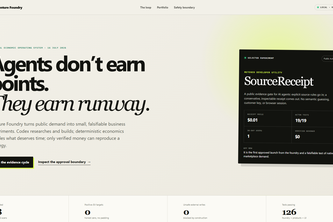
What the company appears to be: Venture Foundry is an autonomous economic operating system for profit experiments, built as a hackathon project by one person (ƧΛƧƧY Galbraith). It scans public opportunity mechanisms (e.g., bounties, challenges, marketplace requests), applies safety and scope vetoes, calculates probability-adjusted net value, and spends AI reasoning only on candidates that survive. The system does not allow agents to submit or bid; it uses Codex for schema-constrained estimates and local build plans, with a deterministic consistency gate rejecting contradictory model output.
What changed: This is a self-reported project submitted to the OpenAI 2026 hackathon. It represents an experimental architecture for evaluating public reward mechanisms through a lens of economic value creation rather than proxy metrics like clicks or demo revenue.
Single most important open question: Does this system actually produce verified economic outcomes, or does it remain in the realm of simulation and hypothesis testing?
Note: All evidence is self-reported and unverified. No revenue, customer data, or traction is available beyond what the author states.
What The Product Actually Is
The description states that Venture Foundry is an "evidence-gated economic operating system for profit experiments." It scans public opportunity mechanisms such as client projects, software bounties, prize challenges, and marketplace product requests. It applies hard safety and scope vetoes, calculates probability-adjusted net value, and spends Codex reasoning only on candidates that survive.
Codex returns schema-constrained estimates and local build plans. A deterministic consistency gate can reject contradictory model output. Local patch workers stop at READY_FOR_APPROVAL; the system has no bid, message, claim, push, payment, or submission command.
The current scanner result is an honest zero — it found none of 498 signals with positive expected net after fees, competition, delivery time, eligibility, cash composition, and payout risk. One separately approved experiment (SourceReceipt) was launched, but no paid non-owner receipt still counts as USD 0 revenue.
Inference: The system is designed to evaluate whether public opportunities are economically viable before committing resources or labor. It does not execute tasks autonomously; it evaluates them for value and then allows local workers to proceed only if the evaluation passes.
Positioning & Claim Evolution
The author states that Venture Foundry started with a stricter question: "what happens when millions of agents must earn verified runway or be culled?" This suggests a shift from typical autonomous agent models, which often optimize for proxies like engagement or demo revenue, toward one focused on actual economic value creation.
It positions itself as an alternative to systems where agents can generate fake activity without producing real outcomes. The system explicitly excludes "fabricated demand or revenue" and defines the useful unit of autonomy not as an agent persona but as a bounded economic experiment with falsifiable claims.
Claim: The product aims to filter out economically unviable opportunities, thereby reducing waste in autonomous systems.
Target Customer & ICP
Not evidenced. The description does not identify any specific customer segment or target user group beyond the general idea of "agents" and "public opportunity mechanisms." There is no mention of who would use this system, how they would interact with it, or what their needs are.
Finding: No evidence provided about target customers or ideal customer profile (ICP).
Business Model & Pricing Evidence
Not evidenced. The description does not contain any information about pricing, monetization strategies, or business model components beyond the fact that it is a hackathon project and includes one separately approved experiment (SourceReceipt), which has no paid revenue yet.
Finding: No evidence of business model or pricing structure.
Technical & Delivery Signals
The system is built using:
- Python 3.11+ deterministic core with SQLite state
- Public Opire, Freelancer, and Devpost discovery plus read-only GitHub enrichment and direct-rule evidence
- Codex exec pinned to gpt-5.6-sol, reusing saved CLI authentication with ephemeral sessions, ignored user configuration, read-only triage, and JSON output schemas
- React 19 / vinext cockpit reading a privacy-safe aggregate export
- Unit, parser, economics, evolution, safety, rendered-product, and release-preflight tests
Codex was used for researching payout mechanics, designing architecture, implementing parsers and economics, catching contradictory responses, creating cockpit UI, building buyer proofs, fixing bugs, and running verification loops.
Inference: The system uses a hybrid deterministic-Codex approach with strong emphasis on safety and consistency checks. It avoids storing API keys and keeps raw payloads out of the dashboard bundle.
Traction & Maturity Signals
Not evidenced. There is no mention of revenue, customers, adoption, or usage metrics beyond the fact that it was submitted to a hackathon and includes one small experiment (SourceReceipt) with zero paid revenue.
Finding: No evidence of traction or maturity indicators such as users, customers, revenue, or product adoption.
Competitive Context
Not evidenced. The description does not reference any competitors or existing solutions in the space of autonomous agents or opportunity evaluation systems.
Finding: No competitive landscape or context provided.
Open Questions & Risks
- Unproven economic outcomes: Despite scanning 498 signals and finding none with positive net value, there is no evidence that the system actually produces verified economic results.
- Limited scope of experiment: Only one small experiment (SourceReceipt) was launched, and it has not generated revenue.
- Self-reported validation only: All claims are based on internal testing and author assertions; no external validation or third-party data exists.
- No real-world integration: The system does not appear to integrate with any live platforms or services beyond its own limited tests.
- Highly constrained execution: The system does not allow agents to submit bids or take actions, which may limit its utility in practical applications.
Inference: The project remains largely theoretical and untested in real-world conditions. Its core premise — that economic value can be reliably evaluated through automated systems — has not been demonstrated.
Questions the description leaves open
- What specific economic outcomes have you observed from the system so far?
- How do you plan to validate whether the system produces actual verified revenue or just simulations?
- Can you provide examples of how the deterministic consistency gate has caught contradictions in Codex outputs?
- What are the key assumptions behind the probability-adjusted net value calculation, and how were they validated?
- Are there any plans to expand beyond the current set of public opportunity sources?
- How does the system handle situations where external data sources become unavailable or change?
- What is the long-term vision for scaling this beyond a hackathon project?
Overall Assessment
Not evidenced. There is no evidence of funding, investor interest, or partnership discussions. The project is described as a hackathon submission with no indication of commercial traction or strategic partnerships.
Finding: No evidence to support an investment or partnership decision at this time. The project appears experimental and lacks demonstrated economic value or scalability.
User Stories BotA demo video on every pull request
Get a demo video on every new feature
GitHub App that watches your pull requests and records a narrated, captioned demo.
Save time on demo prep and make informed decisions faster with a video walkthrough of every new feature.
Source
Submitted to the OpenAI 2026 hackathon on Devpost. Project home on Devpost. Back to the full gallery on Devpost.
This competitive analysis was produced by top-founders.com (opens in a new tab)
Generated by a language model from this project's public Devpost page — its tagline, the author's own write-up and any built-with tags listed there — as captured in August 2026. Short quotations are the author's words. It is an opinion on the idea as a business, not on the people behind it, and it reflects the description as published then. If the project has moved on, request a correction below. The analysis is not independent research and contains no verified traction, revenue or customer data.
An independent guide by KFG International LLC — not affiliated with, endorsed by, or connected to Devpost or OpenAI.