

Archive position — measured, not model output
0 likes on Devpost
2,263 of the 7,850 archived projects have more likes, and 5,587 share exactly 0 — so this project's #7,506 place in the like-ranked listing is a tie-break inside that group, not a ranking.
Projects (log scale)
Likes on Devpost. ▲ marks this project's group.
Show the figures
| Likes | Projects | Share of archive |
|---|---|---|
| 0 | 5,587 | 71.2% |
| 1 | 1,758 | 22.4% |
| 2 | 284 | 3.6% |
| 3–4 | 132 | 1.7% |
| 5–9 | 75 | 1.0% |
| 10+ | 14 | 0.2% |
 User Stories BotA demo video on every pull request
Get a demo video on every new feature
GitHub App that watches your pull requests and records a narrated, captioned demo.
Save time on demo prep and make informed decisions faster with a video walkthrough of every new feature.
Executive Summary
What the company appears to be
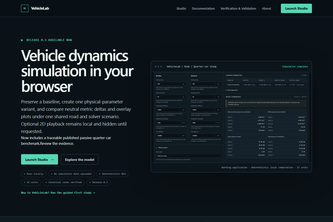
VehicleLab Studio is a browser-native engineering tool for conducting and comparing quarter-car ride-dynamics simulations. It allows users to configure parameters, run deterministic simulations locally in the browser, inspect results, compare configurations, and review validation evidence. The product is described as a learning and exploration platform, not a production or certification tool.
What changed
The project evolved from an initial quarter-car simulation into Release 0.3 of a structured engineering product with features like comparison workflows, motion playback, and reproducible benchmarking. It includes support for numerical verification, traceable evidence, and automated testing.
Single most important open question
Is there any evidence of user adoption or commercial traction beyond the author’s own development efforts?
What The Product Actually Is
The description states that VehicleLab Studio is a browser-native engineering lab for quarter-car ride-dynamics studies. It enables users to:
- Configure parameters such as sprung mass, unsprung mass, suspension stiffness, damping, and tire stiffness
- Choose documented road inputs
- Run deterministic simulations locally in the browser
- Inspect results like displacement, acceleration, suspension-travel, and tire-deflection
- Compare Baseline and Variant A configurations under same conditions
- Replay results through optional SVG motion visualization
- Review governing equations and numerical method
- Inspect generated Verification & Validation evidence
- Reproduce a published passive quarter-car benchmark
The product is built using Astro, React, TypeScript, Web Workers, uPlot, KaTeX, and Cloudflare Workers. It avoids being presented as a production or certification tool.
Inference The system separates physics from UI and uses deterministic numerical methods (Runge–Kutta integration) with float64 precision.
Positioning & Claim Evolution
The author states that VehicleLab Studio was created to bring complete reasoning chain into one transparent browser-based workflow, addressing gaps in how vehicle-dynamics simulation is typically split across textbooks, desktop software, and reports.
It positions itself as a learning and exploration tool rather than a production-grade or certification platform. It explicitly distinguishes between:
- Mathematical verification
- Numerical verification
- Published numerical reproduction
- Physical correlation (not yet performed)
The product also claims to avoid becoming a "black box" by maintaining strict separation between physics and presentation, and by tying all public engineering claims to equations, tests, tolerances, or traceable external evidence.
Inference The positioning reflects an intent to build a transparent, educational, and reproducible simulation environment for engineers and students — not a commercial product for industry use.
Target Customer & ICP
The description does not name specific customer segments or personas. However, it implies that the intended users are:
- Students learning vehicle dynamics
- Engineers exploring quarter-car models
- Researchers needing reproducible simulations
It is described as a tool for "running, comparing, visualizing, and validating" ride studies — suggesting an audience interested in understanding how parameters affect outcomes.
The product avoids targeting production or certification use cases, indicating that its ICP likely centers around education, research, and exploration, not enterprise or industrial applications.
Inference The target customer is likely academic or engineering professionals who value transparency, reproducibility, and learning over deployment or scalability.
Business Model & Pricing Evidence
There is no evidence of pricing, monetization strategy, or business model in the description. The project is described as a self-developed tool for educational and exploratory purposes, not a commercial offering.
Inference No information is provided about whether the product will be sold, offered free, or used internally by a company.
Technical & Delivery Signals
The system is built using:
- Frontend: Astro, React, TypeScript, Zod
- Simulation Engine: Browser Web Worker, deterministic fixed-step fourth-order Runge–Kutta integration
- Visualization: uPlot for charts, KaTeX for equations
- Testing: Vitest, Playwright
- Deployment: Cloudflare Workers Static Assets
- AI Tools Used: GPT-5.6 and Codex for reasoning, architecture design, and validation criteria
The description emphasizes:
- Separation of physics and UI
- Deterministic simulation results
- Traceable evidence and provenance
- Independent numerical references
- Regression protection through automated tests
Inference The technical stack supports a lightweight, browser-based, deterministic simulation with strong emphasis on reproducibility and validation.
Traction & Maturity Signals
The project is described as progressing from an initial simulation to Release 0.3, including:
- Guided learning path
- Baseline-versus-Variant A comparison
- Motion playback
- Reproduction of a peer-reviewed benchmark (5,003 points) within declared tolerances
- Machine-readable evidence and provenance
- Protected numerical regression boundaries
It also includes automated testing for unit, integration, browser, accessibility, and deployment checks.
Inference The project shows signs of iterative development and increasing maturity. However, there is no evidence of users beyond the author or early adopters.
Competitive Context
The description does not mention direct competitors. It does not reference existing tools in the vehicle dynamics simulation space, nor does it describe how VehicleLab Studio differentiates from them.
Inference No competitive landscape is described, which leaves open whether this tool addresses a gap or overlaps with existing solutions.
Open Questions & Risks
- No commercial traction: The project appears to be self-developed without any evidence of users or revenue.
- Limited scope: It focuses on quarter-car models and does not yet support higher-fidelity models or production use cases.
- Unproven market demand: There is no indication that the target audience (students, engineers) has adopted or requested this tool.
- AI dependency: While AI was used for reasoning and architecture, it is not generating simulation conclusions — but reliance on AI tools may raise questions about scalability or long-term viability.
Inference The risk lies in assuming that a self-developed educational tool will translate into a viable commercial product without evidence of market interest or adoption.
Questions the description leaves open
- What is the intended use case for this tool beyond personal development?
- Are there any users or early adopters who have provided feedback on its utility?
- How does the team plan to monetize or scale the product if at all?
- Has the team considered integrating with existing engineering platforms or LMS systems?
- What are the long-term plans for expanding beyond quarter-car models?
- Is there any interest from universities, research labs, or engineering firms in using this tool?
Overall Assessment
Not evidenced.
There is no evidence of revenue, customers, partnerships, or funding rounds. The project appears to be a self-developed educational tool with limited commercial traction.
The author states that the project was submitted to an OpenAI hackathon and does not describe any investment or partnership activity beyond its own development.
Inference Without evidence of users, adoption, or monetization, there is no basis for evaluating whether this represents a viable investment or partnership opportunity.
User Stories BotA demo video on every pull request
Get a demo video on every new feature
GitHub App that watches your pull requests and records a narrated, captioned demo.
Save time on demo prep and make informed decisions faster with a video walkthrough of every new feature.
Source
Submitted to the OpenAI 2026 hackathon on Devpost. Project home on Devpost. Back to the full gallery on Devpost.
This competitive analysis was produced by top-founders.com (opens in a new tab)
Generated by a language model from this project's public Devpost page — its tagline, the author's own write-up and any built-with tags listed there — as captured in August 2026. Short quotations are the author's words. It is an opinion on the idea as a business, not on the people behind it, and it reflects the description as published then. If the project has moved on, request a correction below. The analysis is not independent research and contains no verified traction, revenue or customer data.
An independent guide by KFG International LLC — not affiliated with, endorsed by, or connected to Devpost or OpenAI.