

Archive position — measured, not model output
0 likes on Devpost
2,263 of the 7,850 archived projects have more likes, and 5,587 share exactly 0 — so this project's #7,505 place in the like-ranked listing is a tie-break inside that group, not a ranking.
Projects (log scale)
Likes on Devpost. ▲ marks this project's group.
Show the figures
| Likes | Projects | Share of archive |
|---|---|---|
| 0 | 5,587 | 71.2% |
| 1 | 1,758 | 22.4% |
| 2 | 284 | 3.6% |
| 3–4 | 132 | 1.7% |
| 5–9 | 75 | 1.0% |
| 10+ | 14 | 0.2% |
 User Stories BotA demo video on every pull request
Get a demo video on every new feature
GitHub App that watches your pull requests and records a narrated, captioned demo.
Save time on demo prep and make informed decisions faster with a video walkthrough of every new feature.
Executive Summary
The description states that Vehicle Truth Engine by TransferAuto is a self-reported end-to-end vehicle verification ecosystem integrating live OBD diagnostics, vehicle records, and AI to support pre-purchase checks and ownership transfer workflows. The system includes an OBD scan app, analytics reports, online transaction tools, and a WhatsApp-based AI assistant (DORA). It uses GPT-5.6 to interpret structured evidence into explainable decision workflows.
The author claims the platform is built as a closed-loop intelligence model that improves with use, and that it was developed during a hackathon. There is no evidence of revenue, customers, or traction beyond the project submission itself.
Key open question
What is the actual commercial viability of this ecosystem? The description does not clarify whether there are real users or transactions, nor how the platform intends to monetize its services.
What The Product Actually Is
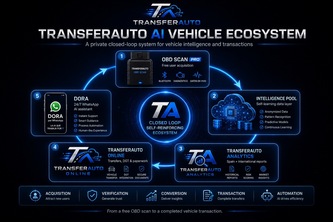
The description states that Vehicle Truth Engine by TransferAuto is an end-to-end vehicle verification ecosystem composed of:
- OBD Scan Pro: A free app for live vehicle diagnostics using OBD-II adapters.
- TransferAuto Analytics: Vehicle reports and verification context, available for Spain and internationally.
- TransferAuto Online: Tools for vehicle transfer, registration, and paperwork workflows.
- DORA: A 24/7 AI assistant on WhatsApp to guide users through support and automation.
The system is described as a connected ecosystem where users can begin with a free scan, verify the vehicle’s history, and complete next steps within the same platform. It integrates live OBD data, vehicle records, and workflow logic using GPT-5.6 to generate structured summaries of knowns, inconsistencies, unknowns, and next actions.
Inference: The system appears designed to be a closed-loop intelligence model that improves with more usage, but no evidence supports whether this has occurred or how it scales.
Positioning & Claim Evolution
The description states the company positions itself as an end-to-end vehicle verification ecosystem, aiming to connect fragmented processes in vehicle buying and transfer. It claims to combine live diagnostics, records, and AI into a single workflow.
It also states that the platform was built during a hackathon and is focused on a new AI layer that transforms raw evidence into explainable decision workflows. The author emphasizes that GPT-5.6 works best when given structured evidence and clear boundaries.
Inference: The positioning suggests a move from isolated tools to an integrated intelligence system, but the claim of “closed-loop” improvement lacks traction or validation.
Target Customer & ICP
The description states that the platform is designed for users who are buying or transferring used vehicles, and that it aims to connect layers of diagnostics, records, paperwork, and support into one workflow. It includes a free utility (OBD Scan Pro) to attract users, with deeper intelligence and transactional tools to convert them.
It also mentions that the next steps include expanding B2B workflows for professionals, suggesting an intent to target both individual consumers and business users.
Inference: The ICP appears to be vehicle buyers and sellers, with a potential expansion toward professionals in the automotive industry. No evidence of actual customer segments or personas is provided.
Business Model & Pricing Evidence
The description states that OBD Scan Pro is free, suggesting a freemium model to attract users. It also mentions that the platform connects diagnostic insights with real vehicle transactions, implying monetization through transactional services or B2B workflows.
There is no mention of pricing tiers, subscription models, or revenue streams beyond the initial free utility and future B2B expansion.
Inference: The business model appears to be based on freemium with potential monetization via transactional services or B2B offerings, but no concrete evidence supports this.
Technical & Delivery Signals
The description states that the system was built as a connected ecosystem, not a single app. It uses:
- OBD Scan Pro for live diagnostics
- TransferAuto Analytics for reports and verification
- TransferAuto Online for workflows
- DORA AI assistant on WhatsApp
- GPT-5.6 API to interpret structured evidence into clear explanations
It also mentions that Codex was used during development to accelerate implementation.
Inference: The technical architecture is described as integrated, but no details are given about scalability, data handling, or backend infrastructure beyond the use of AI and OBD-II.
Traction & Maturity Signals
The description states that this project was submitted to the OpenAI 2026 hackathon, and that it was built during a “Build Week.” It also mentions that the system is designed to improve with more diagnostic interactions and verification workflows, but there is no evidence of actual usage, customers, or revenue.
Inference: The platform is at an early stage (hackathon submission), with no demonstrated traction or maturity in terms of users or adoption.
Competitive Context
The description does not provide any information about competitors, nor does it describe how the product differentiates from existing vehicle verification tools or platforms.
Inference: No competitive positioning or differentiation is evident, and there is no evidence of market analysis or competitive landscape awareness.
Open Questions & Risks
- The platform is described as a hackathon project with no evidence of real users or transactions.
- The use of GPT-5.6 is claimed to work best with structured data, but the description does not clarify how this is managed in practice.
- No pricing model, monetization strategy, or revenue sources are evident.
- There is no indication of technical scalability or infrastructure beyond the described components.
- The platform’s ability to combine noisy OBD data with inconsistent vehicle records and administrative data is questioned, but no mitigation strategies are detailed.
Inference: The project is at a very early stage, and there are significant risks related to commercial viability, technical execution, and market traction.
Questions the description leaves open
- What is the actual user base or customer traction beyond this hackathon submission?
- How does the platform handle inconsistencies between OBD data, vehicle records, and administrative sources?
- What are the specific monetization strategies for both individual users and B2B clients?
- How is the GPT-5.6 integration structured to avoid overconfidence in uncertain data?
- What is the plan for scaling beyond Spain and international markets?
- Are there any partnerships or integrations with vehicle manufacturers, dealerships, or insurance providers?
Overall Assessment
The description states that this is a self-reported hackathon project submitted to the OpenAI 2026 hackathon. There is no evidence of revenue, customers, or traction beyond the author’s own account.
Inference: The platform is in an early conceptual or prototype phase with no demonstrated commercial viability or market readiness. It lacks key signals for investment or partnership consideration at this stage.
User Stories BotA demo video on every pull request
Get a demo video on every new feature
GitHub App that watches your pull requests and records a narrated, captioned demo.
Save time on demo prep and make informed decisions faster with a video walkthrough of every new feature.
Source
Submitted to the OpenAI 2026 hackathon on Devpost. Project home on Devpost. Back to the full gallery on Devpost.
This competitive analysis was produced by top-founders.com (opens in a new tab)
Generated by a language model from this project's public Devpost page — its tagline, the author's own write-up and any built-with tags listed there — as captured in August 2026. Short quotations are the author's words. It is an opinion on the idea as a business, not on the people behind it, and it reflects the description as published then. If the project has moved on, request a correction below. The analysis is not independent research and contains no verified traction, revenue or customer data.
An independent guide by KFG International LLC — not affiliated with, endorsed by, or connected to Devpost or OpenAI.