

Archive position — measured, not model output
1 like on Devpost
505 of the 7,850 archived projects have more likes, and 1,758 share exactly 1 — so this project's #1,618 place in the like-ranked listing is a tie-break inside that group, not a ranking.
Projects (log scale)
Likes on Devpost. ▲ marks this project's group.
Show the figures
| Likes | Projects | Share of archive |
|---|---|---|
| 0 | 5,587 | 71.2% |
| 1 | 1,758 | 22.4% |
| 2 | 284 | 3.6% |
| 3–4 | 132 | 1.7% |
| 5–9 | 75 | 1.0% |
| 10+ | 14 | 0.2% |
 User Stories BotA demo video on every pull request
Get a demo video on every new feature
GitHub App that watches your pull requests and records a narrated, captioned demo.
Save time on demo prep and make informed decisions faster with a video walkthrough of every new feature.
Executive Summary
What the company appears to be
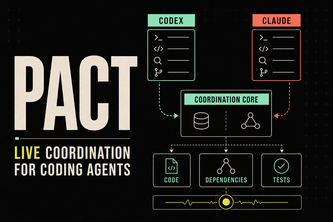
PACT is a self-reported collaboration protocol designed for coding agents, aiming to improve coordination between them in shared codebases. It is described as a live coordination layer that helps agents share intent, detect dependencies, and leave verifiable handoffs before conflicts reach Git.
What changed
The project evolved from an initial question about how a collaboration protocol might be built specifically for coding agents rather than adapted from human chat. The authors report building a reference implementation including CLI, daemon, JSON schemas, MCP bridge, and a benchmarking tool (PACT Bench) to test the hypothesis.
Single most important open question
Is there evidence of real-world usage or integration with actual coding agents beyond the authors’ own experiments? The description states no revenue, customers, or adoption data are available — only self-reported claims about functionality and testing.
What The Product Actually Is
The description states that PACT is a provider-neutral live coordination protocol for coding agents. It allows agents like Codex and Claude to:
- Declare their objective and expected semantic surfaces they will change;
- See active agents and discover overlapping or dependent work;
- Receive compact, relevant project context instead of another agent’s conversation;
- Publish proposed overlays, checkpoints, evidence, and required actions;
- Leave revision-pinned, verifiable handoffs that another agent can resume.
It is described as not storing Git history, but rather storing coordination state that exists before and between commits. Git remains the source of truth for code.
The product includes:
- A versioned JSON Schema and conformance fixtures;
- A dependency-free CLI and local hash-chained daemon;
- Deterministic semantic-surface overlap and typed producer/consumer handoffs;
- Speculative overlays, checkpoints, leases, resume/restart recovery;
- A provider-neutral JavaScript driver and six-tool MCP bridge;
- Shared agent-host lifecycle with thin Codex and Claude launchers;
- A Team HTTP service with isolated credentials and PostgreSQL persistence;
- Docker, Nginx, Terraform, and a live OCI deployment;
- PACT Bench, an experiment harness with immutable, graph-ready results.
Not evidenced No evidence of actual integration or usage by third-party agents beyond the authors’ own testing. No mention of real-world deployments, customer feedback, or production use cases.
Positioning & Claim Evolution
The description states that PACT started from a simple question: “What would a collaboration protocol look like if it were designed for coding agents rather than adapted from human chat?”
It positions itself as:
- A live coordination layer;
- A provider-neutral system (though the authors note this must exist at the protocol and driver boundary, not in marketing copy);
- A solution to semantic collisions that occur when multiple agents work on overlapping parts of a codebase.
The claim has evolved from:
- Initial idea: “what if Git were adapted for agents?”
- To current form: a structured coordination protocol with typed dependencies, checkpoints, and verifiable handoffs.
Inference The evolution suggests an iterative refinement toward a more robust system, but the description does not provide evidence of prior versions or user feedback shaping this progression.
Target Customer & ICP
The description states that PACT is intended for coding agents, such as:
- Codex;
- Claude;
- And future runtimes.
It targets developers working in teams using AI-powered tools who are trying to coordinate changes across shared codebases without relying on Git alone or noisy chat histories.
There is no mention of end-users, enterprise customers, or specific personas beyond the agents themselves.
Not evidenced No evidence of target customer segmentation, user interviews, or adoption by any real users. No indication of whether the product is aimed at individual developers or teams within organizations.
Business Model & Pricing Evidence
The description does not contain any information about:
- Revenue streams;
- Pricing models;
- Monetization strategy;
- Subscription plans or licensing terms.
It also does not state whether PACT will be open-source, commercial, or offered as a service.
Not evidenced No business model or pricing evidence is provided. The project appears to be in early development and has no commercial traction.
Technical & Delivery Signals
The authors report building:
- A reference implementation including CLI, daemon, JSON schemas, MCP bridge, SDK, provider hosts, Team server, benchmark runner, tests, infrastructure, documentation, and public site;
- A PACT Bench experiment harness with immutable, graph-ready results;
- Use of Codex and GPT-5.6 in development;
- Tools built using JavaScript, React, Next.js, Node.js, Docker, Terraform, PostgreSQL, Oracle Cloud Infrastructure, Nginx, MCP, JSON Schema.
The system supports:
- Local mode for one repository and sibling Git worktrees;
- Team mode with shared coordination records stored in a PostgreSQL-backed service;
- Explicit CLI commands for managing Team lifecycle;
- Integration into provider hosts (planned).
Inference The technical stack and architecture suggest a developer-focused tool built using modern web and infrastructure technologies. However, no evidence of production deployment or scalability testing is provided.
Traction & Maturity Signals
The description reports:
- A preliminary counterbalanced pilot comparing Git-only baseline, passive shared ledger, and active PACT coordination;
- Across 12 valid trials, PACT integrated successfully in 3 of 4 trials;
- Git-only and passive ledger both failed in 0 of 4 each;
- PACT detected all four dependencies with no false alerts.
However:
- The denominator is small (only one scenario and four PACT trials);
- The authors note that even successful trials did not guarantee correct implementation by receiving agents;
- No evidence of real-world adoption or usage beyond internal experiments.
Not evidenced No data on customer acquisition, retention, usage metrics, or product-market fit. No mention of any revenue, paying customers, or user feedback loops.
Competitive Context
The description does not provide any information about:
- Direct competitors;
- Indirect substitutes;
- Market positioning relative to existing tools for code collaboration or AI agent coordination.
It implies that current solutions (like Git-based workflows and chat history sharing) are inadequate for agent coordination, but no comparative analysis is given.
Not evidenced No competitive landscape or differentiation strategy is described. No evidence of prior art or market gaps addressed.
Open Questions & Risks
- Lack of real-world usage: The product has only been tested in controlled experiments and not integrated into actual workflows.
- Unclear commercial viability: No pricing, monetization, or revenue model is described.
- Limited team size (2 members): Suggests limited capacity to scale or build out a full product.
- Self-reported success metrics: Results from PACT Bench are preliminary and not validated externally.
- No customer feedback loop: No evidence of user testing or iteration based on external input.
Inference The project is in an early experimental phase, with no clear path to market traction or commercialization. The lack of external validation raises concerns about scalability and real-world utility.
Questions the description leaves open
- What specific problems are you solving for coding agents that current tools like Git or chat logs do not address?
- How many actual agents (not just test cases) have used PACT in practice, and what was their feedback?
- Are there any plans to open-source PACT or offer it as a service? If so, how will you monetize it?
- What are the key assumptions behind your benchmark results, and how do they generalize beyond this one scenario?
- How do you plan to integrate PACT into existing AI agent platforms (e.g., Codex, Claude)?
- What is your roadmap for moving from local mode to full Team mode integration with providers?
Overall Assessment
Self-reported and unverified basis
This analysis is based entirely on the project description provided by the caller — no external data or verification sources are available.
Confidence level Very low. The description contains only self-reported claims, no evidence of traction, revenue, customers, or real-world usage.
Assessment PACT appears to be a conceptual and experimental tool built by two individuals in the context of a hackathon. It shows early-stage technical development and conceptual clarity but lacks any commercial or user validation. There is no evidence of product-market fit, revenue, or adoption beyond internal testing.
Recommendation
If this is a pre-product idea or prototype, further due diligence should focus on:
- Whether the concept has traction in real-world use cases;
- Whether there are early adopters or partners interested in piloting it;
- Whether the team can scale from two people to a viable product organization.
Otherwise, this project is not ready for investment or partnership unless significant progress and validation are demonstrated.
User Stories BotA demo video on every pull request
Get a demo video on every new feature
GitHub App that watches your pull requests and records a narrated, captioned demo.
Save time on demo prep and make informed decisions faster with a video walkthrough of every new feature.
Source
Submitted to the OpenAI 2026 hackathon on Devpost. Project home on Devpost. Back to the full gallery on Devpost.
This competitive analysis was produced by top-founders.com (opens in a new tab)
Generated by a language model from this project's public Devpost page — its tagline, the author's own write-up and any built-with tags listed there — as captured in August 2026. Short quotations are the author's words. It is an opinion on the idea as a business, not on the people behind it, and it reflects the description as published then. If the project has moved on, request a correction below. The analysis is not independent research and contains no verified traction, revenue or customer data.
An independent guide by KFG International LLC — not affiliated with, endorsed by, or connected to Devpost or OpenAI.