

Archive position — measured, not model output
1 like on Devpost
505 of the 7,850 archived projects have more likes, and 1,758 share exactly 1 — so this project's #1,617 place in the like-ranked listing is a tie-break inside that group, not a ranking.
Projects (log scale)
Likes on Devpost. ▲ marks this project's group.
Show the figures
| Likes | Projects | Share of archive |
|---|---|---|
| 0 | 5,587 | 71.2% |
| 1 | 1,758 | 22.4% |
| 2 | 284 | 3.6% |
| 3–4 | 132 | 1.7% |
| 5–9 | 75 | 1.0% |
| 10+ | 14 | 0.2% |
 User Stories BotA demo video on every pull request
Get a demo video on every new feature
GitHub App that watches your pull requests and records a narrated, captioned demo.
Save time on demo prep and make informed decisions faster with a video walkthrough of every new feature.
Executive Summary
What the company appears to be
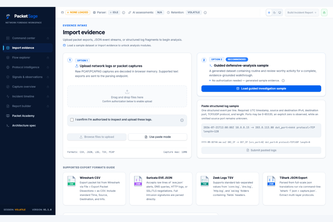
PacketSage is a self-reported network forensics tool that accepts various forms of network evidence (e.g., PCAP, CSV, JSON) and converts them into a structured investigation workspace. It claims to support deterministic signal identification, bounded AI analysis, and analyst-controlled reporting.
What changed
During the OpenAI Build Week hackathon, the author rebuilt the product around a core principle: “evidence before explanation.” This involved removing unreliable identifiers, adding native PCAP decoding, implementing a bounded GPT-5.6 investigation workflow, separating AI inference from deterministic evidence, and ensuring explicit analyst control over report inclusion.
The single most important open question
Is there sufficient evidence that the described architecture and controls are actually implemented in a way that prevents AI from rewriting or exaggerating evidence — as claimed?
What The Product Actually Is
The description states that PacketSage is a network-forensics workspace designed to process authorized network and security evidence. It supports multiple formats including:
- PCAP
- PCAPNG
- Wireshark CSV
- Suricata EVE JSON
- Zeek logs
- TShark JSON
- Strict structured-text records
It performs browser-side decoding for Ethernet, IPv4, IPv6, TCP, UDP, ICMP, and basic DNS metadata.
The tool presents normalized network events, grouped communication flows, DNS/HTTP/TLS records, deterministic suspicious signals, timelines, exact relationships between evidence records, AI assessments, and professional reports.
Key claim
PacketSage does not send raw packet captures or payloads to AI models. Instead, it constructs bounded evidence packets for AI input, which include only selected signals, related flows, events, protocol records, and explicit port provenance.
Inference (based on description)
The system appears to be built with a focus on separating observed data from AI-generated interpretations, using deterministic identities and strict boundaries in how AI is invoked.
Positioning & Claim Evolution
Self-reported positioning
PacketSage positions itself as an evidence-grounded network investigation tool that balances the precision of packet analysis with the interpretability of AI-assisted insights.
It aims to sit between traditional packet-analysis tools (which can overwhelm users) and generic AI tools (which may produce uncertain or misleading explanations).
Claim evolution
The author notes that the original version was not defensible enough for a cybersecurity product. Key changes during Build Week included:
- Replacing unstable identifiers with deterministic ones
- Removing demo signal leakage and fabricated findings
- Adding native PCAP decoding
- Implementing bounded AI workflows
- Separating AI inference from deterministic evidence
- Making report inclusion an analyst-controlled decision
Inference The evolution reflects a shift from a proof-of-concept to a more structured, defensible approach focused on trustworthiness and transparency in AI use.
Target Customer & ICP
Self-reported target customer
Cybersecurity analysts working with network forensics, particularly those who need to reconstruct incidents, review suspicious behavior, and generate reports from technical evidence.
ICP (Ideal Customer Profile)
Not explicitly defined. However, the tool seems aimed at professionals in incident response, digital forensics, or security operations centers where precise evidence handling is critical.
Inference Given its focus on deterministic signals and AI-assisted but bounded analysis, it likely targets mid-to-senior-level practitioners who value accuracy over speed or automation.
Business Model & Pricing Evidence
Self-reported business model
Not stated. The project description does not mention any pricing structure, monetization strategy, or commercial use case beyond personal development and hackathon submission.
Inference There is no evidence of a commercial model at this stage; the tool appears to be a prototype or early-stage product.
Technical & Delivery Signals
Technology stack (as declared by author)
analysis, api, cybersecurity, dns, evidence, express.js, forensics, gpt-5.6, incident, ipv4, ipv6, network, node.js, openai, pcap, pcapng, react, response, responses, security, tailwind, tls, typescript, vercel, vite
Key technical claims
- Native browser-side decoding for PCAP/PCAPNG
- Deterministic IDs across events, flows, signals, and evidence imports
- Bounded AI input using gpt-5.6-sol model
- Strict schema for AI responses (assessment summary, observed evidence, etc.)
- Citation validation against actual evidence IDs
- Explicit port provenance distinction (observed, unknown, not-applicable)
- Analyst-controlled report inclusion
Inference The system is built with a strong emphasis on structural integrity and separation of concerns between raw data and AI interpretation. The use of Codex for review suggests an iterative engineering process.
Traction & Maturity Signals
Self-reported traction
Not evidenced. No revenue, customers, or adoption metrics are provided.
Maturity signals
- A single developer (Prince Kofi Frimpong Amissah) built the entire solution
- The project was submitted to a hackathon with a tight deadline
- The author conducted an internal audit and made significant revisions during Build Week
Inference This is a very early-stage prototype, likely not yet in production or used by external users. It has undergone rapid iteration but lacks real-world testing or validation.
Competitive Context
Self-reported competitive landscape
Not described. No mention of existing tools or platforms in the network forensics or cybersecurity space.
Inference The tool appears to address a niche within cybersecurity where traditional packet analysis tools are powerful but difficult for junior analysts, while AI tools may lack precision or trustworthiness. It could compete with tools like Wireshark, Zeek, Suricata, or forensic platforms that integrate AI.
Open Questions & Risks
Open questions
- The entire system is built by one person (team size = 1)
- No evidence of real-world usage, testing, or customer feedback
- Claims about AI behavior and data handling are unverified
- The project was submitted to a hackathon with limited time constraints
- No mention of compliance, privacy policies, or security certifications
Risks
- Lack of independent verification of claims around AI control and evidence integrity
- Risk of overpromising on technical rigor without real-world validation
- Dependency on a single individual for development and maintenance
- Unclear path to scalability or commercial viability
Questions the description leaves open
- How was the deterministic identity system implemented? Can you provide examples of how it prevents duplicate or conflicting references?
- What specific mechanisms ensure that AI responses are validated against actual evidence IDs, and what happens when a citation cannot be matched?
- Has the bounded AI workflow been tested with real-world network captures to confirm its effectiveness?
- How does the tool handle edge cases such as malformed packets or unsupported protocols?
- Are there any plans for integrating additional AI models or expanding support for other evidence formats beyond those listed?
- What is the current architecture of the application, and how are trust boundaries enforced in practice?
Overall Assessment
Assessment Not evidenced.
The project description provides a detailed account of a self-reported prototype built under tight time constraints. While it shows strong intent and technical rigor around evidence integrity and AI control, there is no evidence of traction, revenue, or real-world deployment.
This appears to be an early-stage idea with potential, but not yet a viable investment or partnership opportunity without further validation.
Confidence level Low — based on self-reported claims only, with no external verification or demonstration of functionality.
User Stories BotA demo video on every pull request
Get a demo video on every new feature
GitHub App that watches your pull requests and records a narrated, captioned demo.
Save time on demo prep and make informed decisions faster with a video walkthrough of every new feature.
Source
Submitted to the OpenAI 2026 hackathon on Devpost. Project home on Devpost. Back to the full gallery on Devpost.
This competitive analysis was produced by top-founders.com (opens in a new tab)
Generated by a language model from this project's public Devpost page — its tagline, the author's own write-up and any built-with tags listed there — as captured in August 2026. Short quotations are the author's words. It is an opinion on the idea as a business, not on the people behind it, and it reflects the description as published then. If the project has moved on, request a correction below. The analysis is not independent research and contains no verified traction, revenue or customer data.
An independent guide by KFG International LLC — not affiliated with, endorsed by, or connected to Devpost or OpenAI.