

Archive position — measured, not model output
0 likes on Devpost
2,263 of the 7,850 archived projects have more likes, and 5,587 share exactly 0 — so this project's #7,424 place in the like-ranked listing is a tie-break inside that group, not a ranking.
Projects (log scale)
Likes on Devpost. ▲ marks this project's group.
Show the figures
| Likes | Projects | Share of archive |
|---|---|---|
| 0 | 5,587 | 71.2% |
| 1 | 1,758 | 22.4% |
| 2 | 284 | 3.6% |
| 3–4 | 132 | 1.7% |
| 5–9 | 75 | 1.0% |
| 10+ | 14 | 0.2% |
 User Stories BotA demo video on every pull request
Get a demo video on every new feature
GitHub App that watches your pull requests and records a narrated, captioned demo.
Save time on demo prep and make informed decisions faster with a video walkthrough of every new feature.
Executive Summary
What the company appears to be
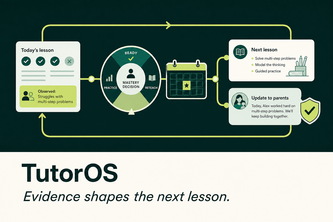
TutorOS is a self-reported tool for independent tutors that uses AI to support evidence-grounded teaching decisions and parent communication. The project is described as a demo-only application built with Next.js, React, TypeScript, and OpenAI APIs, including GPT-5.6.
What changed
The author states this is a hackathon submission (OpenAI 2026) and that the tool was built to explore how AI can be used in tutoring while maintaining evidence integrity and human oversight. It includes a deterministic core for mastery tracking and a "Honesty Gate" to prevent AI-generated content from drifting from observed evidence.
The single most important open question
Is there any evidence of real-world adoption, usage or traction by independent tutors? The description makes no claims about revenue, customers, or actual deployment beyond the demo.
Note
This analysis is based entirely on the self-reported project description provided by the author. No external verification, archived data, or third-party sources are available. All findings are derived from the information explicitly stated in the submission.
What The Product Actually Is
The description states that TutorOS is a system designed for independent tutors to make teaching decisions based on evidence and provide honest parent updates. It separates AI-generated content (e.g., drafts) from deterministic decision-making components such as mastery tracking, review scheduling, and trajectory planning.
Key technical elements include:
- A deterministic core for handling lesson context, session evidence, and mastery.
- GPT-5.6 used optionally to generate structured editable drafts when a server key is present; otherwise, it uses a clearly labeled local mock.
- The Honesty Gate ensures AI output does not stray from observed evidence.
- Human sign-off remains deterministic before any parent update is approved.
Claim
The system allows tutors to record outcomes and observations in an editable log, then generates next-session briefs and parent reports based on this data.
Evidence Yes — described in the write-up under "How it looks".
Claim
The Honesty Gate blocks invented citations, generic praise, softened mastery language, and omitted difficulties.
Evidence Yes — stated in the architecture section.
Claim
Any edit revokes stale sign-off.
Evidence Yes — described in the write-up under "How it looks".
Claim
The complete judge path runs with fictional data and no external model call.
Evidence Yes — explicitly mentioned.
Positioning & Claim Evolution
The author positions TutorOS as a tool that supports evidence-grounded teaching decisions and honest parent updates for independent tutors. It emphasizes integrity in AI use by separating generation from decision-making, ensuring that AI outputs are editable but tied to real observations.
Claim
The tool is built around the idea that model output should be useful as an editable draft inside deterministic boundaries.
Evidence Yes — stated directly in “What I learned”.
Claim
Evidence provenance needs to travel as data.
Evidence Yes — also from “What I learned”.
Claim
Human sign-off only has meaning when tied to the current evidence version.
Evidence Yes — again from “What I learned”.
Claim
A credential-free demo is stronger when it visibly explains what is simulated instead of hiding the runtime boundary.
Evidence Yes — also from “What I learned”.
This positioning reflects an early-stage, experimental approach focused on integrity and human control over AI use in education.
Target Customer & ICP
The description identifies independent tutors as the primary target audience. The system is designed to help them make teaching decisions based on evidence and communicate honestly with parents.
Claim
Independent tutors are the intended users.
Evidence Yes — stated in tagline and throughout the write-up.
Claim
The tool supports tutors who want to base decisions on observed outcomes rather than assumptions or generic feedback.
Evidence Yes — implied through the architecture and emphasis on evidence integrity.
Claim
The system is intended for use before adding persistence or real learner records.
Evidence Yes — mentioned in “What’s next”.
No further segmentation or ICP details are provided beyond this.
Business Model & Pricing Evidence
There is no explicit mention of pricing, business model, monetization strategy, or customer acquisition plans in the description.
Claim
There is no evidence of a defined business model or pricing structure.
Evidence Not evidenced — the description does not contain any information about revenue streams, subscriptions, or pricing models.
Technical & Delivery Signals
The project was built using Next.js 16, React 19, TypeScript, Zod, Vitest, OpenAI Responses API, GPT-5.6, Codex, GitHub Actions, and Vercel. It includes CI/CD checks, security headers, privacy guidance, and 74 tests.
Claim
The project uses modern web technologies including Next.js, React, TypeScript, Zod, Vitest, and OpenAI APIs.
Evidence Yes — listed in both tagline and “Built with” section.
Claim
It includes CI/CD checks, security headers, privacy guidance, and 74 tests.
Evidence Yes — described in the “Accomplishments” section.
Claim
The demo is publicly accessible via Vercel.
Evidence Yes — mentioned in “How judges can test it”.
Claim
The source code is public and includes setup instructions, benchmarks, and methodology.
Evidence Yes — referenced in the repository link.
Traction & Maturity Signals
There is no evidence of real-world usage, customer adoption, or traction beyond the demo and benchmark tests. The project is described as a hackathon submission with no mention of actual deployment or user base.
Claim
There is no evidence of revenue, customers, or user engagement.
Evidence Not evidenced — the description makes no claims about real-world usage or adoption.
Claim
The system has not yet added persistence or real learner records.
Evidence Yes — explicitly stated in “What’s next”.
Competitive Context
No competitive landscape is described. There are no references to existing tools, competitors, or market positioning beyond the author's own claims.
Claim
No information about competitors or market context.
Evidence Not evidenced — the description does not reference any other products or markets.
Open Questions & Risks
- The project is described as a hackathon submission with no real-world deployment or traction.
- It has not yet implemented persistence or real learner records, suggesting it's in an early experimental phase.
- No evidence of revenue, customers, or monetization strategy.
- The system relies heavily on human sign-off and deterministic logic, which may limit scalability or automation potential.
Inference If the tool is only used in demo mode, its utility for actual tutoring workflows is unclear.
Evidence Not evidenced — this is an inference drawn from lack of real-world usage data.
Questions the description leaves open
- What specific problems are independent tutors facing that this tool aims to solve?
- How does the Honesty Gate prevent AI-generated content from drifting away from evidence in practice?
- Is there any plan to integrate with existing tutoring platforms or LMS systems?
- What is the timeline for moving beyond demo mode and adding real learner data?
- Are there any privacy or compliance considerations around handling student data?
- How does the system handle edge cases where evidence contradicts AI-generated suggestions?
Overall Assessment
At this stage, TutorOS appears to be a proof-of-concept or early-stage prototype developed for a hackathon. There is no evidence of traction, revenue, customers, or a defined business model.
Assessment Not ready for investment or partnership at this time.
Reasoning
The description lacks any indication of real-world usage, monetization, or customer validation. It remains an experimental tool with no demonstrated path to market adoption or scalability.
Confidence Level Low — based on the limited self-reported evidence provided.
User Stories BotA demo video on every pull request
Get a demo video on every new feature
GitHub App that watches your pull requests and records a narrated, captioned demo.
Save time on demo prep and make informed decisions faster with a video walkthrough of every new feature.
Source
Submitted to the OpenAI 2026 hackathon on Devpost. Project home on Devpost. Back to the full gallery on Devpost.
This competitive analysis was produced by top-founders.com (opens in a new tab)
Generated by a language model from this project's public Devpost page — its tagline, the author's own write-up and any built-with tags listed there — as captured in August 2026. Short quotations are the author's words. It is an opinion on the idea as a business, not on the people behind it, and it reflects the description as published then. If the project has moved on, request a correction below. The analysis is not independent research and contains no verified traction, revenue or customer data.
An independent guide by KFG International LLC — not affiliated with, endorsed by, or connected to Devpost or OpenAI.