

Archive position — measured, not model output
1 like on Devpost
505 of the 7,850 archived projects have more likes, and 1,758 share exactly 1 — so this project's #1,537 place in the like-ranked listing is a tie-break inside that group, not a ranking.
Projects (log scale)
Likes on Devpost. ▲ marks this project's group.
Show the figures
| Likes | Projects | Share of archive |
|---|---|---|
| 0 | 5,587 | 71.2% |
| 1 | 1,758 | 22.4% |
| 2 | 284 | 3.6% |
| 3–4 | 132 | 1.7% |
| 5–9 | 75 | 1.0% |
| 10+ | 14 | 0.2% |
 User Stories BotA demo video on every pull request
Get a demo video on every new feature
GitHub App that watches your pull requests and records a narrated, captioned demo.
Save time on demo prep and make informed decisions faster with a video walkthrough of every new feature.
Executive Summary
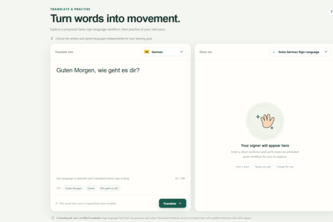
What the company appears to be: Noima is a self-reported project that claims to convert text into 3D hand-sign animations using computer vision, natural language processing, and pose estimation. It integrates with SignSuisse lexicons for Swiss sign language and allows users to record their own signing practice, which is then evaluated against reference poses using dynamic time warping.
What changed: The project was submitted as part of an OpenAI hackathon in 2026. There is no evidence of prior development or commercial activity beyond this submission.
Single most important open question: Is there any evidence that Noima has achieved product-market fit, traction, or revenue generation? The description contains no data on users, adoption, monetization, or market validation.
What The Product Actually Is
The description states that Noima:
- Detects user input language and translates it into Italian, German, or French.
- Renders a simplified 3D skeletal pose animation in Swiss sign language (SGG/SSR/SLF).
- Allows users to watch the animation at different speeds, loop parts, and mirror the view.
- Enables users to record their own signing practice via webcam.
- Provides feedback on recording quality using MediaPipe and DTW comparison.
The system uses:
- Flask and Python for backend API and translation pipeline
- JigsawStack for automatic language detection and translation
- SignSuisse pose lexicons for Swiss sign-language motion
- Three.js for real-time skeletal rendering
- MediaPipe Tasks Vision for webcam tracking
- Dynamic Time Warping (DTW) for motion-sequence comparison
Not evidenced: The actual functionality beyond the described architecture, including whether it works as claimed or how accurate its translations and pose generation are.
Positioning & Claim Evolution
The author states that Noima:
- Converts text into clear, expressive hand signs instantly.
- Is inspired by a desire to build something impressive for resumes.
- Was built during a hackathon with no prior development history.
- Uses the Greek word "νόημα" (meaning/message) as its name, referencing sign language.
The project positions itself as a tool for translating text into sign language and offering practice feedback. It does not claim to be a commercial product or service but rather an experimental hackathon submission.
Not evidenced: Any positioning strategy beyond the author’s personal motivation or marketing claims; no evidence of target audience alignment or competitive differentiation.
Target Customer & ICP
The description states that Noima:
- Translates text into Swiss sign language (SGG/SSR/SLF).
- Allows users to record and evaluate their own signing practice.
- Provides feedback on timing, arm trajectory, hand shape/path, and upper body movement.
It appears aimed at individuals learning or practicing Swiss sign language, particularly those interested in self-paced learning with visual feedback.
Not evidenced: Specific customer segments, user personas, or evidence of actual users beyond the author’s personal use case.
Business Model & Pricing Evidence
The description does not contain any information about:
- Revenue streams
- Pricing models
- Monetization strategy
- Paid features or subscriptions
- Customer acquisition costs
Not evidenced: No indication of how this would be monetized or whether it is intended as a paid product.
Technical & Delivery Signals
The system architecture includes:
- End-to-end layers from text input to pose rendering
- Use of Flask, Python, Three.js, MediaPipe, JigsawStack, and SignSuisse datasets
- Asynchronous translation jobs with polling UI updates
- Canonical pose representation using normalized coordinates
- Local webcam analysis without uploading raw video
- Motion feature extraction and constrained DTW for comparison
Not evidenced: Performance benchmarks, scalability, or production deployment details.
Traction & Maturity Signals
The description states that:
- This is a hackathon project submitted to the OpenAI 2026 hackathon.
- The team consists of one person (Sean Yong).
- There is no mention of users, customers, revenue, or adoption metrics.
Not evidenced: Any evidence of traction, growth, or maturity beyond the initial prototype phase.
Competitive Context
The description mentions:
- Inspiration from projects like Prompt2Sign and spoken-to-signed-translation.
- Use of SignSuisse pose lexicons for Swiss sign language.
- Integration with open-source tools and libraries such as MediaPipe and Three.js.
Not evidenced: Direct competitors, market size, or competitive positioning in the broader sign-language translation or educational technology space.
Open Questions & Risks
Key risks identified from the self-reported description:
- Unproven commercial viability: No evidence of revenue, customers, or product-market fit.
- Single-person team: Limited capacity for scaling or development beyond prototype stage.
- Hackathon origin: Likely not a mature product or business model.
- No independent validation: All claims are self-reported with no external verification.
- Technical complexity without demonstration: The system is described in detail but lacks evidence of real-world performance or accuracy.
Not evidenced: Any risk mitigation strategies, market demand, or technical validation beyond the author’s own account.
Questions the description leaves open
- What specific problems are you solving for users?
- Have you tested the accuracy of your translation and pose generation in real-world conditions?
- How do you plan to scale beyond a single developer and hackathon prototype?
- Are there any existing products or services that already solve similar problems?
- Do you have any user feedback or data on how people interact with the system?
- What is your long-term vision for Noima — is it intended as a commercial product?
Overall Assessment
The description indicates that Noima is a self-reported hackathon project with no evidence of traction, revenue, or commercial viability.
It is not evident whether this represents a viable investment opportunity or partnership candidate. The project lacks:
- Revenue or customer data
- Market validation
- Product-market fit
- Scalable business model
Assessment: Not evidenced as a commercially viable opportunity at this time. The project appears to be an experimental prototype with no demonstrated path to monetization or growth.
User Stories BotA demo video on every pull request
Get a demo video on every new feature
GitHub App that watches your pull requests and records a narrated, captioned demo.
Save time on demo prep and make informed decisions faster with a video walkthrough of every new feature.
Source
Submitted to the OpenAI 2026 hackathon on Devpost. Project home on Devpost. Back to the full gallery on Devpost.
This competitive analysis was produced by top-founders.com (opens in a new tab)
Generated by a language model from this project's public Devpost page — its tagline, the author's own write-up and any built-with tags listed there — as captured in August 2026. Short quotations are the author's words. It is an opinion on the idea as a business, not on the people behind it, and it reflects the description as published then. If the project has moved on, request a correction below. The analysis is not independent research and contains no verified traction, revenue or customer data.
An independent guide by KFG International LLC — not affiliated with, endorsed by, or connected to Devpost or OpenAI.