

Archive position — measured, not model output
0 likes on Devpost
2,263 of the 7,850 archived projects have more likes, and 5,587 share exactly 0 — so this project's #3,500 place in the like-ranked listing is a tie-break inside that group, not a ranking.
Projects (log scale)
Likes on Devpost. ▲ marks this project's group.
Show the figures
| Likes | Projects | Share of archive |
|---|---|---|
| 0 | 5,587 | 71.2% |
| 1 | 1,758 | 22.4% |
| 2 | 284 | 3.6% |
| 3–4 | 132 | 1.7% |
| 5–9 | 75 | 1.0% |
| 10+ | 14 | 0.2% |
 User Stories BotA demo video on every pull request
Get a demo video on every new feature
GitHub App that watches your pull requests and records a narrated, captioned demo.
Save time on demo prep and make informed decisions faster with a video walkthrough of every new feature.
Executive Summary
What the company appears to be
ContinuityIQ is a self-reported proof-of-concept tool built for the OpenAI 2026 hackathon. The author describes it as an "evidence-backed continuity intelligence" system that uses synthetic data and GPT-5.6 to identify hidden organizational risks when critical employees become unavailable.
What changed
The project is presented as a narrow MVP, built in a hackathon context, with no production integrations or real-world deployment claimed. It focuses on revealing what breaks if an employee leaves tomorrow, using structured AI workflows and deterministic validation gates.
Single most important open question — the commercial due-diligence read
Is there evidence that this concept has traction or demand beyond a hackathon demo? The description states no revenue, customers, or adoption data exist. The author explicitly notes that the tool is not production-ready and lacks enterprise integrations or authentication systems.
What The Product Actually Is
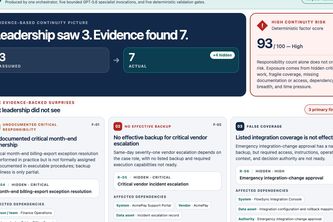
The description states that ContinuityIQ is a system designed to reveal organizational risks when critical employee knowledge disappears. It uses synthetic data and GPT-5.6 to compare leadership's assumed view of an employee’s responsibilities with actual day-to-day work evidence.
It includes:
- A responsibility map comparing official vs. practical ownership.
- An explainable continuity-risk score (93/100).
- Three hidden-risk reveals.
- A Systems & Access Inventory.
- Clickable citations to source records.
- A five-phase, 10-business-day handoff plan.
The system is built using:
- GPT-5.6 specialists in five stages: Document Extraction, Responsibility Classification, Dependency Mapping, Contradiction Detection, and Executive Reporting.
- A server-side Continuity Orchestrator controlling these stages.
- Deterministic validation gates (E1, R1, D1, F1, X1) to ensure output integrity.
- No autonomous agents or external tools beyond GPT-5.6.
The tool is described as a narrow hackathon MVP, not intended for production use or enterprise integration.
Positioning & Claim Evolution
The author positions ContinuityIQ as a solution to a common organizational blind spot: the gap between what leadership believes an employee owns and what they actually do in practice. The tagline, “Evidence-backed continuity intelligence that reveals what breaks when critical employee knowledge disappears,” reflects this core claim.
Key claims:
- It answers: “What breaks if this person leaves tomorrow—and what should management transfer during the next 10 business days?”
- It uses AI to surface hidden dependencies and access gaps.
- It provides a structured, explainable output including risk scores, citations, and actionable plans.
The positioning is self-reported and unverified. There is no evidence of prior market testing or customer feedback beyond the author’s own account.
Target Customer & ICP
The description states that ContinuityIQ targets leadership who manage roles with critical knowledge dependencies. It is aimed at:
- Managers trying to understand what breaks when an employee leaves.
- Organizations seeking visibility into undocumented responsibilities and access gaps.
- Teams looking for a structured approach to knowledge transfer.
However, the author explicitly says this is not a production-ready tool and does not include enterprise integrations or authentication systems. No specific customer segments or personas are named.
Business Model & Pricing Evidence
Not evidenced.
The description does not mention any pricing model, monetization strategy, or business model. The project is described as a hackathon MVP with no indication of how it would be sold or used in production.
Technical & Delivery Signals
The system uses:
- GPT-5.6 in five bounded specialist stages.
- A server-side Continuity Orchestrator.
- Deterministic validation gates (E1–X1) to enforce output quality and prevent hallucinations.
- Structured outputs, no tools or sessions, no peer-to-peer communication.
- Playwright browser journeys for testing.
- 291 unit/integration tests, linting, type-checking, secret scanning, and patch integrity checks.
The architecture is described as deterministic and non-autonomous. It includes:
- A cached recovery path that does not require API keys.
- Synthetic data only, no real-world document uploads or integrations.
- The tool is built with Next.js, React, TypeScript, Vitest, Zod, etc.
Traction & Maturity Signals
Not evidenced.
There is no evidence of revenue, customers, usage metrics, or adoption. The project is explicitly described as a hackathon MVP and not intended for production use. No traction signals beyond the author’s own account are present.
Competitive Context
Not evidenced.
The description does not mention any competitors or competitive landscape. No market analysis or positioning relative to other tools is provided.
Open Questions & Risks
- No real-world data or use cases: The system uses only synthetic data.
- Not production-ready: The author explicitly states it lacks enterprise integrations, authentication, and scalability.
- Unverified claims: All assertions are self-reported and unverified.
- Limited scope: Designed for a narrow hackathon demo, not broad application.
- No monetization strategy: No indication of how the product would be sold or used commercially.
Questions the description leaves open
- What is the actual business problem you're solving, and who has articulated that need?
- Has anyone outside of yourself tested or validated this concept?
- Are there any real-world pilot programs or early adopters?
- How would you scale this beyond a hackathon MVP?
- What are your plans for integrating with existing HRIS, Microsoft 365, or other enterprise systems?
- Do you have any idea of the cost structure for running such an AI-powered system at scale?
Overall Assessment
Not evidenced.
There is no evidence of revenue, customers, traction, or financials to support a commercial investment or partnership decision. The project is described as a narrow hackathon demo with no indication of market demand or product-market fit beyond the author’s own claims.
The description states that this is a self-reported, unverified account and should not be taken as proof of traction or viability.
User Stories BotA demo video on every pull request
Get a demo video on every new feature
GitHub App that watches your pull requests and records a narrated, captioned demo.
Save time on demo prep and make informed decisions faster with a video walkthrough of every new feature.
Source
Submitted to the OpenAI 2026 hackathon on Devpost. Project home on Devpost. Back to the full gallery on Devpost.
This competitive analysis was produced by top-founders.com (opens in a new tab)
Generated by a language model from this project's public Devpost page — its tagline, the author's own write-up and any built-with tags listed there — as captured in August 2026. Short quotations are the author's words. It is an opinion on the idea as a business, not on the people behind it, and it reflects the description as published then. If the project has moved on, request a correction below. The analysis is not independent research and contains no verified traction, revenue or customer data.
An independent guide by KFG International LLC — not affiliated with, endorsed by, or connected to Devpost or OpenAI.