

Archive position — measured, not model output
0 likes on Devpost
2,263 of the 7,850 archived projects have more likes, and 5,587 share exactly 0 — so this project's #3,501 place in the like-ranked listing is a tie-break inside that group, not a ranking.
Projects (log scale)
Likes on Devpost. ▲ marks this project's group.
Show the figures
| Likes | Projects | Share of archive |
|---|---|---|
| 0 | 5,587 | 71.2% |
| 1 | 1,758 | 22.4% |
| 2 | 284 | 3.6% |
| 3–4 | 132 | 1.7% |
| 5–9 | 75 | 1.0% |
| 10+ | 14 | 0.2% |
 User Stories BotA demo video on every pull request
Get a demo video on every new feature
GitHub App that watches your pull requests and records a narrated, captioned demo.
Save time on demo prep and make informed decisions faster with a video walkthrough of every new feature.
Executive Summary
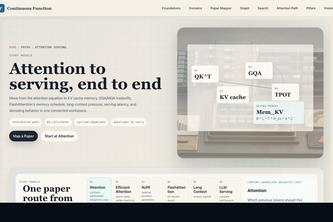
What the company appears to be: Continuous Function is an AI-native learning and research platform that the author describes as a system for turning frontier AI concepts and papers into intuitive learning blocks. It combines interactive mathematical tools, personal notebooks, experimental workbenches, and a research environment. The platform supports a pedagogical loop involving prediction, manipulation, evidence, and invariant identification.
What changed: The project was built over time using a sequence of repository-based Codex sessions and GPT-5.6 audits. It evolved from an idea about how to help learners develop mechanistic understanding to a system that includes educational content stored in YAML/MDX files, interactive visualizations (via D3.js, Three.js), and code-based experiments.
Single most important open question: Is there any evidence of actual user engagement or adoption beyond the author’s own use? The description contains no data on learners, usage metrics, or product-market fit.
Note: This analysis is based entirely on the self-reported project description provided by the author. No external verification, revenue figures, customer data, or traction indicators are available.
What The Product Actually Is
The description states that Continuous Function is:
- An AI-native learning and research platform.
- Designed to turn frontier AI concepts and papers into intuitive learning blocks.
- A system combining:
- Interactive mathematical atlas
- Personal notebook
- Experimental workbench
- Research environment for modern AI
- Built using Next.js, React, TypeScript, and various libraries including D3.js, Three.js, KaTeX, and GPT-5.6.
It is described as a tool where learners can:
- Begin with a paper or concept
- Identify prerequisites
- Follow a connected knowledge graph to relevant notebooks
- Explore mechanisms through intuition, mathematics, runnable code, and interactive demonstrations
The author emphasizes that the system supports a "learning loop" involving:
- Question → Prediction → Manipulation → Evidence → Invariant → Next move
Inference: The product appears to be an educational platform focused on deep conceptual understanding rather than passive consumption. It is not described as a commercial SaaS offering or marketplace.
Positioning & Claim Evolution
The author states:
- The goal was not simply to provide more explanations but to help learners develop mechanistic understanding that remains useful after they close the page.
- The system aims to be between a passive course and a general-purpose chatbot.
- It is intended as a place where serious learners can bring difficult papers or models, make predictions, test them, and leave with insights they can apply elsewhere.
The positioning has evolved from:
- A personal project driven by curiosity
- To a tool that supports structured experimentation in learning
- Toward a vision of an AI-native commons for learning and research
Claim: The platform is positioned as a tool for deep, interactive understanding rather than surface-level summarization.
Inference: This suggests the author sees a gap in current AI tools — those that offer summaries but not true comprehension.
Target Customer & ICP
The description states:
- The target audience includes serious learners who want to understand complex AI concepts.
- These users are likely researchers, graduate students, or advanced practitioners working with frontier AI papers and models.
- The system supports a pedagogical loop that requires active engagement from the learner.
Claim: The platform targets individuals seeking deep conceptual understanding rather than casual consumption.
Inference: There is no evidence of segmentation beyond "serious learners", nor any indication of specific personas or use cases beyond academic or research contexts.
Business Model & Pricing Evidence
Not evidenced.
The description does not mention:
- Any pricing structure
- Revenue model
- Commercialization plans
- Monetization strategy
Finding: No evidence of a business model or pricing strategy is present in the self-reported description.
Technical & Delivery Signals
The author states:
- Built with Next.js, React, TypeScript, and libraries such as D3.js, Three.js, GSAP, KaTeX.
- Educational content stored in filesystem-driven YAML and MDX.
- Uses Codex for repository-based development sessions.
- GPT-5.6 used for final audit.
- Includes validators, unit tests, accessibility checks, browser-based verification.
- Content is designed to be consistent across explanation, mathematics, code, and demonstration.
Claim: The platform uses modern web technologies and AI-assisted development tools.
Inference: This suggests a technical stack suitable for building scalable educational platforms, though no evidence of production deployment or scalability is given.
Traction & Maturity Signals
Not evidenced.
The description does not contain:
- Any metrics on user engagement
- Customer feedback or testimonials
- Product usage data
- Evidence of market traction or adoption beyond the author’s own use
Finding: No evidence of traction, adoption, or maturity indicators is present in the self-reported description.
Competitive Context
Not evidenced.
The description does not:
- Identify direct competitors
- Describe competitive advantages
- Mention existing solutions in the space of AI learning platforms or research environments
Finding: No competitive context is provided; therefore, no assessment of positioning relative to other players can be made.
Open Questions & Risks
Open Question 1: The entire project was built by one person (architrk Khare), with no indication of team expansion or external contributors.
Inference: This raises concerns about scalability and long-term maintenance.
Open Question 2: There is no evidence of user testing, feedback loops, or real-world validation beyond the author’s own experience.
Inference: Without external input, it's unclear whether the platform meets actual needs.
Open Question 3: The platform is described as a research tool and not a commercial product, but there is no clear path to monetization or market fit.
Inference: This could be a barrier if the goal is to transition into a scalable business model.
Open Question 4: The author explicitly avoids "capability theater" — i.e., making claims without sufficient evidence — which may indicate internal uncertainty about what has been achieved.
Inference: This suggests that while the vision is strong, execution and validation are still in early stages.
Questions the description leaves open
- What specific learning outcomes have you observed from users engaging with the platform?
- How do you plan to scale beyond a single developer's involvement?
- Have you conducted any user studies or gathered feedback from learners?
- Is there a clear path toward monetization or commercial viability?
- What distinguishes your approach from existing tools like Coursera, Khan Academy, or academic papers with code repositories?
- How do you ensure consistency between explanation, math, code, and interactive elements as the platform grows?
- What are the key assumptions underlying your pedagogical framework?
Overall Assessment
Not evidenced.
The description does not provide:
- Financials
- Revenue or ARR
- Funding history
- Strategic partnerships
- Market opportunity size
Finding: No basis for evaluating investment potential or partnership value exists in the self-reported description.
Confidence Level: Low — this is a very early-stage concept with no demonstrated traction, revenue, or customer base.
User Stories BotA demo video on every pull request
Get a demo video on every new feature
GitHub App that watches your pull requests and records a narrated, captioned demo.
Save time on demo prep and make informed decisions faster with a video walkthrough of every new feature.
Source
Submitted to the OpenAI 2026 hackathon on Devpost. Project home on Devpost. Back to the full gallery on Devpost.
This competitive analysis was produced by top-founders.com (opens in a new tab)
Generated by a language model from this project's public Devpost page — its tagline, the author's own write-up and any built-with tags listed there — as captured in August 2026. Short quotations are the author's words. It is an opinion on the idea as a business, not on the people behind it, and it reflects the description as published then. If the project has moved on, request a correction below. The analysis is not independent research and contains no verified traction, revenue or customer data.
An independent guide by KFG International LLC — not affiliated with, endorsed by, or connected to Devpost or OpenAI.