

Archive position — measured, not model output
0 likes on Devpost
2,263 of the 7,850 archived projects have more likes, and 5,587 share exactly 0 — so this project's #5,464 place in the like-ranked listing is a tie-break inside that group, not a ranking.
Projects (log scale)
Likes on Devpost. ▲ marks this project's group.
Show the figures
| Likes | Projects | Share of archive |
|---|---|---|
| 0 | 5,587 | 71.2% |
| 1 | 1,758 | 22.4% |
| 2 | 284 | 3.6% |
| 3–4 | 132 | 1.7% |
| 5–9 | 75 | 1.0% |
| 10+ | 14 | 0.2% |
 User Stories BotA demo video on every pull request
Get a demo video on every new feature
GitHub App that watches your pull requests and records a narrated, captioned demo.
Save time on demo prep and make informed decisions faster with a video walkthrough of every new feature.
Executive Summary
What the company appears to be
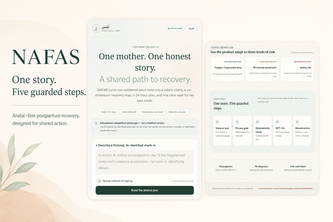
NAFAS is a self-reported AI-powered postpartum recovery companion built as a hackathon project. It accepts unfiltered maternal check-ins in Arabic or English and generates four outputs: a safety priority, a visual recovery map, a 24-hour plan with clear ownership, and a task for the care circle. The system uses deterministic safety rules and GPT-5.6 Terra for personalization, with an emergency bypass to human help.
What changed
The project is presented as a working prototype built in a hackathon context. It does not report any prior commercial activity or traction beyond its demonstration.
Single most important open question
Is there evidence of clinical validation, user testing, or real-world deployment that would support the claims made about safety and utility?
What The Product Actually Is
The description states that NAFAS is an AI postpartum recovery companion. It accepts a mother’s unfiltered story in Arabic or English and turns it into four outputs:
- A deterministic safety priority.
- A visual recovery-load map across physical recovery, sleep, mood, nutrition, infant feeding, and support.
- A focused 24-hour plan with no more than four actions, each with a clear owner.
- A ready-to-share task for the care circle, plus a clinician-ready summary.
It includes a Judge Mode that demonstrates how responses change based on risk levels (routine, same-day review, immediate action), and an emergency phrase that bypasses GPT to return human-help steps.
The system is built using:
- Codex
- CSS
- GPT-5.6 Terra
- HTML, JavaScript, Node.js
- OpenAI APIs
- RTL support for Arabic
It uses a layered pipeline with:
- A privacy gate rejecting identifiers.
- Deterministic open question rules.
- GPT-5.6 with low reasoning effort and strict JSON schema outputs.
- A responsive bilingual interface.
- A timeout-bounded safe fallback.
Not evidenced: No data on actual users, clinical integration, or real-world usage beyond the prototype.
Positioning & Claim Evolution
The author positions NAFAS as a tool that:
- Does not give mothers another library of advice.
- Starts with their unfiltered story.
- Reduces decisions and protects safety boundaries.
- Makes recovery a shared responsibility.
It is described as an alternative to traditional postpartum tools, aiming to reduce cognitive load rather than increase information. The author claims the AI should remove work from the mother rather than add more advice.
The project also emphasizes:
- Safety through deterministic gates and bounded model use.
- Cultural nuance in Arabic-first design.
- Transparency in execution path and privacy handling.
Not evidenced: No evidence of prior positioning or evolution of these claims beyond this single submission. No mention of market feedback, iterations, or product-market fit.
Target Customer & ICP
The description states that NAFAS is designed for postpartum mothers, particularly those experiencing:
- Pain
- Fragmented sleep
- Feeding demands
- Nutrition issues
- Emotional distress
- Inadequate practical support
It is intended to be used by mothers in the immediate postpartum period, with a focus on reducing their cognitive load and coordinating care.
Not evidenced: No evidence of target customer segmentation, user personas, or feedback from actual users. No indication of whether the tool is aimed at mothers in specific regions or contexts (e.g., urban vs rural, first-time vs. experienced mothers).
Business Model & Pricing Evidence
The description does not state a business model or pricing structure.
Not evidenced: No mention of monetization strategy, revenue streams, or pricing plans.
Technical & Delivery Signals
The system uses:
- GPT-5.6 Terra with low reasoning effort and structured outputs.
- A layered pipeline including privacy gates, deterministic safety rules, and fallback mechanisms.
- Codex for scaffolding implementation.
- Responsive bilingual interface (RTL/LTR support).
- Twenty automated Arabic and English safety and privacy evaluations.
The author notes:
- The system avoids diagnosis or prescribing.
- Emergency language bypasses the model.
- The interface exposes execution path, latency, privacy gate, structured output, and no-storage status to judges.
- It was built in a hackathon context with a focus on live-demo latency.
Not evidenced: No evidence of scalability, production deployment, or long-term technical architecture beyond this prototype.
Traction & Maturity Signals
The description states that NAFAS is:
- A public end-to-end working product (not a mockup).
- Built in a hackathon context.
- Includes Judge Mode for demonstration.
- Has 20 automated safety and privacy evaluations.
- Was submitted to the OpenAI 2026 hackathon.
Not evidenced: No evidence of user adoption, customer feedback, or real-world usage. No mention of follow-up development or product evolution beyond this prototype.
Competitive Context
The description does not provide any information about competitors or market positioning relative to existing tools in maternal health or AI-powered wellness platforms.
Not evidenced: No competitive analysis, benchmarking, or awareness of existing solutions in the space.
Open Questions & Risks
- Clinical safety: The system claims to avoid diagnosis and prescribing but does not provide evidence of clinical validation or professional oversight.
- User trust: The tool is built as a prototype; no evidence of user testing or feedback from mothers or clinicians.
- Scalability: No indication of how the system would scale beyond a single developer’s hackathon effort.
- Regulatory readiness: The author mentions privacy, security, and regulatory review are needed before real-world use — suggesting no current compliance or approval status.
- Language and cultural nuance: While Arabic-first design is noted, there is no evidence of localization for other dialects or broader cultural contexts.
Questions the description leaves open
- What clinical validation or expert review has been conducted on the safety rules and outputs?
- Has the system been tested with real postpartum mothers or caregivers?
- How does the team plan to ensure compliance with healthcare regulations in target markets?
- Are there any plans for user consent, data ownership, or authenticated care-circle collaboration?
- What is the roadmap for moving from prototype to a production-ready product?
- How will the system handle edge cases or unexpected inputs beyond the current scenarios?
Overall Assessment
This project is presented as a hackathon prototype with no evidence of traction, revenue, or real-world deployment. It is described as a working end-to-end demo but lacks clinical validation, user testing, and any indication of commercial viability.
The author’s claims about reducing cognitive load and coordinating care are compelling in concept, but the lack of external verification, user feedback, or product development beyond this single submission raises significant uncertainty.
Confidence level: Low. The entire analysis is based on self-reported information with no corroboration or external data.
Assessment: Not ready for investment or partnership without further evidence of clinical validation, user testing, and product evolution.
User Stories BotA demo video on every pull request
Get a demo video on every new feature
GitHub App that watches your pull requests and records a narrated, captioned demo.
Save time on demo prep and make informed decisions faster with a video walkthrough of every new feature.
Source
Submitted to the OpenAI 2026 hackathon on Devpost. Project home on Devpost. Back to the full gallery on Devpost.
This competitive analysis was produced by top-founders.com (opens in a new tab)
Generated by a language model from this project's public Devpost page — its tagline, the author's own write-up and any built-with tags listed there — as captured in August 2026. Short quotations are the author's words. It is an opinion on the idea as a business, not on the people behind it, and it reflects the description as published then. If the project has moved on, request a correction below. The analysis is not independent research and contains no verified traction, revenue or customer data.
An independent guide by KFG International LLC — not affiliated with, endorsed by, or connected to Devpost or OpenAI.