

Archive position — measured, not model output
0 likes on Devpost
2,263 of the 7,850 archived projects have more likes, and 5,587 share exactly 0 — so this project's #3,503 place in the like-ranked listing is a tie-break inside that group, not a ranking.
Projects (log scale)
Likes on Devpost. ▲ marks this project's group.
Show the figures
| Likes | Projects | Share of archive |
|---|---|---|
| 0 | 5,587 | 71.2% |
| 1 | 1,758 | 22.4% |
| 2 | 284 | 3.6% |
| 3–4 | 132 | 1.7% |
| 5–9 | 75 | 1.0% |
| 10+ | 14 | 0.2% |
 User Stories BotA demo video on every pull request
Get a demo video on every new feature
GitHub App that watches your pull requests and records a narrated, captioned demo.
Save time on demo prep and make informed decisions faster with a video walkthrough of every new feature.
Executive Summary
What the company appears to be
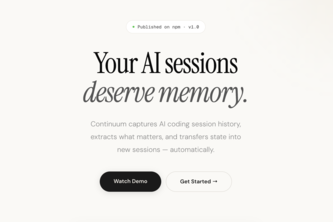
Continuum is a self-reported local-first platform that records AI work sessions, extracts structured project state from those sessions, and transfers that context into new AI sessions without manual copy-pasting. It is built as a CLI tool and MCP server with npm packages available for installation.
What changed
The author states that Continuum was developed in response to the problem of AI coding sessions starting from zero when users switch tools or environments. The project includes support for importing transcripts from multiple AI agents (Claude, ChatGPT, Codex 5.6, etc.), extracting structured facts about a session's progress, and resuming work using an MCP tool.
Single most important open question
Is there evidence of any real-world usage or adoption beyond the author’s own development environment?
What The Product Actually Is
The description states that Continuum is a local-first CLI and MCP server designed to capture AI sessions, extract structured project state, and transfer it into new sessions. It supports:
- Importing transcripts from:
- Claude
- ChatGPT
- Codex 5.6
- Claude Code
- Other generic AI agents local session logs
- Extracting structured facts such as:
- Objectives
- Decisions
- Requirements
- Constraints
- Failed attempts
- Completed work
- Next steps
- Transferring context into new sessions using a layered, token-budgeted package organized into levels (L0–L4)
- Resuming work through an MCP tool called
context.resume
- Verifying that critical facts were retained in the new session
- Protecting sensitive information before context leaves the local machine
It is built as a TypeScript monorepo using pnpm, with packages for core logic, CLI, MCP server, and web visualization.
Positioning & Claim Evolution
The author claims Continuum addresses the issue of AI coding sessions starting from zero when switching tools or environments. The stated principle is:
“A change of session should never force valuable work to begin again.”
This positions Continuum as a tool for preserving working context across AI sessions, especially in local-first development workflows.
The evolution of this claim appears to be from a developer pain point (repeatedly explaining project context) to a technical solution (automated capture and transfer of structured state).
There is no evidence of prior positioning or product iteration beyond the hackathon submission.
Target Customer & ICP
The description states that Continuum targets developers who use AI agents for coding, particularly those working with tools like Claude, ChatGPT, Codex 5.6, etc., and who experience repeated context loss during session changes.
It is implied that users are individual developers or small teams using local AI tools, not enterprise clients.
No explicit segmentation beyond developer type or tool preference is provided.
Business Model & Pricing Evidence
There is no evidence of a business model or pricing structure. The author states that Continuum is published as npm packages and is installable via:
```
npm install -g @dhruv-techdev/continuum-cli
```
No mention of monetization, subscriptions, or paid features.
Technical & Delivery Signals
The project is built using:
- TypeScript monorepo managed with pnpm
- Node.js
- CLI tools (commander.js)
- SQLite and JSONL ledger for storage
- MCP protocol integration
- Heuristic-based state extraction
- Provider-specific adapters for different AI platforms
Key technical signals include:
- Use of append-only, hash-verified JSONL ledger
- Support for multiple AI provider formats through adapter architecture
- End-to-end testing with 988 passing tests
- Published npm packages (
@dhruv-techdev/continuum-*) - Session-scoped resume capability added after initial release
Traction & Maturity Signals
There is no evidence of traction or adoption beyond the author’s own development.
The project was submitted to a hackathon and includes:
- 988 passing tests
- Published npm packages
- End-to-end demonstration of cross-session resume
- Support for multiple AI providers
However, there are no metrics on user numbers, revenue, customer feedback, or product usage beyond the author’s own testing.
Competitive Context
The description does not provide any information about competitors or existing solutions in this space. It is unclear whether similar tools exist or how Continuum compares to them.
No mention of prior art or competitive positioning.
Open Questions & Risks
- No real-world usage: The product has only been tested in development environments and by the author.
- Limited scope: Only supports local-first operation; no evidence of team or shared workspace features beyond stated future plans.
- Heuristic-based extraction: Relies on deterministic heuristics, not LLM-assisted extraction, which may limit accuracy for complex or ambiguous conversations.
- Self-reported maturity: All claims are self-reported and unverified.
- No commercialization path: No evidence of pricing, monetization, or go-to-market strategy.
Questions the description leaves open
- What is the actual adoption rate among developers using Continuum?
- How does Continuum handle edge cases in real-world usage (e.g., very long conversations, multi-agent workflows)?
- Are there any known issues with accuracy or completeness of extracted state?
- Has the team considered how to scale beyond a single developer's workflow?
- What are the plans for monetization and commercial viability?
- How does Continuum integrate with existing IDEs or development environments?
- Is there any plan to support cloud-based synchronization or collaboration features?
Overall Assessment
Not evidenced
There is no evidence of revenue, customers, traction, or financial performance beyond the author’s own account.
The project appears to be a proof-of-concept or prototype, built for a hackathon, with no indication of commercial viability or market readiness.
It is unclear whether Continuum has moved past the experimental stage or if it represents a viable product for investment or partnership.
User Stories BotA demo video on every pull request
Get a demo video on every new feature
GitHub App that watches your pull requests and records a narrated, captioned demo.
Save time on demo prep and make informed decisions faster with a video walkthrough of every new feature.
Source
Submitted to the OpenAI 2026 hackathon on Devpost. Project home on Devpost. Back to the full gallery on Devpost.
This competitive analysis was produced by top-founders.com (opens in a new tab)
Generated by a language model from this project's public Devpost page — its tagline, the author's own write-up and any built-with tags listed there — as captured in August 2026. Short quotations are the author's words. It is an opinion on the idea as a business, not on the people behind it, and it reflects the description as published then. If the project has moved on, request a correction below. The analysis is not independent research and contains no verified traction, revenue or customer data.
An independent guide by KFG International LLC — not affiliated with, endorsed by, or connected to Devpost or OpenAI.