

Archive position — measured, not model output
0 likes on Devpost
2,263 of the 7,850 archived projects have more likes, and 5,587 share exactly 0 — so this project's #3,504 place in the like-ranked listing is a tie-break inside that group, not a ranking.
Projects (log scale)
Likes on Devpost. ▲ marks this project's group.
Show the figures
| Likes | Projects | Share of archive |
|---|---|---|
| 0 | 5,587 | 71.2% |
| 1 | 1,758 | 22.4% |
| 2 | 284 | 3.6% |
| 3–4 | 132 | 1.7% |
| 5–9 | 75 | 1.0% |
| 10+ | 14 | 0.2% |
 User Stories BotA demo video on every pull request
Get a demo video on every new feature
GitHub App that watches your pull requests and records a narrated, captioned demo.
Save time on demo prep and make informed decisions faster with a video walkthrough of every new feature.
Executive Summary
What the company appears to be
Continuum is a self-reported local-first context infrastructure for AI agents, built as a macOS-native tool that observes developer activity (e.g., VS Code, Git, terminal) and provides structured, privacy-preserving context to AI models like Codex. It claims to enable AI agents to continue work without screenshots or pasted history.
What changed
The project is described as a hackathon submission (Devpost entry), with no evidence of prior development, funding, or product release beyond this self-reported write-up.
Single most important open question
Is there any evidence that Continuum has been used in real-world developer workflows or tested with actual users?
What The Product Actually Is
The description states:
- Continuum is a “live, local-first context operating system for AI agents.”
- It observes metadata from tools like VS Code, zsh, Git, Chrome, macOS app activity, and approved folders.
- It groups this activity into checkpoints, a project graph, and a deterministic Context Diff.
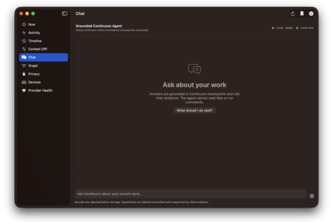
- It provides access through a native macOS app, grounded chat, an optional synchronized PWA, and read-only MCP tools for Codex.
Inference The product appears to be a local daemon that collects metadata from developer tools and presents it in structured formats (timeline, graph, diff) to AI agents. It is not a model or service itself but a context delivery layer.
Evidence strength
- Evidenced: The description states what the system does.
- Inferred: That this is a local-first tool with privacy as a core design principle.
Positioning & Claim Evolution
The description states:
- Continuum aims to solve the problem of AI agents losing context during interruptions.
- It positions itself as an alternative to “screenshots, recordings, or chat history” that creates privacy issues.
- The system is described as “privacy-first,” excluding screenshots, source-file contents, terminal output, and browsing history.
Inference The positioning is focused on developer workflows and AI agent context management, with a strong emphasis on privacy and local execution.
Evidence strength
- Evidenced: The author’s claims about privacy, context loss, and alternative approaches.
- Not evidenced: Any traction, customer feedback, or market validation of this positioning.
Target Customer & ICP
The description states:
- Continuum is built for developers using AI agents like Codex.
- It supports macOS users with tools such as VS Code, Git, zsh, and Chrome.
- The system is designed to help AI agents “continue where the user left off.”
Inference The target customer is likely technical users who rely on AI agents for coding tasks and are concerned about context loss or privacy.
Evidence strength
- Evidenced: The stated audience (developers using AI tools).
- Not evidenced: Any segmentation, persona details, or user research.
Business Model & Pricing Evidence
The description states:
- Continuum includes a native macOS app and an optional synchronized PWA.
- It supports local and remote MCP access via a self-hosted companion.
- There is no mention of pricing, subscriptions, or monetization strategy.
Inference The product appears to be free-to-use in its current form, with optional self-hosting for advanced use cases.
Evidence strength
- Evidenced: The presence of local and remote access options.
- Not evidenced: Any business model, pricing, or monetization strategy.
Technical & Delivery Signals
The description states:
- Continuum uses a TypeScript/Node.js local daemon with SQLite for storage.
- It combines FTS5, graph relationships, recency, and optional vector retrieval.
- The macOS app is built with Swift, SwiftUI, and AppKit.
- It supports Apple Foundation Models, Ollama, and OpenAI, with explicit provider choice.
- An optional self-hosted companion uses Fastify, PostgreSQL, Neo4j, React, Vite, Auth0, and Docker Compose.
Inference The system is built with a local-first architecture, emphasizing privacy and modularity across platforms.
Evidence strength
- Evidenced: The tech stack and architecture described.
- Not evidenced: Any performance data, scalability, or production deployment details.
Traction & Maturity Signals
The description states:
- This is a hackathon submission (OpenAI 2026 hackathon).
- It was built by one person (Nishith P).
- No mention of users, customers, revenue, or product adoption.
Inference There is no evidence of traction or maturity beyond the initial prototype.
Evidence strength
- Evidenced: The project is a hackathon submission and solo effort.
- Not evidenced: Any real-world usage, user feedback, or business metrics.
Competitive Context
The description states:
- Continuum aims to solve context loss in AI agents like Codex.
- It avoids common approaches such as screenshots or chat history.
- It is described as a privacy-first alternative.
Inference It competes with tools that attempt to provide context to AI agents, but no specific competitors are named.
Evidence strength
- Evidenced: The stated problem and approach.
- Not evidenced: Any competitive analysis or market positioning against existing tools.
Open Questions & Risks
The description states:
- Continuum is a solo effort (1 person).
- It is a hackathon submission with no prior product history.
- It excludes screenshots, source contents, and other potentially useful context.
- It does not support cloud fallback or remote shell access.
Inference Key risks include lack of team, limited scope, and potential under-delivery due to privacy constraints.
Evidence strength
- Evidenced: The solo development and hackathon nature.
- Not evidenced: Any risk mitigation strategy or scalability plan.
Questions the description leaves open
- What is the actual use case for this tool? Is it being tested with developers?
- How does Continuum handle edge cases like multiple projects, ambiguous Git clones, or cross-device sync?
- Are there any plans to expand beyond macOS or support other AI agents besides Codex?
- What are the privacy trade-offs in excluding certain data types (e.g., terminal output)?
- Is there a plan for monetization or product development beyond this prototype?
Overall Assessment
The description states:
- This is a hackathon submission with no evidence of traction, revenue, or customer base.
- It is built by one person and lacks any indication of team or funding.
Inference At this stage, there is no commercial due-diligence basis to recommend investment or partnership. The project appears to be an early-stage prototype with strong technical design but no demonstrated market fit or business model.
Evidence strength
- Evidenced: The project is a solo hackathon submission.
- Not evidenced: Any commercial viability, traction, or strategic value.
User Stories BotA demo video on every pull request
Get a demo video on every new feature
GitHub App that watches your pull requests and records a narrated, captioned demo.
Save time on demo prep and make informed decisions faster with a video walkthrough of every new feature.
Source
Submitted to the OpenAI 2026 hackathon on Devpost. Project home on Devpost. Back to the full gallery on Devpost.
This competitive analysis was produced by top-founders.com (opens in a new tab)
Generated by a language model from this project's public Devpost page — its tagline, the author's own write-up and any built-with tags listed there — as captured in August 2026. Short quotations are the author's words. It is an opinion on the idea as a business, not on the people behind it, and it reflects the description as published then. If the project has moved on, request a correction below. The analysis is not independent research and contains no verified traction, revenue or customer data.
An independent guide by KFG International LLC — not affiliated with, endorsed by, or connected to Devpost or OpenAI.