

Archive position — measured, not model output
1 like on Devpost
505 of the 7,850 archived projects have more likes, and 1,758 share exactly 1 — so this project's #1,539 place in the like-ranked listing is a tie-break inside that group, not a ranking.
Projects (log scale)
Likes on Devpost. ▲ marks this project's group.
Show the figures
| Likes | Projects | Share of archive |
|---|---|---|
| 0 | 5,587 | 71.2% |
| 1 | 1,758 | 22.4% |
| 2 | 284 | 3.6% |
| 3–4 | 132 | 1.7% |
| 5–9 | 75 | 1.0% |
| 10+ | 14 | 0.2% |
 User Stories BotA demo video on every pull request
Get a demo video on every new feature
GitHub App that watches your pull requests and records a narrated, captioned demo.
Save time on demo prep and make informed decisions faster with a video walkthrough of every new feature.
Executive Summary
What the company appears to be
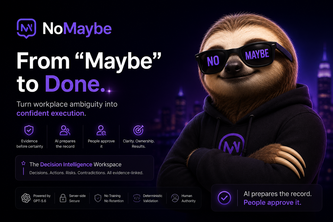
NoMaybe is a decision intelligence workspace that processes workplace conversations (e.g., meeting notes) into structured records called a Decision Ledger. It uses GPT-5.6 for candidate extraction and deterministic code for validation, evidence resolution, and transparency in scoring. The system separates model interpretation from human review, allowing users to edit, approve, or reject decisions.
What changed
NoMaybe was submitted as part of the OpenAI 2026 hackathon. It is described as a proof-of-concept with two modes: Sample Mode (local) and Live Mode (server-side). The product intentionally excludes persistence, authentication, export, and integrations—these are future features.
Single most important open question
Is there evidence of traction or commercial interest in this concept beyond the hackathon submission?
What The Product Actually Is
The description states that NoMaybe is a decision intelligence workspace. It takes workplace conversations (e.g., meeting summaries, transcripts) and turns them into a Decision Ledger containing:
- Confirmed, conditional, and proposed decisions
- Assigned actions
- Open questions
- Risks
- Contradictions
- Accountability gaps
Each item in the ledger retains source quotations that support it. The process involves:
- Inputting source text (e.g., meeting notes)
- Using GPT-5.6 to generate candidate records
- Validating and resolving quotations deterministically
- Presenting these records for human review
The system is built using Next.js 16, React 19, and compiled via Vinext and Vite to a Cloudflare Worker-compatible runtime.
Claim: NoMaybe transforms ambiguous workplace conversations into evidence-linked decision records.
Evidence: The author describes the workflow, including GPT-5.6 use, deterministic validation, and human review steps.
Positioning & Claim Evolution
The product positions itself around the idea that “evidence before certainty” is key to better workplace decisions. It claims to address a structural problem in meeting summaries: ambiguity that obscures commitments, owners, deadlines, and contradictions.
It emphasizes:
- Evidence integrity: Every decision record links back to source quotations
- Transparency: Evidence Strength is calculated from visible factors
- Separation of roles: GPT contributes interpretation; deterministic code ensures validity; humans make final judgments
Claim: NoMaybe is a decision intelligence workspace that makes ambiguity explicit and inspectable.
Evidence: The description repeatedly frames the product as solving the problem of unclear or untraceable decisions in meetings.
Target Customer & ICP
The author does not explicitly define a target customer or ideal customer profile (ICP). However, based on the context and use case described:
- The system is designed for teams or individuals who take notes during meetings
- It targets users who want to turn ambiguous conversations into official records
- It may appeal to knowledge workers, project managers, or decision-makers in collaborative environments
Claim: NoMaybe serves teams that need clarity from meeting summaries.
Evidence: The product is framed as solving the problem of unclear decisions, but no named customer segments are provided.
Business Model & Pricing Evidence
There is no evidence in the description of a business model or pricing structure. The submission is described as a hackathon project and does not mention monetization, subscriptions, or any commercial offering.
Claim: NoMaybe has a defined business model.
Evidence: Not evidenced.
Technical & Delivery Signals
The system uses:
- GPT-5.6 via the OpenAI Responses API
- Zod for structured output validation
- Next.js 16 App Router, React 19, and TypeScript
- Compiled to a Cloudflare Worker-compatible runtime
- Server-side only for Live Mode
- No model tools or browsing enabled
- OpenAI storage disabled (
store: false) - 99 passing automated tests
Claim: The system is built with secure, deterministic, and scalable architecture.
Evidence: The description details technical stack, security practices, and test coverage.
Traction & Maturity Signals
The product is described as a hackathon submission, not a commercial product. It includes:
- A publicly deployed version via OpenAI Sites
- 99/99 passing automated tests
- A complete workflow with desktop and mobile UI
- No persistence, authentication, or integrations (intentionally excluded)
Claim: NoMaybe has traction or adoption.
Evidence: Not evidenced. The product is a prototype.
Competitive Context
The description does not mention competitors or direct market comparisons. It does not reference existing tools for decision intelligence, meeting summarization, or collaboration platforms like Notion, Slack, or Confluence.
Claim: NoMaybe competes with other workplace collaboration or AI tools.
Evidence: Not evidenced.
Open Questions & Risks
- No commercial traction or revenue data
- No customer base or user feedback
- Intentionally limited scope (no persistence, no integrations)
- Unproven market demand beyond the hackathon
- Self-reported only, with no independent verification
- No pricing model or monetization strategy
Inference: The product may not be ready for commercial deployment without further development and market validation.
Questions the description leaves open
- What is the intended path to market beyond the hackathon?
- Are there any early adopters or pilot users?
- How does NoMaybe plan to monetize its platform?
- What are the key assumptions about user behavior and decision-making?
- Is there a roadmap for adding persistence, authentication, and integrations?
- How does the team plan to validate the need for this product in real-world settings?
Overall Assessment
Not evidenced.
The project is described as a hackathon submission with no commercial traction, revenue, or customer data. It is a proof-of-concept that demonstrates technical capability but lacks evidence of market readiness or scalability.
Inference: If this were to evolve into a product, it would require significant development and validation before attracting investment or partnership interest.
User Stories BotA demo video on every pull request
Get a demo video on every new feature
GitHub App that watches your pull requests and records a narrated, captioned demo.
Save time on demo prep and make informed decisions faster with a video walkthrough of every new feature.
Source
Submitted to the OpenAI 2026 hackathon on Devpost. Project home on Devpost. Back to the full gallery on Devpost.
This competitive analysis was produced by top-founders.com (opens in a new tab)
Generated by a language model from this project's public Devpost page — its tagline, the author's own write-up and any built-with tags listed there — as captured in August 2026. Short quotations are the author's words. It is an opinion on the idea as a business, not on the people behind it, and it reflects the description as published then. If the project has moved on, request a correction below. The analysis is not independent research and contains no verified traction, revenue or customer data.
An independent guide by KFG International LLC — not affiliated with, endorsed by, or connected to Devpost or OpenAI.