

Archive position — measured, not model output
1 like on Devpost
505 of the 7,850 archived projects have more likes, and 1,758 share exactly 1 — so this project's #1,541 place in the like-ranked listing is a tie-break inside that group, not a ranking.
Projects (log scale)
Likes on Devpost. ▲ marks this project's group.
Show the figures
| Likes | Projects | Share of archive |
|---|---|---|
| 0 | 5,587 | 71.2% |
| 1 | 1,758 | 22.4% |
| 2 | 284 | 3.6% |
| 3–4 | 132 | 1.7% |
| 5–9 | 75 | 1.0% |
| 10+ | 14 | 0.2% |
 User Stories BotA demo video on every pull request
Get a demo video on every new feature
GitHub App that watches your pull requests and records a narrated, captioned demo.
Save time on demo prep and make informed decisions faster with a video walkthrough of every new feature.
Executive Summary
What the company appears to be
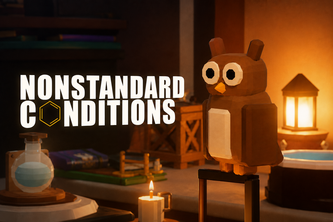
Nonstandard Conditions is a self-reported educational game for organic chemistry that uses gamification and interactive synthesis to teach students. The project was built as part of the OpenAI 2026 hackathon, with two team members using GPT-5.6 and Codex tools.
What changed
The description does not indicate any prior version or evolution of the product; this is a new submission from a hackathon entry.
Single most important open question
Is there evidence of traction, revenue, or user adoption beyond the hackathon submission?
What The Product Actually Is
- The description states that Nonstandard Conditions is a game where players act as "fake wizards" (chemists) and learn organic chemistry by synthesizing real chemicals.
- It includes interactive elements such as immediate feedback on mistakes, visual structure learning, and mechanism-based understanding.
- The game uses 3D low-poly assets, skeleton-driven animations, cinematic camera movement, lighting effects, a chemistry library, particle effects, mathematically synthesized sound, image generation for UI, performance-aware codebase optimization, and integration across desktop and iOS platforms.
- It was built using Codex and GPT-5.6 tools.
Confidence Low — this is entirely self-reported, with no independent verification or demonstration of functionality beyond the author's own account.
Positioning & Claim Evolution
- The description states that the goal was not to create a class helper but to inspire people to learn hard things through play.
- It claims the product makes organic chemistry feel approachable and encourages curiosity, experimentation, and play over traditional memorization-based study methods.
- The authors say they are “bored of all the quiz and study platforms” and aim to teach through interaction rather than content.
Confidence Low — these are claims about intent and positioning, not proof of traction or adoption.
Target Customer & ICP
- The description states that Nonstandard Conditions is designed for:
- Students in organic chemistry
- People preparing to take the subject
- Anyone curious about chemistry
Confidence Low — no evidence of actual customer segmentation, targeting, or validation beyond stated intent.
Business Model & Pricing Evidence
- Not evidenced. The description does not mention any pricing model, monetization strategy, or business model.
Technical & Delivery Signals
- The project was built using Codex and GPT-5.6.
- It includes:
- 3D low-poly assets from math geometry
- Skeleton-driven animation rigs
- Cinematic camera movement via interpolation
- Optimized lighting with shadow gating, bloom, and post-processing
- Chemistry library for reagents, products, reactions, and synthesis routes
- Particle effects built by math
- Mathematically synthesized sound effects
- Image generation for UI, icons, storyboards, favicon
- Performance-aware codebase bloat removal
- Remote prompting via phone due to long prompt times
- Full-stack testing through Codex and browser visual verification
- Integration of desktop and iOS gameplay
Confidence Medium — the technical details are self-reported and suggest a significant engineering effort, but no independent validation or delivery evidence.
Traction & Maturity Signals
- Not evidenced. There is no mention of users, adoption, revenue, or usage metrics beyond the hackathon submission.
- The authors note that they had to "tune things down" due to performance constraints on a webapp, indicating early-stage development.
Confidence Very low — no traction or maturity indicators are present.
Competitive Context
- Not evidenced. No mention of competitors, market analysis, or positioning relative to existing educational tools or games in the chemistry space.
Open Questions & Risks
- The project is a hackathon submission with no evidence of prior versions or commercialization.
- It was built using AI tools (Codex, GPT-5.6), which may raise questions about scalability and long-term viability.
- The authors note that prompts took 3+ hours and had to work remotely — suggesting technical inefficiencies or tool limitations.
- No revenue, customer base, or product-market fit data is available.
- The lack of any traction or commercialization signals raises concerns about whether the idea will evolve beyond a prototype.
Confidence Medium — based on the limited evidence, there are several open questions related to maturity and scalability.
Questions the description leaves open
- What is the current stage of development? Is this a prototype or a working product?
- Have you tested the game with actual students or users in organic chemistry?
- How do you plan to scale beyond the hackathon environment?
- Are there any plans for monetization or business model?
- What are your long-term goals for Nonstandard Conditions?
- Can you demonstrate how the learning outcomes differ from traditional methods?
Overall Assessment
- Not evidenced. No financials, traction, or strategic alignment data are provided.
- The project is described as a hackathon submission with no commercialization history or evidence of product-market fit.
- It appears to be an experimental educational tool with potential but lacks any demonstrated path to market or revenue generation.
Confidence Very low — this is a speculative early-stage idea, not a viable investment or partnership opportunity without further development and validation.
User Stories BotA demo video on every pull request
Get a demo video on every new feature
GitHub App that watches your pull requests and records a narrated, captioned demo.
Save time on demo prep and make informed decisions faster with a video walkthrough of every new feature.
Source
Submitted to the OpenAI 2026 hackathon on Devpost. Project home on Devpost. Back to the full gallery on Devpost.
This competitive analysis was produced by top-founders.com (opens in a new tab)
Generated by a language model from this project's public Devpost page — its tagline, the author's own write-up and any built-with tags listed there — as captured in August 2026. Short quotations are the author's words. It is an opinion on the idea as a business, not on the people behind it, and it reflects the description as published then. If the project has moved on, request a correction below. The analysis is not independent research and contains no verified traction, revenue or customer data.
An independent guide by KFG International LLC — not affiliated with, endorsed by, or connected to Devpost or OpenAI.