

Archive position — measured, not model output
0 likes on Devpost
2,263 of the 7,850 archived projects have more likes, and 5,587 share exactly 0 — so this project's #7,425 place in the like-ranked listing is a tie-break inside that group, not a ranking.
Projects (log scale)
Likes on Devpost. ▲ marks this project's group.
Show the figures
| Likes | Projects | Share of archive |
|---|---|---|
| 0 | 5,587 | 71.2% |
| 1 | 1,758 | 22.4% |
| 2 | 284 | 3.6% |
| 3–4 | 132 | 1.7% |
| 5–9 | 75 | 1.0% |
| 10+ | 14 | 0.2% |
 User Stories BotA demo video on every pull request
Get a demo video on every new feature
GitHub App that watches your pull requests and records a narrated, captioned demo.
Save time on demo prep and make informed decisions faster with a video walkthrough of every new feature.
Executive Summary
What the company appears to be
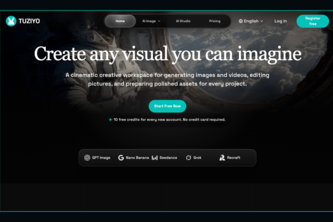
tuziyo is a self-reported AI image and video generation studio built by a solo developer (Wen Gwynn) as part of an OpenAI 2026 hackathon submission. It allows users to combine multiple AI models from providers like OpenAI, Google, ByteDance, and Kling within one creative project, preserving context such as prompts, references, settings, and outputs.
What changed
The description indicates this is a functional product built in a short timeframe (likely a hackathon), not a demo or prototype. It includes full-stack architecture using Cloudflare Workers, D1, R2, Stripe, and React, with asynchronous generation handling and browser-based video export capabilities.
Single most important open question
Is there any evidence of user adoption, revenue, or traction beyond the author’s own account?
What The Product Actually Is
The description states that tuziyo is an edge-first full-stack application designed to help creators combine multiple AI models in a single workspace. It supports:
- Selection and use of models from providers like OpenAI, Google, ByteDance, Kling.
- Preservation of creative context: prompts, reference images, settings, outputs, iterations, and final sequences within one project.
- Asynchronous image/video generation with callbacks, polling, and recovery jobs.
- Browser-based video export using FFmpeg WebAssembly.
- Data storage via Cloudflare D1 (user/session/generation data) and R2 (assets).
- Authentication via Google OAuth and payment via Stripe.
It is described as a studio environment for visual storytelling that aims to streamline workflows around generative AI models.
Claim
tuziyo enables creators to move from idea to coherent visual story in one place.
Evidence The author describes how users can begin with an idea, generate images and videos across multiple models, preserve references and iterations, organize shots into sequences, and export MP4s—all within the same product.
Positioning & Claim Evolution
The description indicates that tuziyo was built to address fragmentation in AI creative workflows. The author explicitly states:
“We built tuziyo because we wanted a single place where the creative context survives: the prompt, reference images, selected model, generation settings, outputs, iterations, and final sequence should all belong to the same project.”
This suggests a shift from building isolated tools (e.g., just a prompt box) toward building the workspace around generative models.
Claim
tuziyo is not another prompt box—it’s a creative environment.
Evidence The author says this goal was not to build another prompt box but to build the workspace that helps creators move from idea to visual story.
There is no indication of prior positioning or evolution beyond this single project submission. No mention of previous versions, pivots, or market feedback shaping the product.
Target Customer & ICP
The description implies tuziyo targets creators who use AI models for image and video generation, particularly those working across multiple tools and seeking a unified workflow.
Claim
The target customer is someone who jumps between different tools, uploads references repeatedly, translates settings, and manually organizes results.
Evidence The author says: “AI image and video models are becoming incredibly capable, but the creative workflow around them is still fragmented.”
No explicit segmentation or persona details are provided. No evidence of customer interviews, personas, or usage patterns beyond the developer’s own experience.
Business Model & Pricing Evidence
The description mentions Stripe integration for credits and subscriptions, suggesting a freemium or credit-based model may be in place.
Claim
tuziyo uses Stripe for managing payments.
Evidence “Stripe supports credits and subscriptions.”
However, no pricing tiers, subscription plans, or monetization strategy are described. There is no evidence of revenue streams, customer acquisition costs, or monetization experiments beyond the developer’s own use case.
Technical & Delivery Signals
The project is built using:
- Frontend: React 19, React Router v7, server-rendered interface.
- Backend/API: Cloudflare Workers and Hono.
- Database: Cloudflare D1.
- Storage: Cloudflare R2.
- Authentication: Google OAuth.
- Payment: Stripe.
- Development Tooling: OpenAI Codex used throughout the development lifecycle.
Claim
The application is edge-first, full-stack, and built by a solo developer using modern tools.
Evidence The author describes building it independently with React, Cloudflare Workers, D1, R2, Stripe, and Codex.
There are no signals of scaling issues, performance metrics, or infrastructure maturity beyond the solo developer’s own experience.
Traction & Maturity Signals
The description states that tuziyo was submitted to the OpenAI 2026 hackathon, suggesting it is a functional prototype rather than a mature product. It also notes:
“I’m proud that tuziyo has become a working product rather than a disconnected Build Week demo.”
No evidence of user base, retention, or usage data is provided.
Claim
The product is functional and not a demo.
Evidence The author says it’s a working product, not a demo.
There is no evidence of revenue, customers, or traction beyond the developer's own account.
Competitive Context
The description does not mention any direct competitors. It focuses on the fragmentation of workflows and the need for a unified environment, but does not name or describe existing alternatives.
Claim
There are fragmented tools in the AI creative workflow space.
Evidence The author says: “AI image and video models are becoming incredibly capable, but the creative workflow around them is still fragmented.”
No evidence of competitive analysis, market positioning, or differentiation from other tools.
Open Questions & Risks
- Solo Developer Risk: The product was built by a single person. There is no team structure or operational support.
- Lack of Traction: No evidence of users, revenue, or adoption beyond the author’s own experience.
- Unproven Business Model: While Stripe integration exists, there is no indication of monetization strategy or customer feedback loops.
- No Market Validation: The project was submitted to a hackathon; no evidence of real-world testing or iteration.
- Technical Complexity Without Operational Evidence: The architecture is complex but lacks any signal of operational robustness or scalability.
Inference If the product has not been tested in production with users, it may not reflect actual needs or workflows.
Questions the description leaves open
- What specific user feedback have you received since launch?
- How do you plan to scale beyond a solo developer?
- Are there any early adopters or paying customers?
- What is your long-term vision for monetization and product evolution?
- How are you handling model-specific differences in input/output formats?
- Have you considered integrating with existing design or creative platforms?
Overall Assessment
Not evidenced.
There is no evidence of revenue, customers, traction, or financials beyond the author’s own account. The product appears to be a functional prototype built by one person in a hackathon setting.
Inference If this were a commercial venture, it would require further due diligence into user feedback, scalability, and operational readiness.
The description is self-reported and unverified. No third-party validation or independent evidence exists to assess its viability as an investment or partnership opportunity.
User Stories BotA demo video on every pull request
Get a demo video on every new feature
GitHub App that watches your pull requests and records a narrated, captioned demo.
Save time on demo prep and make informed decisions faster with a video walkthrough of every new feature.
Source
Submitted to the OpenAI 2026 hackathon on Devpost. Project home on Devpost. Back to the full gallery on Devpost.
This competitive analysis was produced by top-founders.com (opens in a new tab)
Generated by a language model from this project's public Devpost page — its tagline, the author's own write-up and any built-with tags listed there — as captured in August 2026. Short quotations are the author's words. It is an opinion on the idea as a business, not on the people behind it, and it reflects the description as published then. If the project has moved on, request a correction below. The analysis is not independent research and contains no verified traction, revenue or customer data.
An independent guide by KFG International LLC — not affiliated with, endorsed by, or connected to Devpost or OpenAI.