

Archive position — measured, not model output
1 like on Devpost
505 of the 7,850 archived projects have more likes, and 1,758 share exactly 1 — so this project's #2,073 place in the like-ranked listing is a tie-break inside that group, not a ranking.
Projects (log scale)
Likes on Devpost. ▲ marks this project's group.
Show the figures
| Likes | Projects | Share of archive |
|---|---|---|
| 0 | 5,587 | 71.2% |
| 1 | 1,758 | 22.4% |
| 2 | 284 | 3.6% |
| 3–4 | 132 | 1.7% |
| 5–9 | 75 | 1.0% |
| 10+ | 14 | 0.2% |
 User Stories BotA demo video on every pull request
Get a demo video on every new feature
GitHub App that watches your pull requests and records a narrated, captioned demo.
Save time on demo prep and make informed decisions faster with a video walkthrough of every new feature.
Executive Summary
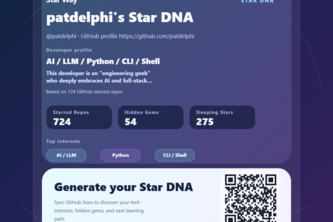
The description states that the star way is a tool that turns GitHub Stars into a developer interest map and AI-powered learning path. The author describes building a dual-deployment frontend (React + Vite) with local Node.js backend and Cloudflare Workers backend, using TypeScript, AI APIs, and SQLite at the edge. It offers features like star syncing, smart classification, multi-dimensional filtering, statistical analysis, and AI-derived insights such as Star DNA and learning paths.
The project appears to be a developer-focused SaaS or tooling product, likely targeting developers who want to analyze their own or others' GitHub stars for personal interest mapping or learning path generation. It is self-reported as being built by one person (Pat Delphi), with no evidence of revenue, customers or traction beyond the hackathon submission.
The single most important open question
Does this tool have any commercial viability or user adoption beyond its hackathon prototype?
What The Product Actually Is
- The description states that the star way is a tool for analyzing GitHub stars.
- It allows users to enter any GitHub username and analyze their starred repositories.
- Features include:
- Star Sync — syncing starred repos with incremental updates
- Smart Classification — auto-tagging based on topics, repo name, and description (60+ categories)
- Multi-dimensional Filtering — filter by language, tag, keyword; sort and paginate
- Statistical Analysis — language distribution, topic clustering, license distribution, star timeline trends
- AI-Powered Insights:
- Star DNA: Developer tech profile generated from starred repos
- Learning Path: Personalized learning path recommendations
- README Summary: Intelligent summary of repo READMEs
- Data export options include CSV / JSON / Markdown / HTML.
- UI supports bilingual (Chinese/English) and tri-state theme switching.
- Demo mode works without backend.
Inference The product is a frontend application that integrates with GitHub APIs, processes data locally or via Cloudflare Workers, and provides structured insights using AI.
Positioning & Claim Evolution
- The description states the project aims to turn "the instinct of 'browsing someone else's bookmarks' into a structured tool."
- It positions itself as helping developers understand what technologies others care about, uncover hidden learning paths, and visualize their own tech interests.
- The author claims that GitHub Stars are a strong proxy for a developer’s interest graph — better than bios or pinned repos.
Inference This is positioned as a developer productivity tool, possibly aimed at self-improvement or career guidance through code exploration.
Target Customer & ICP
- The description does not name specific customer segments.
- It implies usage by developers who star repositories on GitHub and want to analyze those stars for personal interest mapping or learning path generation.
- The author mentions that the tool helps users “understand what technologies they care about” and “uncover hidden learning paths.”
Inference Likely target is technical professionals, especially those interested in continuous learning, career development, or understanding trends in open-source software.
Business Model & Pricing Evidence
- No pricing information or business model is stated.
- The description does not mention monetization strategies, subscription tiers, freemium offerings, or any revenue streams.
- It describes a dual deployment model (local vs. cloud), but no indication of how this might be monetized.
Inference No evidence of a defined business model or pricing strategy.
Technical & Delivery Signals
- Built with:
- Frontend: React 19 + Vite + TypeScript + Tailwind CSS 4 + Radix UI + recharts
- Backend (Local): Node.js + TypeScript + better-sqlite3 (WAL mode)
- Backend (Cloud): Cloudflare Workers + D1 (SQLite at the edge)
- Shared Layer: TypeScript types + pure logic reused across both backends
- AI: OpenAI-compatible API (supports Zhipu GLM, Alibaba dashscope, SenseNova, OpenAI, Ollama, etc.)
- Testing: Vitest (132 backend tests + 85 Worker tests)
- CI/CD: GitHub Actions auto-deploys Worker + Pages on push to master
- Challenges include middleware migration, D1 SQL variable limit, Worker CPU timeouts, edge cases in classification, TypeScript bundler quirks, bilingual stability
Inference The technical stack suggests a modern, lightweight, serverless approach, leveraging edge compute for performance and scalability. The use of AI APIs indicates an intent to provide intelligent insights.
Traction & Maturity Signals
- No evidence of revenue, customers, or adoption.
- The project was submitted to the OpenAI 2026 hackathon on Devpost.
- The author states that it has 217 tests keeping both backends honest.
- It includes demo mode and supports self-hosting via Docker (mentioned in “What’s next” section).
Inference No traction or maturity beyond a hackathon prototype.
Competitive Context
- No mention of competitors.
- The author does not reference existing tools that do similar things, such as GitHub star analysis tools, developer interest mapping platforms, or AI-powered learning path generators.
Inference There is no evidence of competitive positioning or awareness of existing solutions in this space.
Open Questions & Risks
- The project is described as a single-person hackathon effort, with no evidence of team size beyond one individual.
- No revenue, customers, or traction data are provided — all claims are self-reported.
- The tool is presented as a personal interest mapping tool, which may not scale into a commercial product without significant user demand or monetization strategy.
- The use of AI APIs implies potential cost and dependency risks if pricing changes or access becomes limited.
Inference High risk due to lack of commercial traction, unclear monetization model, and reliance on developer self-interest rather than market-driven adoption.
Questions the description leaves open
- What is the intended target customer segment beyond developers?
- How do you plan to monetize this tool if it remains free or low-cost for now?
- Have you validated demand from potential users outside of the hackathon context?
- Is there any plan to expand beyond GitHub stars, e.g., other platforms or data sources?
- What are your long-term goals for growth and user engagement?
Overall Assessment
- Not evidenced.
Confidence Low — this is a self-reported hackathon project with no verified traction, revenue, or customer base. The description does not indicate any commercial viability or clear path to monetization. It is unclear whether the tool has sufficient market demand or strategic value for investment or partnership.
User Stories BotA demo video on every pull request
Get a demo video on every new feature
GitHub App that watches your pull requests and records a narrated, captioned demo.
Save time on demo prep and make informed decisions faster with a video walkthrough of every new feature.
Source
Submitted to the OpenAI 2026 hackathon on Devpost. Project home on Devpost. Back to the full gallery on Devpost.
This competitive analysis was produced by top-founders.com (opens in a new tab)
Generated by a language model from this project's public Devpost page — its tagline, the author's own write-up and any built-with tags listed there — as captured in August 2026. Short quotations are the author's words. It is an opinion on the idea as a business, not on the people behind it, and it reflects the description as published then. If the project has moved on, request a correction below. The analysis is not independent research and contains no verified traction, revenue or customer data.
An independent guide by KFG International LLC — not affiliated with, endorsed by, or connected to Devpost or OpenAI.