

Archive position — measured, not model output
0 likes on Devpost
2,263 of the 7,850 archived projects have more likes, and 5,587 share exactly 0 — so this project's #5,999 place in the like-ranked listing is a tie-break inside that group, not a ranking.
Projects (log scale)
Likes on Devpost. ▲ marks this project's group.
Show the figures
| Likes | Projects | Share of archive |
|---|---|---|
| 0 | 5,587 | 71.2% |
| 1 | 1,758 | 22.4% |
| 2 | 284 | 3.6% |
| 3–4 | 132 | 1.7% |
| 5–9 | 75 | 1.0% |
| 10+ | 14 | 0.2% |
 User Stories BotA demo video on every pull request
Get a demo video on every new feature
GitHub App that watches your pull requests and records a narrated, captioned demo.
Save time on demo prep and make informed decisions faster with a video walkthrough of every new feature.
Executive Summary
What the company appears to be
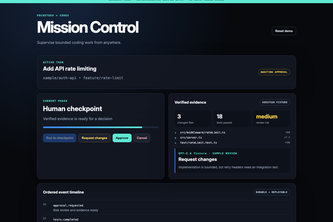
PocketDev Agent Control is a self-reported tool designed to supervise AI coding agents like Codex. The author states it manages coding tasks as durable workflows with explicit lifecycle stages, incorporating Git diffs, test results, and GPT-5.6 risk reviews. It is built for developers who want to approve or reject changes made by an agent, while maintaining audit trails.
What changed
The project was developed during the OpenAI 2026 hackathon (Build Week). It extends an existing platform called PocketDev, which previously allowed remote access to developer environments. This new extension introduces a control plane specifically for managing Codex-based tasks.
The single most important open question
Is there any evidence of actual usage or adoption beyond the author's own development and sandbox demonstration?
Note
All findings are based on self-reported information from the project description provided by the caller. No independent verification, traction data, revenue figures, customer names, or third-party corroboration is available.
What The Product Actually Is
The description states that PocketDev Agent Control:
- Manages coding work as a "durable task with explicit lifecycle states"
- Collects changed-file Git diffs, command output, and test evidence
- Uses GPT-5.6 to produce structured risk assessments on bounded artifacts
- Allows developers to approve, cancel, or request changes to agent-generated code
- Maintains an ordered audit trail of decisions and supporting evidence
- Does not claim that code was merged, pushed, or deployed unless those operations actually occurred
It is described as a system where:
- The API owns authentication, task state, event ordering, approvals, and reports
- The VS Code extension handles workspace validation, Codex execution, Git inspection, and test execution
- Codex performs implementation and revision stages
- GPT-5.6 provides artifact-grounded risk review
- Developers retain authority over revisions and final approval
Inference The product appears to be a workflow control system for AI-assisted coding tasks, integrating with existing tools like Git, VS Code, and Codex.
Positioning & Claim Evolution
The author claims:
- AI coding agents can implement changes quickly but supervision remains difficult
- The tool turns a fragmented process into a structured, human-controlled workflow
- It enables supervision "from anywhere"
- It avoids claiming that code was merged or deployed unless it actually happened
- It separates trustworthy evidence from agent narration
Inference The positioning is centered on human-in-the-loop control over AI coding agents, emphasizing structured workflows, auditability, and evidence-based decision-making.
There is no indication of prior versions, market positioning beyond this hackathon submission, or how the product might evolve beyond its current sandbox form.
Target Customer & ICP
The description states:
- The tool is designed for developers who want to supervise Codex
- It integrates with VS Code and Git-based workflows
- It supports remote access to developer environments (via PocketDev)
Inference The primary customer segment appears to be developers working in remote or distributed teams, using AI coding tools like Codex, and requiring oversight of automated changes.
There is no evidence of segmentation beyond this general use case, nor any indication of whether the tool targets enterprise customers, individual developers, or specific industries.
Business Model & Pricing Evidence
Not evidenced.
The description does not contain any information about pricing models, monetization strategies, or business model assumptions. No mention of subscriptions, per-user fees, or usage-based billing is present.
Technical & Delivery Signals
The author states:
- Built with Node.js, TypeScript, MongoDB, GraphQL, Redis, VS Code extension, OpenAI Codex, GPT-5.6
- Uses a deterministic judge sandbox for demonstration purposes
- Includes interactive task progression, ordered events, test evidence, changed files, revision requests, cancellation, and approval
- Implements shared TypeScript contracts, transition rules, persistent models, authenticated GraphQL operations
- Separates responsibilities between API, VS Code extension, Codex worker, and GPT-5.6
Inference The technical stack suggests a modern backend/frontend architecture with integration points for AI services, Git, and IDEs. The sandbox indicates some level of delivery readiness, though it's not production-grade.
Traction & Maturity Signals
Not evidenced.
There is no evidence of revenue, customers, user base, or adoption metrics beyond the author’s own development efforts and sandbox demonstration.
Competitive Context
Not evidenced.
No mention of competitors, market size, or competitive landscape is included in the description.
Open Questions & Risks
- Unverified claims: All statements are self-reported; no external validation.
- No traction or usage data: No evidence of real-world adoption or performance metrics.
- Limited scope: The product exists only as a sandbox and prototype, not a full platform.
- Unclear commercial viability: No indication of monetization strategy or path to market.
- Dependency on proprietary infrastructure: The judge sandbox avoids exposing core PocketDev code, suggesting that the actual platform remains private or unshared.
Questions the description leaves open
- What is the current status of PocketDev as a product? Is this an extension of an existing platform?
- Has there been any real-world testing or feedback from developers using this system?
- How does the tool integrate with other CI/CD pipelines or deployment systems?
- Are there plans to support more repositories or test runners beyond what’s shown in the sandbox?
- What are the key assumptions about developer workflows that underpin this design?
- How is the risk review by GPT-5.6 validated or calibrated for accuracy?
- Is there any plan to open-source parts of the system, or does it rely on proprietary components?
Overall Assessment
Not evidenced.
There is no evidence of funding rounds, valuation, or investment interest in this project. The description provides no indication of whether the founders are seeking investment or partnership opportunities.
The author describes a prototype with clear design principles and technical execution, but without any signs of traction, revenue, or commercialization efforts. The tool remains largely conceptual and sandbox-based.
Confidence level Low — based entirely on self-reported project description with no external corroboration.
User Stories BotA demo video on every pull request
Get a demo video on every new feature
GitHub App that watches your pull requests and records a narrated, captioned demo.
Save time on demo prep and make informed decisions faster with a video walkthrough of every new feature.
Source
Submitted to the OpenAI 2026 hackathon on Devpost. Project home on Devpost. Back to the full gallery on Devpost.
This competitive analysis was produced by top-founders.com (opens in a new tab)
Generated by a language model from this project's public Devpost page — its tagline, the author's own write-up and any built-with tags listed there — as captured in August 2026. Short quotations are the author's words. It is an opinion on the idea as a business, not on the people behind it, and it reflects the description as published then. If the project has moved on, request a correction below. The analysis is not independent research and contains no verified traction, revenue or customer data.
An independent guide by KFG International LLC — not affiliated with, endorsed by, or connected to Devpost or OpenAI.