

Archive position — measured, not model output
4 likes on Devpost
89 of the 7,850 archived projects have more likes, and 39 share exactly 4 — so this project's #112 place in the like-ranked listing is a tie-break inside that group, not a ranking.
Projects (log scale)
Likes on Devpost. ▲ marks this project's group.
Show the figures
| Likes | Projects | Share of archive |
|---|---|---|
| 0 | 5,587 | 71.2% |
| 1 | 1,758 | 22.4% |
| 2 | 284 | 3.6% |
| 3–4 | 132 | 1.7% |
| 5–9 | 75 | 1.0% |
| 10+ | 14 | 0.2% |
 User Stories BotA demo video on every pull request
Get a demo video on every new feature
GitHub App that watches your pull requests and records a narrated, captioned demo.
Save time on demo prep and make informed decisions faster with a video walkthrough of every new feature.
Executive Summary
What the company appears to be
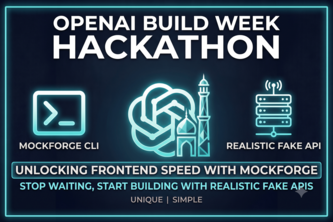
MockForge is a self-reported CLI tool that generates realistic, AI-powered mock APIs from API specification files (e.g., OpenAPI/Swagger). It aims to solve frontend development friction by enabling developers to work with fake but believable data without manual setup or configuration.
What changed
The project was submitted as part of the OpenAI 2026 hackathon. No evidence of prior traction, funding, or commercial activity is provided.
Single most important open question
Is there any evidence that MockForge has been used beyond its own development context, and if so, how does it perform in real-world frontend workflows?
What The Product Actually Is
The description states that MockForge is a CLI tool that takes an API spec file and generates a fake API server returning realistic data, using AI to produce content like emails, names, addresses, and relational data. It is described as generating data that "looks real" rather than placeholder strings.
It uses AI models (e.g., GROQ) to generate context-aware sample data per field and endpoint, and serves this through a lightweight local server mimicking the real endpoints defined in the spec.
Inference The tool appears to be built for frontend developers who need to simulate backend behavior during early-stage development or when backend services are not yet ready.
Positioning & Claim Evolution
The author states that MockForge addresses a common pain point: frontend teams needing to build UIs before backend APIs exist, and the limitations of existing tools (waiting on backend, hand-written data, or generic placeholders).
It positions itself as an improvement over traditional mock tools by generating realistic and consistent data using AI.
Inference The positioning implies a shift from static fixtures or placeholder-based mocking to dynamic, schema-aware, and AI-generated data generation.
Target Customer & ICP
The description states that MockForge is aimed at frontend teams, particularly those working in environments where backend services are not yet available. It is designed for developers who want to simulate real API behavior without manual effort.
Inference The primary customer segment appears to be frontend engineers or full-stack developers working in agile or fast-paced development environments, likely within startups or tech companies with rapid iteration cycles.
Business Model & Pricing Evidence
There is no evidence of a business model or pricing structure in the description. The project is presented as a hackathon submission and lacks any mention of monetization, subscriptions, or paid features.
Not evidenced
Technical & Delivery Signals
The tool is built using:
- CLI interface
- Node.js, Express.js, TypeScript, Python, JavaScript
- OpenAPI support
- GROQ (AI model)
- Local server generation
It claims to handle messy or incomplete specs gracefully and supports a one-command experience without configuration files.
Inference The tool is lightweight and developer-focused, designed for local development use cases rather than production environments.
Traction & Maturity Signals
The description states that the project was submitted to the OpenAI 2026 hackathon. No evidence of revenue, customers, or adoption beyond its own development context is provided.
Not evidenced
Competitive Context
The description does not name specific competitors but implies a gap in the market for tools that generate realistic, consistent, and context-aware mock data instead of generic placeholders.
Inference MockForge likely competes with existing API mocking tools (e.g., Postman, WireMock, Mockoon) that are often static or less sophisticated in their data generation capabilities.
Open Questions & Risks
- The tool is described as a hackathon project, suggesting it may not have been tested in production environments.
- No evidence of real-world usage or feedback from users beyond the team.
- AI-generated data raises questions about consistency, accuracy, and performance under load.
- Lack of support for common formats (e.g., GraphQL) at launch could limit adoption.
- No mention of scalability, security, or enterprise features.
Inference The lack of traction, commercialization, or user feedback makes it difficult to assess whether the tool solves a real market need beyond its own developers.
Questions the description leaves open
- Has MockForge been used by teams outside of the development team? If so, what was the adoption rate and feedback?
- How does the AI model handle edge cases or malformed API specs?
- What is the performance impact of AI generation on local development workflows?
- Are there plans to support enterprise features like authentication, stateful mocking, or sharing configurations across teams?
- Is there any plan for monetization or commercial use beyond the hackathon?
Overall Assessment
The project is presented as a hackathon submission with no evidence of traction, revenue, or customer adoption.
Not evidenced
There is insufficient information to assess whether MockForge has commercial viability or strategic value for investment or partnership. The tool appears to address a real pain point but lacks any demonstration of market validation or scalability beyond its own use case.
User Stories BotA demo video on every pull request
Get a demo video on every new feature
GitHub App that watches your pull requests and records a narrated, captioned demo.
Save time on demo prep and make informed decisions faster with a video walkthrough of every new feature.
Source
Submitted to the OpenAI 2026 hackathon on Devpost. Project home on Devpost. Back to the full gallery on Devpost.
This competitive analysis was produced by top-founders.com (opens in a new tab)
Generated by a language model from this project's public Devpost page — its tagline, the author's own write-up and any built-with tags listed there — as captured in August 2026. Short quotations are the author's words. It is an opinion on the idea as a business, not on the people behind it, and it reflects the description as published then. If the project has moved on, request a correction below. The analysis is not independent research and contains no verified traction, revenue or customer data.
An independent guide by KFG International LLC — not affiliated with, endorsed by, or connected to Devpost or OpenAI.