

Archive position — measured, not model output
4 likes on Devpost
89 of the 7,850 archived projects have more likes, and 39 share exactly 4 — so this project's #113 place in the like-ranked listing is a tie-break inside that group, not a ranking.
Projects (log scale)
Likes on Devpost. ▲ marks this project's group.
Show the figures
| Likes | Projects | Share of archive |
|---|---|---|
| 0 | 5,587 | 71.2% |
| 1 | 1,758 | 22.4% |
| 2 | 284 | 3.6% |
| 3–4 | 132 | 1.7% |
| 5–9 | 75 | 1.0% |
| 10+ | 14 | 0.2% |
 User Stories BotA demo video on every pull request
Get a demo video on every new feature
GitHub App that watches your pull requests and records a narrated, captioned demo.
Save time on demo prep and make informed decisions faster with a video walkthrough of every new feature.
Executive Summary
What the company appears to be
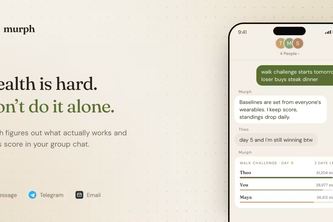
Murph is a self-reported personal health assistant that operates through text-based interfaces (iMessage, Telegram, email) and integrates with wearables, lab reports, and clinical records. It is described as an open-source, private-by-default system built around a "file-native health vault" that supports both individual experimentation and group challenges.
What changed
The project description indicates Murph was already developed before the hackathon but was advanced during Build Week using AI tools like Codex and GPT-5.6 to move from a conversational assistant toward an agent capable of gathering evidence, acting, and following through on health-related tasks.
The single most important open question
Is there sufficient evidence of real-world usage or traction to validate the utility of Murph’s core functionality?
What The Product Actually Is
- The description states Murph is a private-by-default personal health assistant.
- It can be interacted with via iMessage, Telegram, or email.
- It supports connecting supported wearables, lab reports, and clinical records.
- It allows users to run health challenges with friends in group chats, and conduct personal experiments.
- Murph is described as a TypeScript system built around a private, file-native health vault.
- It uses Markdown for human-readable context and append-only event logs for tracking changes.
- The system includes integrations with Next.js, Tailwind, Postgres, Temporal, Cloudflare, and Codex, and supports on-device meal detection and parsing.
Note
The product is described as open-source and self-hostable under Apache 2.0. No revenue or customer data is provided.
Positioning & Claim Evolution
- The project’s tagline states: “Murph is OpenClaw for your health.” This positions Murph as a tool that enables personal autonomy in health management, similar to how OpenClaw (from Interstellar) enabled space exploration.
- The description claims Murph helps users connect the dots across wearables, labs, records, routines, and real life.
- It is positioned as a personal assistant that remembers context, answers questions, suggests next steps, and follows up proactively.
- The evolution from a conversational assistant to an agent capable of gathering evidence, acting, and following through was demonstrated during Build Week.
Inference The positioning implies Murph aims to be a personal health agent rather than just a tool for information retrieval. However, this is not substantiated by usage data or customer feedback.
Target Customer & ICP
- The description states Murph is intended for individuals who want to make health progress easier and less lonely.
- It supports both personal experimentation and group challenges, suggesting a dual audience: individual users and communities.
- Users are expected to be tech-savvy enough to use iMessage, Telegram, or email and potentially self-host the system.
Note
No explicit customer segments, personas, or market size are provided. The description does not indicate whether Murph targets specific demographics (e.g., chronic patients, fitness enthusiasts) or health conditions.
Business Model & Pricing Evidence
- The project is described as open-source and self-hostable.
- It includes a companion app on the App Store, but no pricing information is provided.
- No evidence of monetization strategy, subscription plans, or revenue streams is available.
Inference If Murph is open-source, it may rely on community support or future paid features. However, there is no indication of how this will be monetized.
Technical & Delivery Signals
- Murph is built using TypeScript, with a file-native health vault.
- It uses Markdown for context, and append-only event logs to track provenance.
- The system integrates with Next.js, Tailwind, Postgres, Temporal, Cloudflare, and Codex.
- It includes on-device meal detection and parsing, and supports importing Epic records, lab panels, and wearable data.
- A companion app on the App Store was shipped.
Note
The technical stack is described but not validated. No evidence of scalability or production deployment is provided.
Traction & Maturity Signals
- Murph was already developed before Build Week, and was advanced during a hackathon.
- The authors report using it in their own lives, including running sleep experiments and group challenges.
- They mention onboarding people manually and observing where real-life usage breaks the system.
- A companion app on the App Store was shipped.
Note
No data on user base, retention, or adoption is provided. The project is described as being in early stages of development and testing.
Competitive Context
- The description does not mention specific competitors.
- Murph appears to be positioned in a space that includes personal health assistants, wearable data integrators, and health AI agents.
- It is described as open-source, which may differentiate it from proprietary tools.
Note
No competitive analysis or market positioning relative to existing players is provided.
Open Questions & Risks
- The project is self-reported and unverified, with no third-party validation of its functionality or traction.
- It is described as open-source and self-hostable, which may limit monetization opportunities.
- No evidence of user feedback loops, customer acquisition, or revenue models.
- The system’s reliance on manual onboarding and user testing suggests it is not yet scalable or production-ready.
- The use of GPT-5.6 during Build Week raises questions about whether the project has moved beyond experimental phase.
Inference Without traction or monetization data, Murph may be a prototype or early-stage product with uncertain commercial viability.
Questions the description leaves open
- What is the actual user base and adoption rate of Murph?
- How does Murph ensure data privacy and security in its private-by-default model?
- Are there any plans to monetize the open-source version or offer paid features?
- What are the key challenges users face when using Murph, and how are these being addressed?
- How is the system tested for reliability across different health data sources and integrations?
- What is the long-term roadmap for automation and AI-driven decision-making?
Overall Assessment
- The project is self-reported, unverified, and lacks any evidence of traction, revenue, or customer adoption.
- It is described as a prototype or early-stage product with limited commercial signals.
- The open-source nature and lack of monetization strategy raise questions about scalability and business viability.
Assessment Not evidenced. The project is in an early stage and lacks sufficient commercial due-diligence signals to assess investment or partnership potential. A deeper evaluation would require evidence of user engagement, product-market fit, and a clear path to monetization.
User Stories BotA demo video on every pull request
Get a demo video on every new feature
GitHub App that watches your pull requests and records a narrated, captioned demo.
Save time on demo prep and make informed decisions faster with a video walkthrough of every new feature.
Source
Submitted to the OpenAI 2026 hackathon on Devpost. Project home on Devpost. Back to the full gallery on Devpost.
This competitive analysis was produced by top-founders.com (opens in a new tab)
Generated by a language model from this project's public Devpost page — its tagline, the author's own write-up and any built-with tags listed there — as captured in August 2026. Short quotations are the author's words. It is an opinion on the idea as a business, not on the people behind it, and it reflects the description as published then. If the project has moved on, request a correction below. The analysis is not independent research and contains no verified traction, revenue or customer data.
An independent guide by KFG International LLC — not affiliated with, endorsed by, or connected to Devpost or OpenAI.