

Archive position — measured, not model output
1 like on Devpost
505 of the 7,850 archived projects have more likes, and 1,758 share exactly 1 — so this project's #2,074 place in the like-ranked listing is a tie-break inside that group, not a ranking.
Projects (log scale)
Likes on Devpost. ▲ marks this project's group.
Show the figures
| Likes | Projects | Share of archive |
|---|---|---|
| 0 | 5,587 | 71.2% |
| 1 | 1,758 | 22.4% |
| 2 | 284 | 3.6% |
| 3–4 | 132 | 1.7% |
| 5–9 | 75 | 1.0% |
| 10+ | 14 | 0.2% |
 User Stories BotA demo video on every pull request
Get a demo video on every new feature
GitHub App that watches your pull requests and records a narrated, captioned demo.
Save time on demo prep and make informed decisions faster with a video walkthrough of every new feature.
Executive Summary
What the company appears to be
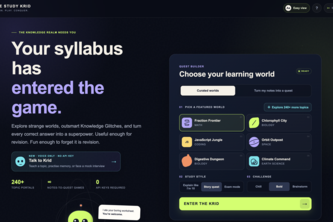
The Study Krid is a self-reported browser-based educational application designed to transform notes, PDFs, speech, and lectures into interactive learning experiences using a voice companion named Krid. It claims to support students with disabilities through accessibility features like speech input, visual adaptations, and non-punitive feedback mechanisms.
What changed
The project was built as a single-day hackathon submission for the OpenAI 2026 hackathon. The author describes it as a proof-of-concept that evolved from a quiz generator into an inclusive game-like learning experience with adaptive feedback and personality-driven interaction.
Single most important open question — commercial due-diligence read
Is there evidence of any traction, revenue, or customer adoption beyond the author’s own development and testing? The description contains no data on usage, users, monetization, or market validation.
What The Product Actually Is
The description states that The Study Krid is a browser-based educational application built with JavaScript, HTML5, CSS3, and various web APIs including SpeechRecognition, SpeechSynthesis, WebAudioAPI, and PDF.js. It supports:
- Conversion of notes, PDFs, and lectures into interactive lessons
- Voice interaction for input and feedback
- In-browser processing without requiring an account or API keys
- A voice companion (Krid) that provides encouragement, quizzes, games, and personalized learning paths
It is described as a Progressive Web App (PWA) with offline support via Service Workers and local storage.
Inference The product appears to be a prototype built for demonstration purposes rather than a production-grade platform. There is no mention of backend infrastructure, user accounts, or scalable delivery mechanisms.
Positioning & Claim Evolution
The author claims the product aims to:
- Turn learning into an “accessible adventure” with quizzes, games, and a humorous voice companion
- Support students with disabilities by enabling speech input, visual adaptations, and non-punitive feedback
- Make learning fun and inclusive for all learners
Inference The positioning evolved from a basic content generator to a more immersive, game-like experience focused on accessibility and emotional engagement. This shift was driven by the author's reflection on educational value and user experience.
Target Customer & ICP
The description states that the target users are:
- Students with disabilities (e.g., those struggling with typing, reading, memorization, communication anxiety)
- Learners who benefit from voice interaction
- Anyone seeking an inclusive, expressive, and playful learning environment
Inference The ICP is narrowly defined around accessibility needs and learners who prefer speech-based interactions. No evidence of broader market segmentation or targeting other demographics (e.g., educators, corporate training, general students).
Business Model & Pricing Evidence
The description states:
- No account, subscription, paid API, or runtime API key is required
- All features are available in-browser without external dependencies
- The app uses local storage and service workers for persistence
Inference There is no evidence of a monetization strategy. The product appears to be free-to-use with no pricing structure, paid tiers, or revenue-generating mechanisms.
Technical & Delivery Signals
The project was built using:
- Modular JavaScript
- Semantic HTML and CSS3
- Web APIs: SpeechRecognition, SpeechSynthesis, WebAudioAPI, WebSpeechAPI
- Libraries: PDF.js, Hugging Face (for optional lecture transcription), Transformers.js
- Tools: GitHub, Node.js, LocalStorage, Service Workers
Inference The technical stack reflects a browser-first approach with strong emphasis on accessibility and offline functionality. However, no evidence of scalability, performance metrics, or deployment infrastructure is provided.
Traction & Maturity Signals
The description states:
- Built within a single day as part of a hackathon
- Submitted as a proof-of-concept
- No mention of user testing, feedback loops, or adoption beyond the author’s own use
- No data on active users, retention, or engagement
Inference There is no evidence of traction, customer acquisition, or product maturity. The project remains in early-stage prototype form.
Competitive Context
The description does not reference any competitors directly. However, it implies a space involving:
- Educational tools with voice interaction
- Accessibility-focused learning platforms
- Gamified learning experiences
- Tools that convert text into quizzes or flashcards
Inference While the author doesn’t name specific competitors, similar products may exist in the educational tech and accessibility sectors. No competitive differentiation or positioning strategy is evident.
Open Questions & Risks
- No traction or revenue evidence: The product is described as a hackathon prototype with no known users or monetization.
- Unverified claims: All descriptions are self-reported; there is no independent validation of functionality or effectiveness.
- Limited scope: No mention of integration capabilities, enterprise features, or long-term roadmap.
- Prototype nature: Built in one day, likely lacks robustness and scalability for real-world deployment.
- No data on accessibility testing: Despite strong claims about inclusion, no evidence of formal user testing with people with disabilities.
Questions the description leaves open
- What specific feedback has been gathered from students or educators who tested the prototype?
- How does the product handle edge cases in real-world note formats (e.g., handwriting, scanned documents)?
- Are there any plans to expand beyond browser-based delivery or add backend services?
- Has the team considered how to scale voice recognition accuracy across different accents and languages?
- What are the long-term goals for monetization or product development?
Overall Assessment
Not evidenced.
The description provides no information on:
- Revenue, ARR, or funding
- Customers or user base
- Product traction or adoption
- Market size or competitive landscape
- Team experience or track record
This is a self-reported hackathon prototype, not a commercial entity. Any investment or partnership decision would require further due diligence into actual usage, market validation, and scalability beyond the author’s own development efforts.
User Stories BotA demo video on every pull request
Get a demo video on every new feature
GitHub App that watches your pull requests and records a narrated, captioned demo.
Save time on demo prep and make informed decisions faster with a video walkthrough of every new feature.
Source
Submitted to the OpenAI 2026 hackathon on Devpost. Project home on Devpost. Back to the full gallery on Devpost.
This competitive analysis was produced by top-founders.com (opens in a new tab)
Generated by a language model from this project's public Devpost page — its tagline, the author's own write-up and any built-with tags listed there — as captured in August 2026. Short quotations are the author's words. It is an opinion on the idea as a business, not on the people behind it, and it reflects the description as published then. If the project has moved on, request a correction below. The analysis is not independent research and contains no verified traction, revenue or customer data.
An independent guide by KFG International LLC — not affiliated with, endorsed by, or connected to Devpost or OpenAI.