

Archive position — measured, not model output
0 likes on Devpost
2,263 of the 7,850 archived projects have more likes, and 5,587 share exactly 0 — so this project's #4,037 place in the like-ranked listing is a tie-break inside that group, not a ranking.
Projects (log scale)
Likes on Devpost. ▲ marks this project's group.
Show the figures
| Likes | Projects | Share of archive |
|---|---|---|
| 0 | 5,587 | 71.2% |
| 1 | 1,758 | 22.4% |
| 2 | 284 | 3.6% |
| 3–4 | 132 | 1.7% |
| 5–9 | 75 | 1.0% |
| 10+ | 14 | 0.2% |
 User Stories BotA demo video on every pull request
Get a demo video on every new feature
GitHub App that watches your pull requests and records a narrated, captioned demo.
Save time on demo prep and make informed decisions faster with a video walkthrough of every new feature.
Executive Summary
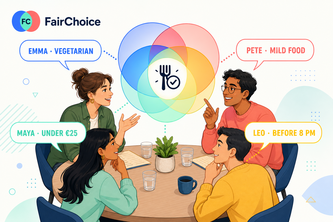
FairChoice is a mobile-first group decision app that claims to help groups find choices everyone can genuinely support without drama. The author, a non-technical medical professional, built it using AI tools like ChatGPT and Codex in a hackathon setting. The app allows hosts to create polls with options, participants to rank choices privately, and aims to balance must-haves against preferences to minimize group regret.
The description states that FairChoice is "very personal" to the author and designed to avoid the loudest voice winning or quiet voices compromising. It includes 24 templates for different decision types (e.g., restaurants, jobs) and integrates Google Maps for location-based decisions. The app supports sharing via QR codes or short links and does not require user accounts.
Key commercial due-diligence read
The project is a self-reported prototype with no evidence of revenue, customers, or adoption. It lacks any demonstration of traction, market validation, or business model clarity beyond the author's own description. The single most important open question is whether this concept has sufficient commercial viability to warrant further investment or partnership consideration — which cannot be answered from the provided information alone.
What The Product Actually Is
The description states that FairChoice is an account-free group decision app designed to help people find choices everyone can genuinely support but without the drama. It allows:
- A host to choose a situation, add options, and share the decision through a short link or QR code.
- Participants to rank choices privately and indicate what matters to them.
- The app to determine which choice causes the least serious disappointment across the group.
- Integration with Google Maps for location-based decisions.
- Support for 24 templates covering various decision types (e.g., restaurants, jobs).
- Mobile-first design with QR sharing and room codes.
It does not require users to have accounts. The author describes it as a tool that balances must-haves against preferences to avoid group tension and ensure no one is left behind.
Inference The app appears to be a single-user-built prototype intended for personal use or small-scale testing, likely in hackathon settings.
Positioning & Claim Evolution
The description states that FairChoice was inspired by the author’s repeated experience of group decision-making becoming complicated due to unspoken needs and preferences. It positions itself as an alternative to majority voting where “the loudest person does not automatically win” and “the quietest person does not have to silently compromise.”
It claims to make complex decisions feel simple, safe, and even fun, aiming to reduce conflict while respecting individual differences such as dietary restrictions, budgets, time constraints, or accessibility needs.
The author emphasizes that FairChoice is not about making decisions for people, but helping them understand one another and find common ground. It also avoids treating unknown facts as negatives, forcing winners when all options hurt someone, assuming popularity equals fairness, or requiring account creation before participation.
Inference The positioning reflects a strong emotional and ethical stance rather than a commercial strategy. There is no evidence of market research, competitive analysis, or pricing strategy beyond the author’s personal vision.
Target Customer & ICP
The description states that FairChoice helps groups choose from various situations including:
- Friends
- Families
- Teams
- Businesses
- Careers
It supports decisions involving:
- Restaurants
- Activities
- Trips
- Meeting places
- Job offers
- Dates
- Film, cinema, format, and showtime combinations
The app is designed for small to medium-sized groups who are looking for a way to make decisions without conflict or negotiation.
It targets users who value inclusivity and fairness in group dynamics, particularly those who want to avoid the “loudest voice” dominating or quiet members silently compromising.
Inference The target customer profile is not clearly defined beyond general categories. No segmentation by demographics, behavior, or usage patterns is evident. The ICP remains speculative based on the author’s personal experience and emotional framing.
Business Model & Pricing Evidence
The description does not provide any information about a business model or pricing structure. It states that FairChoice is an app built in a hackathon setting with no mention of monetization, subscriptions, or revenue streams.
There is no indication of whether the app will be free to use, charge for premium features, or rely on advertising or data sales.
Inference No evidence exists regarding how FairChoice intends to generate value or sustain itself financially. The business model remains undefined.
Technical & Delivery Signals
The project was built using:
- AI tools: ChatGPT, Codex (with GPT-5.6 Sol)
- Frameworks and libraries: React, TypeScript, Vite
- Hosting and infrastructure: Cloudflare D1, Cloudflare Workers
- APIs: Google Maps Platform, MovieGlu API
- Tools: GitHub, ZXing for QR codes
The author reports that Codex helped implement features, debug integrations, write tests, and deploy the app. It also supported iterative improvements based on user feedback.
It includes:
- Location search via Google Maps
- QR code sharing
- Room codes for polling
- Mobile support
- Explainable results
- Automated testing
The app currently stores votes locally on the device where they are submitted, though real-time voting across devices is noted as a future feature.
Inference The technical stack suggests a modern, lightweight web application built with AI assistance. However, there is no evidence of scalability, performance metrics, or production-grade architecture beyond the prototype stage.
Traction & Maturity Signals
The description states that FairChoice was tested by friends and family in the last 48 hours before submission to the hackathon. It is described as a deployed application with:
- A real decision engine
- Automated tests
- Location search
- QR sharing
- Short room codes
- Mobile support
- Explainable results
It has 24 templates and supports multiple decision types.
However, there is no evidence of:
- Revenue or monetization
- Customer base or user adoption
- Market traction or growth data
- Product-market fit validation
- Any form of commercial use beyond the author’s own testing
Inference The project shows early-stage development maturity but lacks any indication of real-world usage or market traction.
Competitive Context
The description does not mention any competitors. It focuses solely on the unique value proposition of FairChoice — balancing must-haves and preferences to minimize regret, without requiring accounts, and avoiding traditional majority voting.
It implies that existing solutions do not adequately address group decision-making challenges related to fairness, inclusivity, or emotional safety.
Inference No competitive landscape is described. The author does not reference similar tools or platforms, nor does the description suggest awareness of existing alternatives in this space.
Open Questions & Risks
- No commercial viability evidence: There is no indication of revenue, customers, or adoption.
- Unproven business model: No pricing strategy, monetization plan, or sustainability mechanism is described.
- Limited technical depth: The app was built by a non-technical person using AI tools; lack of scalable architecture or performance data.
- Self-reported only: All claims are based on the author’s own account and have not been independently verified.
- No market validation: No evidence of user feedback, testing, or demand beyond personal use.
- Unclear scalability: Voting is currently stored locally; real-time multi-device voting is a future feature.
- Lack of team structure: Only one member listed (Sunny Sonnendeck), suggesting limited operational capacity.
Inference The project presents high risk due to lack of evidence for commercial viability, traction, or sustainable growth potential.
Questions the description leaves open
- What specific market pain point are you solving, and how do you know it exists?
- Have you validated your idea with real users outside of friends and family?
- How do you plan to monetize the product, and what is your go-to-market strategy?
- What are the technical limitations or scalability concerns with current architecture?
- Are there any legal or privacy implications related to storing user data locally or handling sensitive preferences?
- What is your roadmap for moving from prototype to a production-ready, scalable version?
- How do you intend to compete with existing group decision-making tools (if any)?
- Have you considered how users will be onboarded and retained?
- What are the key metrics you would track to measure success or failure?
- Is there any plan for user feedback loops or continuous improvement beyond the current prototype?
Overall Assessment
The description states that FairChoice is a self-reported prototype built in a hackathon setting by one individual with no prior software development experience. It includes basic functionality but lacks evidence of traction, revenue, customer adoption, or business model clarity.
There is no indication of market validation, competitive positioning, or commercial readiness beyond the author’s personal vision.
Assessment Not suitable for investment or partnership consideration at this stage. The project requires significant further development, testing, and evidence of market demand before any strategic decision can be made.
User Stories BotA demo video on every pull request
Get a demo video on every new feature
GitHub App that watches your pull requests and records a narrated, captioned demo.
Save time on demo prep and make informed decisions faster with a video walkthrough of every new feature.
Source
Submitted to the OpenAI 2026 hackathon on Devpost. Project home on Devpost. Back to the full gallery on Devpost.
This competitive analysis was produced by top-founders.com (opens in a new tab)
Generated by a language model from this project's public Devpost page — its tagline, the author's own write-up and any built-with tags listed there — as captured in August 2026. Short quotations are the author's words. It is an opinion on the idea as a business, not on the people behind it, and it reflects the description as published then. If the project has moved on, request a correction below. The analysis is not independent research and contains no verified traction, revenue or customer data.
An independent guide by KFG International LLC — not affiliated with, endorsed by, or connected to Devpost or OpenAI.