

Archive position — measured, not model output
0 likes on Devpost
2,263 of the 7,850 archived projects have more likes, and 5,587 share exactly 0 — so this project's #7,164 place in the like-ranked listing is a tie-break inside that group, not a ranking.
Projects (log scale)
Likes on Devpost. ▲ marks this project's group.
Show the figures
| Likes | Projects | Share of archive |
|---|---|---|
| 0 | 5,587 | 71.2% |
| 1 | 1,758 | 22.4% |
| 2 | 284 | 3.6% |
| 3–4 | 132 | 1.7% |
| 5–9 | 75 | 1.0% |
| 10+ | 14 | 0.2% |
 User Stories BotA demo video on every pull request
Get a demo video on every new feature
GitHub App that watches your pull requests and records a narrated, captioned demo.
Save time on demo prep and make informed decisions faster with a video walkthrough of every new feature.
Executive Summary
What the company appears to be
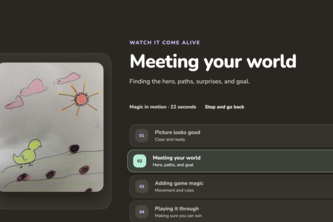
Team SahayakAgent is a self-contained, single-person project that claims to transform children’s hand-drawn artwork into playable browser-based games using AI. The author states it uses GPT-5.6 for understanding drawings and Codex for generating game code, with a focus on fidelity to the original drawing.
What changed
This appears to be an experimental prototype or hackathon submission, not a commercial product. It was submitted to the OpenAI 2026 hackathon and is described as a proof-of-concept built in a short timeframe.
Single most important open question
Is this a viable path toward a scalable SaaS or consumer product, or is it a one-off technical demonstration?
Note: The description is self-reported and unverified. All claims are based on the author's own account and not independently corroborated. No evidence of revenue, customers, traction, or commercial viability exists beyond what is stated.
What The Product Actually Is
The description states that Team SahayakAgent transforms a photo of any drawing into a playable game in a browser. The key features include:
- Input: Any drawing on paper (photo taken with phone)
- Output: A playable game built from the actual drawing
- Core functionality:
- GPT-5.6 interprets the drawing and generates a structured spec
- Codex writes code for behaviors based on that spec
- Code runs in a sandboxed environment
- Simulator validates gameplay before release
- No accounts, no data storage, no sharing unless user chooses to
- Runs in browser on mobile devices
Inference: The system appears to be an experimental pipeline built around AI models for interpretation and code generation. It is not described as a commercial product or platform.
Positioning & Claim Evolution
The author positions the project as a way to bring children’s drawings into playable reality, with a nostalgic nod to personal creativity in childhood games.
Claims:
- “You draw a world and then you close the book” → The product changes this by enabling play.
- “Nothing is impossible” with AI models like GPT 5.2 → Suggests advanced capabilities.
- “The crayon stays crayon” → Emphasizes fidelity to original drawing.
- “It never lies about what it can do” → Highlights honesty and transparency in system behavior.
Inference: The positioning is nostalgic, child-focused, and emphasizes the emotional connection between creator and creation. It does not appear to be a commercial positioning strategy but rather a personal project with potential future expansion.
Target Customer & ICP
The description states:
- Primary user: A child (specifically a 3-year-old nephew)
- Secondary audience: Parents or caregivers who value creative expression
- Use case: Transforming drawings into interactive games
Inference: The target customer is likely parents or educators looking for tools that encourage creativity in young children. However, there is no evidence of market research, segmentation, or defined personas beyond the author’s personal experience.
Business Model & Pricing Evidence
Not evidenced.
The description does not mention:
- Revenue streams
- Pricing models
- Monetization strategy
- Subscription plans or one-time purchases
- Targeted business verticals
Absence of evidence: No indication of how this would be monetized if scaled.
Technical & Delivery Signals
Key technical elements mentioned:
- Uses GPT-5.6 for vision and understanding
- Codex for code generation
- JavaScript, Node.js, Phaser.js, Python, Vite stack
- Sandboxed execution environment
- Simulator validates gameplay before release
- Model contracts are enforced to prevent errors
Inference: The system is built around a multi-model pipeline with strong emphasis on correctness and sandboxing. It shows technical sophistication but lacks evidence of production-grade infrastructure or scalability.
Traction & Maturity Signals
Not evidenced.
The description states:
- Ten drawings, ten playable games
- Repeated runs show consistent results
- Tested with a 3-year-old’s scribble
- Delivered to family members for testing
Absence of evidence: No data on adoption, user engagement, or market traction. The project is described as a prototype, not a product in use.
Competitive Context
Not evidenced.
The description does not:
- Mention competitors
- Describe the broader marketplace
- Compare to existing tools for drawing-to-game conversion
- Reference similar products or platforms
Absence of evidence: No competitive analysis or positioning within an industry exists.
Open Questions & Risks
- Single-person operation – Limited capacity for scaling, iteration, or maintenance.
- Unverified claims – The author states “nothing is impossible” and “the crayon stays crayon,” but these are not independently verified.
- No commercial model – No evidence of monetization strategy or business plan.
- Prototype nature – Submitted to a hackathon; no indication of long-term development or productization.
- Technical complexity without production data – While the architecture is described, there’s no evidence of robustness in real-world usage.
Inference: The project is experimental and not yet a commercial entity. Risks include lack of scalability, unclear monetization, and limited team capacity.
Questions the description leaves open
- What are the actual technical limitations of the current pipeline?
- How does the system handle edge cases or complex drawings?
- Is there any plan to scale beyond a single developer?
- What would be required to move from prototype to product?
- Are there any plans for monetization or user acquisition?
- How do you intend to validate that the system works reliably across different drawing styles and complexity levels?
Overall Assessment
Not evidenced.
There is no evidence of:
- Funding rounds
- Valuation
- Investor interest
- Strategic partnerships
- Commercial traction
Inference: This appears to be a personal project or hackathon submission, not a venture-ready company. It may have potential for future development but currently lacks the commercial foundation for investment or partnership consideration.
User Stories BotA demo video on every pull request
Get a demo video on every new feature
GitHub App that watches your pull requests and records a narrated, captioned demo.
Save time on demo prep and make informed decisions faster with a video walkthrough of every new feature.
Source
Submitted to the OpenAI 2026 hackathon on Devpost. Project home on Devpost. Back to the full gallery on Devpost.
This competitive analysis was produced by top-founders.com (opens in a new tab)
Generated by a language model from this project's public Devpost page — its tagline, the author's own write-up and any built-with tags listed there — as captured in August 2026. Short quotations are the author's words. It is an opinion on the idea as a business, not on the people behind it, and it reflects the description as published then. If the project has moved on, request a correction below. The analysis is not independent research and contains no verified traction, revenue or customer data.
An independent guide by KFG International LLC — not affiliated with, endorsed by, or connected to Devpost or OpenAI.