

Archive position — measured, not model output
0 likes on Devpost
2,263 of the 7,850 archived projects have more likes, and 5,587 share exactly 0 — so this project's #3,240 place in the like-ranked listing is a tie-break inside that group, not a ranking.
Projects (log scale)
Likes on Devpost. ▲ marks this project's group.
Show the figures
| Likes | Projects | Share of archive |
|---|---|---|
| 0 | 5,587 | 71.2% |
| 1 | 1,758 | 22.4% |
| 2 | 284 | 3.6% |
| 3–4 | 132 | 1.7% |
| 5–9 | 75 | 1.0% |
| 10+ | 14 | 0.2% |
 User Stories BotA demo video on every pull request
Get a demo video on every new feature
GitHub App that watches your pull requests and records a narrated, captioned demo.
Save time on demo prep and make informed decisions faster with a video walkthrough of every new feature.
Executive Summary
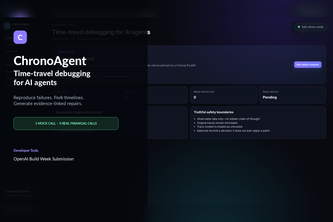
ChronoAgent is presented by its author as a tool for recording AI-agent executions, replaying failures, and enabling root-cause analysis using GPT-5.6 and Codex. It claims to support timeline forking, human-in-the-loop fixes, and deployment review before execution.
The description is self-reported and unverified. No evidence of revenue, customers, or traction is provided. The author states the tool was built for the OpenAI 2026 hackathon, suggesting it may be early-stage or experimental.
Key open question
What is the actual use case for this tool? The description does not clarify whether ChronoAgent targets developers building agents, teams managing agent deployments, or a specific failure scenario. Without further detail, its commercial viability and applicability remain unclear.
What The Product Actually Is
The description states that ChronoAgent records AI-agent runs, safely replays failures, forks timelines, finds root causes with GPT-5.6, and uses Codex to propose tested, reviewable fixes with human approval before deployment.
It is described as a tool for debugging and managing agent-based workflows, with features including:
- Recording of agent execution
- Replay of failures
- Timeline forking
- Root cause analysis using GPT-5.6
- Fix generation via Codex
- Human-in-the-loop review and deployment
Inference The product appears to be a debugging or observability tool for AI agents, likely in development or testing environments.
Not evidenced No details on how the tool integrates with existing workflows, what types of agents it supports, or whether it is a standalone tool or part of a larger platform.
Positioning & Claim Evolution
The author states that ChronoAgent is designed to "record AI-agent runs, safely replays failures, forks timelines, finds root causes with GPT-5.6, and uses Codex to propose tested, reviewable fixes with human approval before deployment."
This positioning implies a tool for debugging and managing AI agents, particularly in contexts where agent behavior needs to be traced, replayed, or corrected.
Inference The product is positioned as an observability or debugging tool for AI agents, possibly targeting developers or teams working on agent-based systems.
Not evidenced No evidence of prior positioning or evolution of claims. The description does not indicate whether this is a new idea or a refinement of an existing concept.
Target Customer & ICP
The author states that ChronoAgent is for recording AI-agent runs and replaying failures, suggesting it targets users who are building, testing, or managing AI agents.
Inference The target customer likely includes developers or engineering teams working with AI agents, particularly in environments where agent behavior needs to be debugged or improved.
Not evidenced No specific customer segments, personas, or use cases are described. There is no indication of whether the tool targets startups, enterprises, or individual developers.
Business Model & Pricing Evidence
The description does not contain any information about pricing, revenue streams, or business model.
Not evidenced No evidence of how the product would be monetized, whether it's a SaaS offering, open-source, or a one-time tool.
Technical & Delivery Signals
The author declares that ChronoAgent was built using:
- agentic, agents, ai, codex, compose, debugging, developer, docker, fastapi, fault, github, gpt-5.6, human-in-the-loop, injection, observability, openai, pydantic, pytest, python, regression, replay, sqlite, tools
This suggests a developer-focused tool, likely built in Python with AI and debugging capabilities.
Inference The tool is likely a developer utility or internal tool for debugging agent-based systems, possibly integrated into CI/CD pipelines or development environments.
Not evidenced No information on delivery mechanism (e.g., web app, CLI, plugin), deployment model, or scalability.
Traction & Maturity Signals
The project was submitted to the OpenAI 2026 hackathon, suggesting it is in an early stage of development.
Inference The tool may be experimental or prototype-level, not yet ready for production use.
Not evidenced No evidence of user adoption, customer feedback, revenue, or product maturity beyond its hackathon submission.
Competitive Context
The description does not mention any direct competitors, nor does it describe how ChronoAgent compares to existing tools in the AI-agent debugging or observability space.
Inference The tool may be a novel idea or an experimental take on agent debugging, but no competitive landscape is described.
Not evidenced No evidence of existing tools or platforms that perform similar functions.
Open Questions & Risks
- Unproven commercial viability: The tool was submitted to a hackathon and lacks any evidence of traction or revenue.
- Unclear target use case: The description does not clarify who uses the tool or in what context, making it hard to assess demand.
- No pricing or monetization model: No indication of how the product would be sold or funded.
- Highly technical and niche: The tool appears to be aimed at developers working with AI agents, a potentially narrow market.
Questions the description leaves open
- What specific problem are you solving for users?
- Who are your early adopters or target customers?
- How does this tool integrate into existing workflows or development environments?
- What is the expected path to monetization?
- Have you validated the need for this tool with potential users?
- What are the technical limitations of the current prototype?
Overall Assessment
Not evidenced: No evidence of revenue, traction, or market validation exists in the description.
The author states that ChronoAgent is a hackathon project, and no further commercial or product development details are provided.
Inference This tool may be an early-stage idea or prototype with potential, but lacks sufficient evidence to assess its viability for investment or partnership.
Confidence: Low. The description is self-reported, unverified, and lacks any commercial signals.
User Stories BotA demo video on every pull request
Get a demo video on every new feature
GitHub App that watches your pull requests and records a narrated, captioned demo.
Save time on demo prep and make informed decisions faster with a video walkthrough of every new feature.
Source
Submitted to the OpenAI 2026 hackathon on Devpost. Project home on Devpost. Back to the full gallery on Devpost.
This competitive analysis was produced by top-founders.com (opens in a new tab)
Generated by a language model from this project's public Devpost page — its tagline and any built-with tags listed there, since the author published no write-up — as captured in August 2026. Short quotations are the author's words. It is an opinion on the idea as a business, not on the people behind it, and it reflects the description as published then. If the project has moved on, request a correction below. The analysis is not independent research and contains no verified traction, revenue or customer data.
An independent guide by KFG International LLC — not affiliated with, endorsed by, or connected to Devpost or OpenAI.