

Archive position — measured, not model output
0 likes on Devpost
2,263 of the 7,850 archived projects have more likes, and 5,587 share exactly 0 — so this project's #5,203 place in the like-ranked listing is a tie-break inside that group, not a ranking.
Projects (log scale)
Likes on Devpost. ▲ marks this project's group.
Show the figures
| Likes | Projects | Share of archive |
|---|---|---|
| 0 | 5,587 | 71.2% |
| 1 | 1,758 | 22.4% |
| 2 | 284 | 3.6% |
| 3–4 | 132 | 1.7% |
| 5–9 | 75 | 1.0% |
| 10+ | 14 | 0.2% |
 User Stories BotA demo video on every pull request
Get a demo video on every new feature
GitHub App that watches your pull requests and records a narrated, captioned demo.
Save time on demo prep and make informed decisions faster with a video walkthrough of every new feature.
Executive Summary
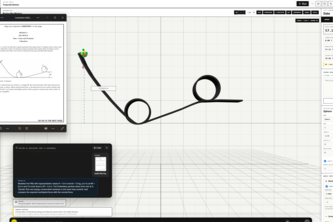
What the company appears to be: Mechanarium is a self-reported interactive 3D physics sandbox and virtual laboratory designed for AP Physics 1, AP Physics C: Mechanics, and introductory university-level physics education. It allows users to construct physical systems, observe their motion in real time, record measurements, and explore core principles through simulation.
What changed: The project evolved from a single student's AP Physics C: Mechanics final project into what the author describes as a multi-topic physics laboratory with built-in curriculum-aligned experiments, measurement instrumentation, telemetry, and AI-assisted guidance. It includes a deterministic 120 Hz physics engine using velocity Verlet integration, support for complex mechanical systems like compound pendulums and Atwood machines, and tools for data export.
Single most important open question: Is there evidence of traction or adoption beyond the author's own classroom? The description states no revenue, customers, or usage metrics are available — only self-reported claims about impact in a local educational setting.
What The Product Actually Is
The description states that Mechanarium is an interactive mechanics sandbox and virtual laboratory. It is built using JavaScript, React 18, Vite, and Three.js. The product features:
- A 3D environment powered by Three.js
- A deterministic 2D planar physics simulation loop running at 120 Hz
- Support for constructing and analyzing various mechanical systems (projectiles, collisions, pendulums, Atwood machines, etc.)
- Built-in curriculum-aligned experiments
- Measurement instrumentation (rulers, photogates)
- Telemetry and data export capabilities (CSV/JSON)
- An AI agent named Vector that provides Socratic guidance
The author describes the physics engine as implementing a velocity Verlet integrator with symplectic structure for energy preservation. The system supports curved tracks modeled using $C^2$ quintic Hermite splines.
Evidence: Self-reported by the author; no independent verification or external data provided.
Positioning & Claim Evolution
The author positions Mechanarium as a tool to bridge abstract physics concepts with visual, hands-on experimentation. It is described as addressing a fundamental challenge in STEM education: helping students connect theoretical equations with real-world motion.
Key claims include:
- The product helps students discover physical principles directly from data
- It supports AP Physics and introductory university courses
- It integrates AI for problem parsing, world building, and guidance
The evolution appears to be from an individual student project to a more comprehensive educational tool with built-in experiments, measurement tools, and AI integration.
Evidence: Self-reported; no external validation or market positioning data provided.
Target Customer & ICP
The description states that Mechanarium targets:
- AP Physics 1 students
- AP Physics C: Mechanics students
- Introductory university physics students
It is described as being aligned with curriculum standards and designed for classroom use.
Evidence: Self-reported; no information on actual customer base, adoption rate, or specific institutional users provided.
Business Model & Pricing Evidence
There is no evidence of a business model or pricing structure in the description. The author does not mention any monetization strategy, subscription plans, licensing fees, or sales channels.
Evidence: Not evidenced.
Technical & Delivery Signals
The product is built using:
- JavaScript
- React 18
- Vite
- Three.js
- Node.js
- OpenAI API (for Vector AI agent)
- GitHub for version control
- Webpack-like build system via Vite
Technical details include:
- Physics engine with fixed timestep at 120 Hz
- Velocity Verlet integration method
- Support for $C^2$ Hermite splines
- Integration of LLMs (GPT-5.6 Luna, Gemini, Claude) in development workflow
- Local fallback for AI agent when remote LLM is unavailable
The author also describes troubleshooting challenges related to physics bugs and AI hallucinations.
Evidence: Self-reported; no external validation or delivery performance metrics provided.
Traction & Maturity Signals
There is no evidence of traction, revenue, customer adoption, or usage statistics. The description mentions:
- A local classroom impact
- Teacher interest in the tool
- Personal achievement from seeing immediate viability in learning
However, these are not quantified or verified.
Evidence: Not evidenced.
Competitive Context
The description does not provide any information about competitors or market context. No mention of existing physics simulators, educational platforms, or similar tools is made.
Evidence: Not evidenced.
Open Questions & Risks
- No traction or revenue evidence: The product exists only in self-reported form with no verified adoption.
- Single-person team: Only one member listed (Dani Vasquez), which raises questions about scalability and long-term maintenance.
- Unverified claims: All assertions are self-reported without corroboration.
- Limited commercialization path: No indication of how the product would be monetized or scaled beyond a classroom setting.
- AI dependency: Reliance on LLMs for key functionality introduces potential instability and hallucination risks.
Evidence: Inferred from lack of external data, team size, and self-reporting nature.
Questions the description leaves open
- What specific feedback have you received from educators or students using this tool outside of your own classroom?
- How do you plan to scale beyond a single developer’s capacity?
- Are there any plans for monetization or commercial partnerships?
- Have you identified any institutional users or pilot programs?
- What are the technical limitations of the current physics engine that might prevent broader use cases?
- How does the AI agent (Vector) perform under different conditions, and what is its reliability in real-world scenarios?
Evidence: Inferred from lack of information in description.
Overall Assessment
There is no evidence to support a commercial or investment case at this time. The product is described as a personal project with limited external validation, no revenue, no customers, and no clear path to monetization or scalability.
Evidence: Self-reported only; no traction or financial data available.
User Stories BotA demo video on every pull request
Get a demo video on every new feature
GitHub App that watches your pull requests and records a narrated, captioned demo.
Save time on demo prep and make informed decisions faster with a video walkthrough of every new feature.
Source
Submitted to the OpenAI 2026 hackathon on Devpost. Project home on Devpost. Back to the full gallery on Devpost.
This competitive analysis was produced by top-founders.com (opens in a new tab)
Generated by a language model from this project's public Devpost page — its tagline, the author's own write-up and any built-with tags listed there — as captured in August 2026. Short quotations are the author's words. It is an opinion on the idea as a business, not on the people behind it, and it reflects the description as published then. If the project has moved on, request a correction below. The analysis is not independent research and contains no verified traction, revenue or customer data.
An independent guide by KFG International LLC — not affiliated with, endorsed by, or connected to Devpost or OpenAI.