

Archive position — measured, not model output
0 likes on Devpost
2,263 of the 7,850 archived projects have more likes, and 5,587 share exactly 0 — so this project's #5,204 place in the like-ranked listing is a tie-break inside that group, not a ranking.
Projects (log scale)
Likes on Devpost. ▲ marks this project's group.
Show the figures
| Likes | Projects | Share of archive |
|---|---|---|
| 0 | 5,587 | 71.2% |
| 1 | 1,758 | 22.4% |
| 2 | 284 | 3.6% |
| 3–4 | 132 | 1.7% |
| 5–9 | 75 | 1.0% |
| 10+ | 14 | 0.2% |
 User Stories BotA demo video on every pull request
Get a demo video on every new feature
GitHub App that watches your pull requests and records a narrated, captioned demo.
Save time on demo prep and make informed decisions faster with a video walkthrough of every new feature.
Executive Summary
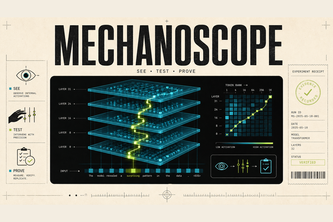
What the company appears to be: Mechanoscope is an open-source observatory for open-weight language models, designed to support controlled, replayable interpretability experiments. The product includes two core instruments — Jacobian Lens and Activation Steering — and integrates a GPT-5.6 research copilot that translates natural-language hypotheses into structured experiment plans.
What changed: The project is presented as a self-contained tool for scientific workflow in AI interpretability, with an emphasis on reproducibility, evidence boundaries, and human-in-the-loop execution. It leverages open-source technologies like FastAPI, React, PyTorch, and Modal, and integrates OpenAI’s GPT-5.6 as part of its core functionality.
Single most important open question: Is there a real-world use case or demand for this type of controlled interpretability tooling among researchers or developers working with language models? The description does not indicate any customers, revenue, or adoption, and the product is presented as an open-source hackathon submission.
What The Product Actually Is
The description states that Mechanoscope is an open-source observatory for open-weight language models. It provides two interpretability instruments:
- Jacobian Lens, which shows how small changes at intermediate layers influence the model's final representation, with linked 2D and 3D views.
- Activation Steering, which constructs a contrastive residual-stream direction and compares a matched baseline with an intervention using the same prompt, seed, and generation settings.
The system also includes:
- A Claim Check feature that explicitly reports supported conclusions, incompatibilities, and what the evidence cannot prove.
- An experiment receipt mechanism that preserves prompts, model revisions, parameters, outputs, timing, and provenance for replaying, forking, comparing, sharing, or exporting.
- A GPT-5.6 research copilot, which translates hypotheses into typed experiment plans and explains structured evidence.
The system is built using:
- Frontend: React, TypeScript, React Three Fiber
- Backend: FastAPI, PyTorch, Modal
- Tools: OpenAI Codex (for engineering assistance), OpenAI GPT-5.6 (as reasoning layer)
Not evidenced: No mention of pricing, monetization, or commercial use cases.
Positioning & Claim Evolution
The description states that Mechanoscope aims to "help a researcher state a hypothesis, plan a controlled experiment, inspect internal representations, intervene on the model, preserve the results, and understand what the evidence does—and does not—support."
It positions itself as an alternative to "stitching together research repositories, notebooks, GPU jobs, and disconnected visualizations," aiming for a "careful scientific workflow."
The project also claims that:
- It makes interpretability feel less like a collection of demos and more like a scientific process.
- The GPT-5.6 copilot is part of the product itself and helps with planning, execution, and explanation.
- It emphasizes scientific honesty, reproducibility, and explicit limits on what experiments can prove.
Inference: The positioning suggests a niche audience: researchers or developers working in AI interpretability or model debugging, but there is no evidence of market traction or demand.
Target Customer & ICP
The description states that Mechanoscope is for researchers who want to:
- State hypotheses
- Plan controlled experiments
- Inspect internal representations
- Intervene on models
- Preserve and replay results
It is described as an observatory for open-weight language models, suggesting a focus on users working with publicly available models.
Not evidenced: No specific customer segments, personas, or use cases beyond the general researcher profile are provided. No indication of whether this is aimed at academic researchers, industry practitioners, or developers in AI labs.
Business Model & Pricing Evidence
The description states that Mechanoscope is open-source, and that it was built for a hackathon.
There is no mention of:
- Pricing
- Monetization
- Commercial licensing
- Revenue streams
- Paid features or tiers
Not evidenced: No evidence of any business model beyond the open-source nature of the project.
Technical & Delivery Signals
The system is built with:
- Frontend: React, TypeScript, React Three Fiber
- Backend: FastAPI, PyTorch, Modal
- AI Integration: GPT-5.6 as reasoning layer; OpenAI Codex used for development assistance
- Execution: GPU compute on-demand via Modal
- Protocol: Model Context Protocol (MCP) is used for communication between tools
The system supports:
- Durable experiment receipts
- Replay, fork, and comparison of experiments
- Streamable HTTP MCP server
- Typed experiment contracts
- Scientific guardrails
Inference: The technical stack suggests a developer-oriented tool with strong backend and AI integration. However, the lack of production deployment or user feedback is not evidenced.
Traction & Maturity Signals
The description states that this was built for the OpenAI 2026 hackathon, and that it is an open-source project.
There is no evidence of:
- Customers
- Revenue
- Adoption
- Product usage metrics
- Deployment in production environments
- User feedback or community engagement
Not evidenced: No traction or maturity signals beyond a hackathon submission.
Competitive Context
The description does not mention any direct competitors. It focuses on the scientific workflow and controlled interpretability, which are areas of growing interest in AI research, but no comparison to existing tools is made.
Inference: The project appears to be positioned in a niche space — interpretability tools for language models — where it may compete with or complement tools like:
- LLM interpretability frameworks
- Model debugging platforms
- Research notebooks and experiment tracking systems
However, no competitive landscape is described, and no evidence of existing solutions is provided.
Open Questions & Risks
- No commercial traction: The project is presented as a hackathon submission with no evidence of adoption or revenue.
- Highly technical niche: Interpretability tools are not mainstream, and the target audience may be limited.
- Dependency on GPT-5.6: The system relies heavily on OpenAI’s proprietary model, which could pose risks if access changes.
- Open-source only: Without a monetization strategy or commercial offering, it is unclear how this will scale or generate value.
- Unproven demand: There is no evidence that researchers or developers actually need this specific type of workflow.
Questions the description leaves open
- What specific use cases have you identified for Mechanoscope in real-world AI research?
- How do you plan to monetize or sustain the project beyond the open-source model?
- Have you tested the system with actual researchers or labs? If so, what feedback did you get?
- What are the limitations of GPT-5.6’s role in the system, and how do you ensure it doesn’t introduce bias or errors?
- How does Mechanoscope handle edge cases or failures in GPU execution or model loading?
- Are there any plans to integrate with existing experiment tracking tools (e.g., MLflow, Weights & Biases)?
- What is the long-term roadmap for expanding interpretability instruments and model support?
Overall Assessment
Not evidenced: There is no evidence of a commercial product, revenue, or customer base. The project is described as an open-source hackathon submission with no indication of traction or scalability.
The description suggests that Mechanoscope could be valuable for AI interpretability researchers, but it does not indicate whether there is sufficient market demand to justify investment or partnership.
Confidence: Low — the evidence provided is limited to a self-reported project description, and no independent validation or commercial signals are present.
User Stories BotA demo video on every pull request
Get a demo video on every new feature
GitHub App that watches your pull requests and records a narrated, captioned demo.
Save time on demo prep and make informed decisions faster with a video walkthrough of every new feature.
Source
Submitted to the OpenAI 2026 hackathon on Devpost. Project home on Devpost. Back to the full gallery on Devpost.
This competitive analysis was produced by top-founders.com (opens in a new tab)
Generated by a language model from this project's public Devpost page — its tagline, the author's own write-up and any built-with tags listed there — as captured in August 2026. Short quotations are the author's words. It is an opinion on the idea as a business, not on the people behind it, and it reflects the description as published then. If the project has moved on, request a correction below. The analysis is not independent research and contains no verified traction, revenue or customer data.
An independent guide by KFG International LLC — not affiliated with, endorsed by, or connected to Devpost or OpenAI.