

Archive position — measured, not model output
0 likes on Devpost
2,263 of the 7,850 archived projects have more likes, and 5,587 share exactly 0 — so this project's #7,167 place in the like-ranked listing is a tie-break inside that group, not a ranking.
Projects (log scale)
Likes on Devpost. ▲ marks this project's group.
Show the figures
| Likes | Projects | Share of archive |
|---|---|---|
| 0 | 5,587 | 71.2% |
| 1 | 1,758 | 22.4% |
| 2 | 284 | 3.6% |
| 3–4 | 132 | 1.7% |
| 5–9 | 75 | 1.0% |
| 10+ | 14 | 0.2% |
 User Stories BotA demo video on every pull request
Get a demo video on every new feature
GitHub App that watches your pull requests and records a narrated, captioned demo.
Save time on demo prep and make informed decisions faster with a video walkthrough of every new feature.
Executive Summary
What the company appears to be
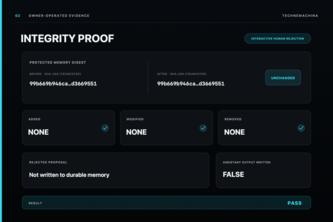
Technemachina: Integrity Demonstrator is a self-reported proof-of-concept project that explores governance of AI memory through cryptographic integrity checks. It demonstrates how an AI system might propose changes to persistent memory, which are then rejected by a human owner, and how such a system could prove that the protected memory remained unchanged even after a provider failure.
What changed
The author states this is part of a broader "Technemachina" vision, but only a focused demonstration was built during OpenAI Build Week. The project uses tools like GPT-5.6, Codex, Python, and SQLite to simulate a controlled scenario involving memory governance, rejection, and cryptographic verification.
Single most important open question
Is there any evidence of traction, revenue, or adoption beyond this one demonstration? The description provides no data on customers, usage, or commercial viability — only a self-contained technical showcase.
What The Product Actually Is
The description states that Technemachina: Integrity Demonstrator is a local-first Python application designed to test and demonstrate how AI memory can be governed with human approval. It includes:
- A deterministic demonstration fixture
- Canonical protected-memory projection
- Before-and-after cryptographic digests
- Structural state diffing
- Deterministic provider-failure injection
- An append-only audit trail
- Machine-readable verification evidence
It is described as a controlled scenario that verifies whether protected memory remained unchanged after an AI proposal was rejected and a provider failed.
Inference The product is not a production-ready system but rather a testbed for demonstrating principles of AI memory integrity under specific conditions.
Positioning & Claim Evolution
The author claims that the project addresses a core concern in AI systems: how to verify that an AI did not silently alter its permanent memory. This is positioned as a governance challenge, where human ownership and control over durable memory are central.
It builds on a broader "Technemachina" vision, which implies a long-term goal of building accountable persistent AI companions.
Inference The project is framed as an early-stage exploration into AI memory governance, not a commercial offering. It does not claim to be a finished product or platform.
Target Customer & ICP
Not evidenced.
The description does not identify any specific customer segment or ideal customer profile (ICP). It focuses on the technical demonstration rather than market targeting or user personas.
Business Model & Pricing Evidence
Not evidenced.
There is no mention of pricing, monetization strategy, or business model in the project description. The author refers to a broader vision but does not describe how this would be turned into a revenue-generating product or service.
Technical & Delivery Signals
The author states that the system was built using:
- Tools: Codex, GPT-5.6, git, GitHub, Python, JSON, pytest, SHA-256, SQLite
- Architecture: Local-first, governed memory, provenance tracking, owner-controlled mutation, provider routing, append-only audit trail
- Features: Deterministic failure handling, cryptographic integrity proofs, structural diffing, machine-readable verification
The system is described as a demonstration, not a scalable or production-ready solution.
Inference The technical approach shows some sophistication in handling memory integrity and audit trails, but the delivery is limited to a single demonstration with no indication of scalability or integration into larger systems.
Traction & Maturity Signals
Not evidenced.
There is no evidence of revenue, customers, user engagement, or product maturity beyond this one demonstration. The project is explicitly described as a controlled scenario and part of a larger vision, not a deployed product.
Competitive Context
Not evidenced.
The description does not mention any competitors or existing solutions in the AI memory governance space. It does not compare its approach to others or situate itself within an industry landscape.
Open Questions & Risks
- No traction or commercialization evidence: The project is described as a demonstration with no data on adoption, revenue, or users.
- Unproven scalability: The system is built for local-first use and does not appear to be designed for large-scale deployment.
- Limited scope: It focuses only on one narrow aspect of AI memory governance — rejecting changes and proving integrity — without addressing broader issues like multi-device authorization or privacy-preserving sync.
- Self-reported only: All claims are unverified, and there is no third-party validation or external evidence.
Questions the description leaves open
- What is the size of the broader Technemachina project beyond this demonstration?
- Is there any plan to move beyond a proof-of-concept into a production-ready system?
- How does this solution integrate with existing AI platforms or services?
- Are there any early adopters or pilot users?
- What are the key assumptions about human behavior in the context of rejecting AI proposals?
- How would this system scale to support multiple users or devices?
Overall Assessment
Not evidenced.
There is no evidence of a business model, revenue, or customer base that would justify investment or partnership interest. The project is described as a single demonstration within a larger vision, with no indication of traction or commercial viability.
The author states that the system is “substantially larger than what can be communicated in a three-minute video,” suggesting a broader ambition, but no evidence supports that ambition being realized or validated.
User Stories BotA demo video on every pull request
Get a demo video on every new feature
GitHub App that watches your pull requests and records a narrated, captioned demo.
Save time on demo prep and make informed decisions faster with a video walkthrough of every new feature.
Source
Submitted to the OpenAI 2026 hackathon on Devpost. Project home on Devpost. Back to the full gallery on Devpost.
This competitive analysis was produced by top-founders.com (opens in a new tab)
Generated by a language model from this project's public Devpost page — its tagline, the author's own write-up and any built-with tags listed there — as captured in August 2026. Short quotations are the author's words. It is an opinion on the idea as a business, not on the people behind it, and it reflects the description as published then. If the project has moved on, request a correction below. The analysis is not independent research and contains no verified traction, revenue or customer data.
An independent guide by KFG International LLC — not affiliated with, endorsed by, or connected to Devpost or OpenAI.