

Archive position — measured, not model output
0 likes on Devpost
2,263 of the 7,850 archived projects have more likes, and 5,587 share exactly 0 — so this project's #3,243 place in the like-ranked listing is a tie-break inside that group, not a ranking.
Projects (log scale)
Likes on Devpost. ▲ marks this project's group.
Show the figures
| Likes | Projects | Share of archive |
|---|---|---|
| 0 | 5,587 | 71.2% |
| 1 | 1,758 | 22.4% |
| 2 | 284 | 3.6% |
| 3–4 | 132 | 1.7% |
| 5–9 | 75 | 1.0% |
| 10+ | 14 | 0.2% |
 User Stories BotA demo video on every pull request
Get a demo video on every new feature
GitHub App that watches your pull requests and records a narrated, captioned demo.
Save time on demo prep and make informed decisions faster with a video walkthrough of every new feature.
Executive Summary
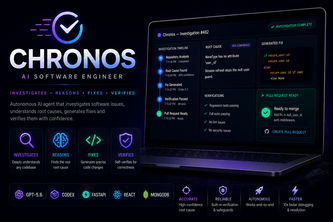
Chronos is an AI-powered software engineering agent designed to automate end-to-end incident investigation in code repositories. The description states that it clones and indexes repositories, analyzes stack traces, identifies root causes, generates fixes, and verifies solutions — all without human intervention. It is built as a web application with React frontend and FastAPI backend, using LLMs like GPT-5.6 and Codex for reasoning and code generation.
The author claims that Chronos performs structured engineering investigations, similar to how senior engineers respond to incidents, and includes features such as automated fix generation, regression test creation, and timeline production.
Key commercial due-diligence question: Is there evidence of real-world usage or traction beyond this hackathon submission?
This analysis is based entirely on the self-reported project description provided by the authors. No independent verification or external data has been used.
What The Product Actually Is
The description states that Chronos is an "autonomous AI software engineering agent" that performs end-to-end code investigations. It claims to:
- Clone and index GitHub repositories
- Understand project architecture
- Analyze stack traces and execution flow
- Form investigation hypotheses
- Identify root causes
- Generate code fixes
- Create regression tests
- Verify generated solutions
- Produce a complete investigation timeline
The system is described as operating without human intervention, performing tasks like an experienced software engineer would during incident response.
Inferred from the description: Chronos appears to be a tool that automates debugging workflows in software teams by leveraging AI for code analysis and fix generation.
Not evidenced: Whether any of these capabilities have been tested or validated outside of the hackathon context.
Positioning & Claim Evolution
The author positions Chronos as an AI assistant that can replace human engineers in incident investigation. The core claim is:
"What if an AI could perform the entire investigation like an experienced software engineer?"
This suggests a shift from reactive debugging to autonomous problem-solving, where the AI handles not just answering questions but executing full investigative workflows.
The evolution of this positioning appears to be:
- Initial framing: A hackathon project aiming to automate incident response
- Core value proposition: End-to-end automation of software engineering tasks
- Future ambitions: Integration with CI/CD pipelines, IDEs, and collaboration tools
Not evidenced: The extent to which this positioning reflects actual market demand or prior user feedback.
Target Customer & ICP
The description implies that Chronos targets software development teams working in environments where production incidents occur regularly. These would likely include:
- Engineering teams managing complex codebases
- DevOps and SRE teams responding to system failures
- Organizations using GitHub for version control
Inferred from the description: The intended users are developers or engineers who currently spend significant time investigating bugs manually.
Not evidenced: Specific customer segments, size of target market, or evidence of existing users or pilot programs.
Business Model & Pricing Evidence
No information is provided about pricing models, monetization strategies, or business structure. The project description does not mention:
- Subscription tiers
- Usage-based billing
- Enterprise licensing
- Freemium offerings
- Revenue streams
Not evidenced: Any indication of how the product would be sold or whether it has a commercial model.
Technical & Delivery Signals
The system is built using:
- Frontend: React, TypeScript, Tailwind CSS
- Backend: FastAPI, Python, Async architecture
- AI Components: GPT-5.6, GPT-5.3 Codex, OpenRouter/OpenAI-compatible APIs
- Infrastructure: MongoDB, GitHub API, Docker, Git
Challenges mentioned include:
- Repository indexing and file selection
- Coordinating multiple AI agents
- Maintaining investigation state
- Structured reasoning workflows
- Root-cause verification
- Generating regression tests
- Handling API failures and model fallbacks
Inferred from the description: The system uses a multi-agent approach with structured reasoning and orchestration to manage complex debugging tasks.
Not evidenced: Performance benchmarks, scalability data, or reliability metrics for these technical components.
Traction & Maturity Signals
The project was submitted to the OpenAI 2026 hackathon on Devpost. No evidence of:
- Revenue
- Customers
- Product usage
- Market traction
- Beta users
- Product roadmap beyond the hackathon
Not evidenced: Any indication that Chronos has moved beyond prototype or proof-of-concept stage.
Competitive Context
The description does not reference existing tools or competitors in the space. It is unclear whether Chronos competes with:
- Existing incident response platforms (e.g., PagerDuty, Splunk)
- AI debugging tools (e.g., GitHub Copilot, Tabnine)
- Automated testing frameworks
- LLM-powered code assistants
Not evidenced: Awareness of competitive landscape or differentiation from existing solutions.
Open Questions & Risks
Several risks and open questions are present based on the self-reported description:
- Unproven AI capabilities: The system claims to generate fixes and verify them, but no evidence of accuracy or reliability is provided.
- Lack of real-world testing: The project is described as a hackathon submission with no mention of deployment in production environments.
- Technical complexity assumptions: The description implies sophisticated multi-agent coordination, which may be difficult to implement reliably.
- No commercial viability: No pricing or monetization strategy is discussed.
- Limited team size: Only two team members are listed, raising questions about execution capacity.
Inferred from the description: The project lacks validation in real-world settings and has not demonstrated any measurable impact or adoption.
Questions the description leaves open
- What specific types of incidents or bugs does Chronos currently support?
- How does it ensure the correctness and safety of generated code fixes?
- Has it been tested on real repositories or only synthetic examples?
- Are there any known limitations in handling large monorepositories?
- What is the current level of automation? Is it fully autonomous, or still requires human oversight?
- Have you considered integrating with existing CI/CD pipelines or incident management tools?
- How do you plan to scale beyond a hackathon-level prototype?
- What are your thoughts on data privacy and security when processing source code?
Overall Assessment
The description indicates that Chronos is a hackathon project with no evidence of traction, revenue, or customer adoption. It presents an ambitious vision for AI-powered debugging automation but lacks validation in real-world usage.
Assessment: Not ready for investment or partnership at this stage. The project shows potential but requires further development and demonstration of utility before it can be considered viable.
Confidence: Low — based on minimal evidence beyond self-reporting.
User Stories BotA demo video on every pull request
Get a demo video on every new feature
GitHub App that watches your pull requests and records a narrated, captioned demo.
Save time on demo prep and make informed decisions faster with a video walkthrough of every new feature.
Source
Submitted to the OpenAI 2026 hackathon on Devpost. Project home on Devpost. Back to the full gallery on Devpost.
This competitive analysis was produced by top-founders.com (opens in a new tab)
Generated by a language model from this project's public Devpost page — its tagline, the author's own write-up and any built-with tags listed there — as captured in August 2026. Short quotations are the author's words. It is an opinion on the idea as a business, not on the people behind it, and it reflects the description as published then. If the project has moved on, request a correction below. The analysis is not independent research and contains no verified traction, revenue or customer data.
An independent guide by KFG International LLC — not affiliated with, endorsed by, or connected to Devpost or OpenAI.