

Archive position — measured, not model output
0 likes on Devpost
2,263 of the 7,850 archived projects have more likes, and 5,587 share exactly 0 — so this project's #3,245 place in the like-ranked listing is a tie-break inside that group, not a ranking.
Projects (log scale)
Likes on Devpost. ▲ marks this project's group.
Show the figures
| Likes | Projects | Share of archive |
|---|---|---|
| 0 | 5,587 | 71.2% |
| 1 | 1,758 | 22.4% |
| 2 | 284 | 3.6% |
| 3–4 | 132 | 1.7% |
| 5–9 | 75 | 1.0% |
| 10+ | 14 | 0.2% |
 User Stories BotA demo video on every pull request
Get a demo video on every new feature
GitHub App that watches your pull requests and records a narrated, captioned demo.
Save time on demo prep and make informed decisions faster with a video walkthrough of every new feature.
Executive Summary
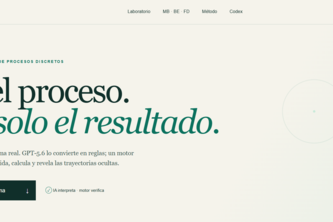
ChronoState AI is an educational tool that interprets natural-language problems in physics and mathematics using GPT-5.6 and a deterministic engine to reveal ordered event histories and final configurations. The author describes it as an "educational AI lab" for teaching combinatorics and statistical mechanics, particularly focusing on how different occupation statistics (Maxwell–Boltzmann, Bose–Einstein, Fermi–Dirac) affect outcomes.
The project is self-reported as a submission to the OpenAI 2026 hackathon. It is not evidenced to have any revenue, customers, or traction beyond its author's description. The product appears to be in early development, with no evidence of a functioning product or marketplace.
Key open question
What is the actual educational value and adoption potential of this tool? The description does not provide evidence of real-world use or impact.
What The Product Actually Is
The description states that ChronoState AI:
- Converts natural-language problems into structured occupation models based on external states, internal positions, ordered events, repetition rules, and global or local scope.
- Uses GPT-5.6 to interpret the problem and propose a model structure.
- Employs a deterministic engine to validate rules and perform exact calculations.
- Does not replace or modify verified results; instead, GPT-5.6 explains the process as an adaptive tutor.
- Reveals ordered histories, final configurations, and the number of distinct histories leading to the same final state.
- Compares occupation behavior under Maxwell–Boltzmann, Bose–Einstein, and Fermi–Dirac statistics.
The author describes it as a hybrid modeling approach connecting ordered-event counting with comparative representations of these three statistical mechanics frameworks.
Inference The product appears to be an educational tool for teaching advanced mathematical concepts in physics and mathematics, particularly combinatorics and statistical mechanics. It is not evidenced to be a commercial product or service with customers or revenue.
Positioning & Claim Evolution
The author positions ChronoState AI as:
- An "educational AI lab" where students can observe the trajectory of events.
- A tool that makes visible the underlying process behind final counts, rather than just presenting results.
- A hybrid modeling approach that connects ordered-event counting with comparative representations of Maxwell–Boltzmann, Bose–Einstein, and Fermi–Dirac statistics.
The claim evolution shows a progression from a personal teaching challenge (a mathematics and physics teacher's need to visualize event sequences) to a tool that can be used for educational purposes in combinatorics and statistical mechanics.
Inference The positioning is clearly educational and focused on making abstract mathematical concepts more accessible. It does not appear to claim commercial viability or market traction beyond its author's own use case.
Target Customer & ICP
The description states that the target customer is:
- Students learning physics and mathematics, particularly those studying combinatorics and statistical mechanics.
- A Physics and Mathematics teacher in Argentina who developed the tool based on their teaching experience.
There is no evidence of other customer segments or a defined ideal customer profile (ICP) beyond this single user.
Inference The primary target appears to be students and educators in STEM fields, particularly those studying advanced mathematical concepts. No evidence exists of broader market targeting or commercial customer segmentation.
Business Model & Pricing Evidence
The description does not provide any information about:
- Revenue streams
- Pricing models
- Customer acquisition costs
- Unit economics
- Monetization strategy
There is no evidence of a business model beyond the author's personal use case and educational context.
Inference No business model or pricing evidence is provided. The tool appears to be an academic or personal project rather than a commercial offering.
Technical & Delivery Signals
The description states that ChronoState AI was built with:
- GPT-5.6
- API, ChatGPT, Codex
- Next.js, React, TypeScript
- OpenAI integration
It uses a hybrid approach combining natural language processing (GPT-5.6) and deterministic computation to validate results.
Inference The technical stack suggests a modern web application with AI integration. However, there is no evidence of actual deployment, scalability, or performance metrics beyond the author's own development environment.
Traction & Maturity Signals
The description states that:
- This project was submitted to the OpenAI 2026 hackathon.
- The author is a single person (Roberto Paez).
- No revenue, customers, or adoption data are provided.
- It is described as an educational tool for teaching combinatorics and statistical mechanics.
There is no evidence of any traction, user base, or market validation beyond the author's own description.
Inference The project appears to be in early development stage with no demonstrated traction or maturity. It has not been commercialized or scaled beyond its submission to a hackathon.
Competitive Context
The description does not provide information about:
- Direct competitors
- Market size
- Competitive advantages
- Differentiation from existing educational tools
- Industry benchmarks
There is no evidence of competitive analysis or positioning within the broader educational technology market.
Inference No competitive context is provided. The tool appears to be unique in its approach but lacks evidence of market presence or competition.
Open Questions & Risks
Key risks and open questions include:
- Single-person development: Only one team member (Roberto Paez) is mentioned, suggesting limited resources for scaling.
- No commercial traction: No evidence of revenue, customers, or adoption beyond the author's own use case.
- Unproven educational impact: The description does not provide evidence of effectiveness or user feedback.
- Speculative technology claims: GPT-5.6 is mentioned as a component, but there is no verification of its actual implementation or performance.
- Limited market validation: No evidence of demand beyond the author's personal teaching needs.
Inference The project faces significant risks related to scalability, commercial viability, and educational effectiveness without independent validation.
Questions the description leaves open
- What specific educational outcomes have been observed with students using this tool?
- How does the deterministic engine validate results compared to traditional methods?
- Has there been any testing or feedback from educators or students beyond the author's own experience?
- What are the technical limitations of the current implementation, and how might they be addressed?
- Are there plans for commercialization or broader educational adoption?
- How does this tool differ from existing educational platforms in combinatorics or statistical mechanics?
- What is the timeline for development beyond the hackathon submission?
Overall Assessment
Not evidenced: There is no evidence to support any investment or partnership decision. The description provides no data on:
- Revenue or financial performance
- Customer base or adoption metrics
- Market size or competitive landscape
- Scalability or technical feasibility
- Commercial viability or monetization strategy
The project appears to be an early-stage educational tool developed by a single individual for personal teaching purposes, with no demonstrated traction or commercial potential beyond its author's own use case.
Confidence level: Very low. The analysis is based entirely on self-reported information without any external validation or evidence of real-world impact.
User Stories BotA demo video on every pull request
Get a demo video on every new feature
GitHub App that watches your pull requests and records a narrated, captioned demo.
Save time on demo prep and make informed decisions faster with a video walkthrough of every new feature.
Source
Submitted to the OpenAI 2026 hackathon on Devpost. Project home on Devpost. Back to the full gallery on Devpost.
This competitive analysis was produced by top-founders.com (opens in a new tab)
Generated by a language model from this project's public Devpost page — its tagline, the author's own write-up and any built-with tags listed there — as captured in August 2026. Short quotations are the author's words. It is an opinion on the idea as a business, not on the people behind it, and it reflects the description as published then. If the project has moved on, request a correction below. The analysis is not independent research and contains no verified traction, revenue or customer data.
An independent guide by KFG International LLC — not affiliated with, endorsed by, or connected to Devpost or OpenAI.