

Archive position — measured, not model output
0 likes on Devpost
2,263 of the 7,850 archived projects have more likes, and 5,587 share exactly 0 — so this project's #7,171 place in the like-ranked listing is a tie-break inside that group, not a ranking.
Projects (log scale)
Likes on Devpost. ▲ marks this project's group.
Show the figures
| Likes | Projects | Share of archive |
|---|---|---|
| 0 | 5,587 | 71.2% |
| 1 | 1,758 | 22.4% |
| 2 | 284 | 3.6% |
| 3–4 | 132 | 1.7% |
| 5–9 | 75 | 1.0% |
| 10+ | 14 | 0.2% |
 User Stories BotA demo video on every pull request
Get a demo video on every new feature
GitHub App that watches your pull requests and records a narrated, captioned demo.
Save time on demo prep and make informed decisions faster with a video walkthrough of every new feature.
Executive Summary
What the company appears to be
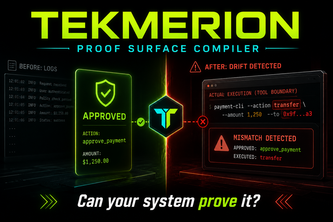
TEKMERION: Proof Surface Compiler is a developer tool that claims to compile structured evidence plans for agentic workflows using GPT-5.6 and Codex. It aims to detect when an action executed by an agent does not match what was human-approved, by generating deterministic proof surfaces from operational guarantees.
What changed
The project description presents a self-contained prototype built for the OpenAI 2026 hackathon. It includes a monorepo implementation with scenario generation, GPT-5.6-based claim compilation, and Codex-assisted patch materialization. The MVP validates one proof slice (action equivalence) but does not yet support broader operational claims or production deployment.
Single most important open question
Is there any evidence of traction, revenue, customer adoption, or real-world usage beyond the hackathon prototype?
What The Product Actually Is
The description states that TEKMERION is a Proof Surface Compiler for agentic workflows, designed to identify and compile evidence required to validate operational guarantees. It uses:
- GPT-5.6 to generate structured candidate evidence plans;
- Codex to materialize instrumentation and verification patches;
- Deterministic software to evaluate the resulting evidence.
It operates on bounded workflows, simulates compliant and violating executions, and maps evidence requirements to repository symbols and execution boundaries.
Inference The product is a developer tool for auditing agentic systems in production-like environments. It does not appear to be a commercial SaaS offering or a general-purpose logging system.
Positioning & Claim Evolution
The author states that TEKMERION began with the thesis:
"Many operational guarantees are not only violated. They are untestable because the system never preserved the evidence required to evaluate them."
It positions itself as a solution to the problem of auditability in agentic systems, where traditional telemetry logs prove activity but not compliance.
The product claims to:
- Not log everything;
- Identify specific evidence needed for a given operational claim;
- Use GPT-5.6 to compile structured plans;
- Use Codex to materialize patches;
- Evaluate evidence deterministically.
Inference The positioning is that of a developer tool for compliance and auditability, not a general-purpose observability platform or AI assistant.
Target Customer & ICP
The description states that TEKMERION targets agentic workflows in production environments, where agents are allowed to perform actions after human approval but lack sufficient evidence to prove compliance.
It is built for developers working with:
- Infrastructure-as-code;
- Deployment automation;
- Agent-based systems;
- Operational guarantees requiring auditability.
Inference The ICP likely includes developers or DevOps engineers in organizations using AI agents for production tasks, such as infrastructure deployment or content publishing.
Business Model & Pricing Evidence
Not evidenced. The description does not mention any pricing model, monetization strategy, or business model.
Technical & Delivery Signals
The project is described as a TypeScript monorepo with packages for:
- Workflow simulation;
- Telemetry normalization;
- Deterministic proof predicates;
- Scenario generation;
- GPT-5.6 claim compilation;
- Web-based judge replay.
It uses:
- OpenAI Responses API with structured output;
- Codex for patch materialization;
- GPT-5.6 to map obligations to concrete repository symbols;
- Deterministic software to validate and enforce policies.
Inference The delivery is a developer tool, likely intended for integration into CI/CD or deployment pipelines. It is not a hosted service.
Traction & Maturity Signals
Not evidenced. No mention of:
- Customers;
- Revenue;
- Usage metrics;
- Product adoption;
- Market traction.
The project is described as an MVP built for a hackathon and does not claim to be in production or used by any organization.
Competitive Context
Not evidenced. The description does not reference competitors, market size, or existing solutions in the space of agentic workflow auditing or operational guarantees.
Open Questions & Risks
- No traction or commercialization evidence: The project is a hackathon prototype with no signs of real-world usage.
- Unproven scalability: The MVP only validates one proof slice; broader implementation remains future work.
- Dependency on GPT-5.6 and Codex: These tools are not yet widely available or stable for production use.
- Limited scope: The system is described as a prototype, with the full “proof surface” remaining unvalidated.
- Self-reported maturity: No external validation or third-party evidence of product quality or performance.
Questions the description leaves open
- What specific operational guarantees are you targeting in production environments?
- How do you plan to scale beyond the MVP’s single proof slice?
- Have you validated your approach with any real-world agents or workflows?
- What is the roadmap for moving from prototype to a commercial product?
- Are there any existing customers or pilot programs?
- How do you handle privacy and data governance in the evidence collection process?
Overall Assessment
Not evidenced.
The description presents a self-reported hackathon prototype with no evidence of traction, revenue, or customer adoption. The project is not yet a commercial product, nor does it appear to be in a position for investment or partnership at this stage.
Confidence Low. This analysis is based entirely on the self-reported project description and lacks any external validation or market signals.
User Stories BotA demo video on every pull request
Get a demo video on every new feature
GitHub App that watches your pull requests and records a narrated, captioned demo.
Save time on demo prep and make informed decisions faster with a video walkthrough of every new feature.
Source
Submitted to the OpenAI 2026 hackathon on Devpost. Project home on Devpost. Back to the full gallery on Devpost.
This competitive analysis was produced by top-founders.com (opens in a new tab)
Generated by a language model from this project's public Devpost page — its tagline, the author's own write-up and any built-with tags listed there — as captured in August 2026. Short quotations are the author's words. It is an opinion on the idea as a business, not on the people behind it, and it reflects the description as published then. If the project has moved on, request a correction below. The analysis is not independent research and contains no verified traction, revenue or customer data.
An independent guide by KFG International LLC — not affiliated with, endorsed by, or connected to Devpost or OpenAI.