

Archive position — measured, not model output
0 likes on Devpost
2,263 of the 7,850 archived projects have more likes, and 5,587 share exactly 0 — so this project's #7,172 place in the like-ranked listing is a tie-break inside that group, not a ranking.
Projects (log scale)
Likes on Devpost. ▲ marks this project's group.
Show the figures
| Likes | Projects | Share of archive |
|---|---|---|
| 0 | 5,587 | 71.2% |
| 1 | 1,758 | 22.4% |
| 2 | 284 | 3.6% |
| 3–4 | 132 | 1.7% |
| 5–9 | 75 | 1.0% |
| 10+ | 14 | 0.2% |
 User Stories BotA demo video on every pull request
Get a demo video on every new feature
GitHub App that watches your pull requests and records a narrated, captioned demo.
Save time on demo prep and make informed decisions faster with a video walkthrough of every new feature.
Executive Summary
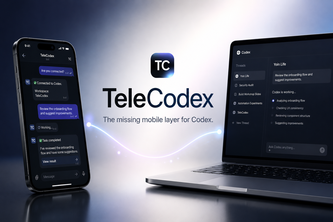
The company appears to be a personal project (or small team effort) that bridges Codex with Telegram for mobile interaction. The author states it began as a personal tool and now forms their daily workflow. It integrates with the Codex App Server via Telegram, enabling thread management, file transfer, voice interaction, and notifications from mobile.
What changed
The project evolved from a solo developer's friction-reduction tool into a structured product that supports a mobile-first Codex experience, built around Telegram as the primary interface.
The single most important open question
Is there evidence of any external adoption or usage beyond the author’s personal use? The description contains no data on customers, revenue, or traction.
Note: This analysis is based solely on the self-reported project description provided by the caller. No third-party verification or historical data exists for this project.
What The Product Actually Is
The description states:
- TeleCodex connects Telegram with the Codex App Server.
- It allows users to manage Codex threads, send prompts, launch tasks, and receive notifications from mobile.
- It supports file transfer between desktop and Telegram.
- It uses local Whisper for voice interaction.
- It is built using TypeScript, Node.js, SQLite, and the Telegram Bot API.
Inference: The product functions as a mobile layer or client that syncs with Codex via its app server. It is not an independent AI service but rather a UI/UX bridge between Codex and Telegram.
Claim: "TeleCodex brings the Codex workflow directly into Telegram."
Fact: Not evidenced — this is a self-stated claim about functionality.
Positioning & Claim Evolution
The description states:
- The project started as a personal tool.
- It aims to make using Codex from anywhere feel effortless.
- It focuses on reducing friction in developer workflows, especially when not at the desk.
- It does not aim to replace Codex but to enhance its usability.
Inference: The positioning evolved from a niche solution for one person to a general-purpose mobile extension of Codex. The author emphasizes user experience and convenience over feature breadth.
Claim: "TeleCodex is not trying to replace Codex."
Fact: Not evidenced — this is a stated intent, not proof of traction or adoption.
Target Customer & ICP
The description states:
- The target is developers who use Codex.
- It targets users who want to interact with Codex on mobile without returning to their desktop.
- It is optimized for Telegram as the primary platform.
Inference: The ideal customer is a developer using Codex regularly and seeking seamless mobile access. The ICP likely includes early-stage developers or power users of AI tools who value convenience and speed.
Claim: "The issue wasn't capability. It was friction."
Fact: Not evidenced — this is a self-assessment, not data on actual users.
Business Model & Pricing Evidence
Not evidenced.
The description does not mention pricing, monetization strategy, or any business model beyond personal use.
Claim: "TeleCodex is not trying to replace Codex."
Fact: Not evidenced — no indication of commercial intent or pricing.
Technical & Delivery Signals
The description states:
- Built with TypeScript, Node.js, Telegram Bot API, SQLite, local Whisper.
- Uses Codex App Server for backend integration.
- Supports real-time notifications, thread switching, file transfer, voice interaction.
- Designed specifically for mobile, not mirroring desktop UI.
Inference: The technical stack suggests a lightweight, developer-oriented tool. It is likely open-source or private, given the small team size and personal origin.
Claim: "A fast, customizable interface designed specifically for Telegram."
Fact: Not evidenced — this is a self-reported design choice.
Traction & Maturity Signals
Not evidenced.
There is no mention of users, customers, revenue, or adoption beyond the author’s own usage. The project was submitted to a hackathon, suggesting early-stage development and limited traction.
Claim: "Today, it's the way I use Codex every single day."
Fact: Not evidenced — this is personal usage, not external validation.
Competitive Context
Not evidenced.
The description does not reference competitors or similar tools. It assumes Codex as the baseline but does not discuss alternatives or market positioning.
Claim: "TeleCodex started as a personal tool."
Fact: Not evidenced — no competitive landscape described.
Open Questions & Risks
- No external adoption: The project is described only as personal use, with no evidence of broader traction.
- Single-person team: No indication of scaling or team structure beyond one member.
- Limited scope: The tool is built for Codex and Telegram — not a general-purpose solution.
- Unverified claims: All descriptions are self-reported without independent verification.
Inference: If the project does not scale beyond personal use, it may lack commercial viability or market demand.
Questions the description leaves open
- What is your actual usage frequency and how many hours per day do you spend with TeleCodex?
- Have you shared this tool with others? If so, what feedback did you get?
- Are there any plans to monetize or open-source the project?
- How does TeleCodex handle data synchronization when multiple devices are involved?
- What is your roadmap for team collaboration and multi-user support?
Overall Assessment
Not evidenced.
There is no evidence of revenue, customers, or traction beyond personal use. The project appears to be a proof-of-concept or early-stage tool with no indication of commercial viability or scalability.
Inference: Without external adoption or business model clarity, the project does not meet typical due-diligence thresholds for investment or partnership consideration.
User Stories BotA demo video on every pull request
Get a demo video on every new feature
GitHub App that watches your pull requests and records a narrated, captioned demo.
Save time on demo prep and make informed decisions faster with a video walkthrough of every new feature.
Source
Submitted to the OpenAI 2026 hackathon on Devpost. Project home on Devpost. Back to the full gallery on Devpost.
This competitive analysis was produced by top-founders.com (opens in a new tab)
Generated by a language model from this project's public Devpost page — its tagline, the author's own write-up and any built-with tags listed there — as captured in August 2026. Short quotations are the author's words. It is an opinion on the idea as a business, not on the people behind it, and it reflects the description as published then. If the project has moved on, request a correction below. The analysis is not independent research and contains no verified traction, revenue or customer data.
An independent guide by KFG International LLC — not affiliated with, endorsed by, or connected to Devpost or OpenAI.